

Audio By Carbonatix
The Spanish government has fined property rentals giant Airbnb €64m (£56m) for advertising unlicensed apartments.
It also said that some of the properties advertised in the popular tourist destination were banned from being rented.
The fine means that Airbnb has to withdraw the adverts promoting unlicensed properties. Although the Consumer Affairs Ministry said the fine cannot be appealed, Airbnb said it intends to challenge it in court.
Spain, one of the most visited countries in the world, has a buoyant tourism economy but that has fuelled concerns about unaffordable housing, as high demand from visitors raises the price of housing, pushing local people out of the market.
"There are thousands of families who are living on the edge due to housing, while a few get rich with business models that expel people from their homes," said Spain's consumer rights minister Pablo Bustinduy in a statement.
But Airbnb said in a statement that it was "confident that the Ministry of Consumer Affairs' actions are contrary to applicable regulations in Spain".
A spokesperson added that since short-term rental regulations in Spain changed in July, Airbnb was "closely collaborating with Spain's Ministry of Housing to support the enforcement of the new national registration system".
Like many countries, Spain's government is concerned about how short-term holiday lets can change a neighbourhood, fuelled by a transient population of holiday-goers.
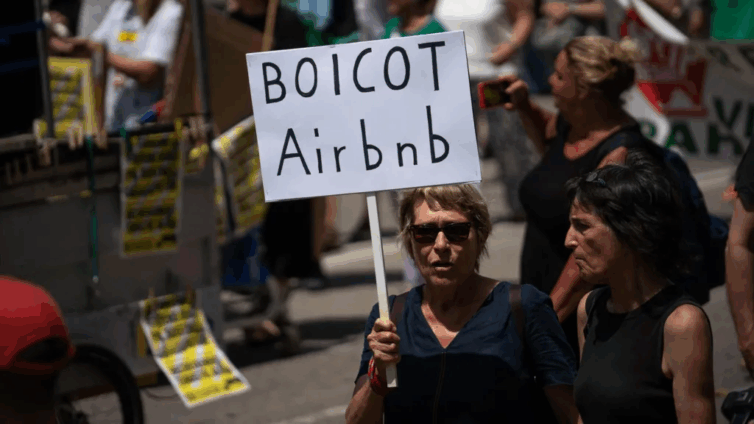
The country has been fighting a battle with thousands of Airbnb listings, banning them and clamping down on how many properties the firm can advertise. In May, there were demonstrations against the firm ahead of the busy summer season.
Spain's government said 65,122 adverts on Airbnb breached consumer rules, including promotion of properties that were not licensed to be rented, and properties whose licence number did not match with those on official registers.
Writing on social network Bluesky, Mr Bustinduy said: "We'll prove it as many times as necessary: no company, no matter how big or powerful, is above the law. Even less so when it comes to housing."
Globally, several popular tourist cities place heavy restriction on Airbnb, including Barcelona, New York, Berlin, Paris and even San Francisco, where Airbnb was founded.
The tech firm started up in 2007 but became hugely popular around 2014, as tourists looked for cheap accommodation without the tax costs imposed on hotels.
Users swelled as anybody could become a "host" and make some extra cash from renting out their spare room - though many major cities have since placed limits on these types of rentals, as complaints of noisy house parties and absent hosts became an issue.
Latest Stories
-
IMMILAC president recounts personal losses as security women lead breast cancer awareness campaign in Wa
2 minutes -
University of Ghana postpones October 12 reopening as GAUA strike persists
16 minutes -
Bahass Foundation launches vocational skills training to support mental health recovery in Wa
48 minutes -
NPP orders parliamentary aspirants and their supporters to suspend campaign activities
1 hour -
Techiman unites against child marriage: Joy Impact Makers Awardee leads charge on International Day of the Girl Child
2 hours -
Ghana Psychological Association calls for greater involvement of people with lived experience in mental health care
3 hours -
Ablakwa says Ghana could evacuate more citizens from South Africa if the situation worsens
3 hours -
Violence against girls must be tackled through individual responsibility – Gender advocate
3 hours -
Ghana’s BRICS bid must be guided by national interest – International Affairs Analyst
3 hours -
Journalists look back on a decade of breast cancer reporting in Ghana
4 hours -
President Mahama ends Resetting Ghana tour of Ahafo Region
6 hours -
African negotiators seek delivery of climate commitments at COP31
6 hours -
BoG develops AI rules for financial sector
6 hours -
‘Big Push’: Government assures contractors of prompt payments
6 hours -
Court fines miner for breaking into gold buying shop
6 hours