

Audio By Carbonatix
For many Ghanaians, Independence Day used to come with a familiar rhythm, perfectly aligned formations of school children and personnel of the Armed Forces who had rehearsed for weeks under the sun.
The long hours spent at the parade grounds, the anticipation of the military displays, and the collective pride that swept through the crowd when the national flag was raised at the Independence Square.
For decades, the national celebration of Ghana’s independence was defined by this grand spectacle. The parade at the iconic Independence Square was the centrepiece of the nation’s birthday. It was a moment when the state staged a visible display of discipline, patriotism and national unity.
It was the rhythm of marching boots, military and school bands. But in the past two years, that familiar script has changed.
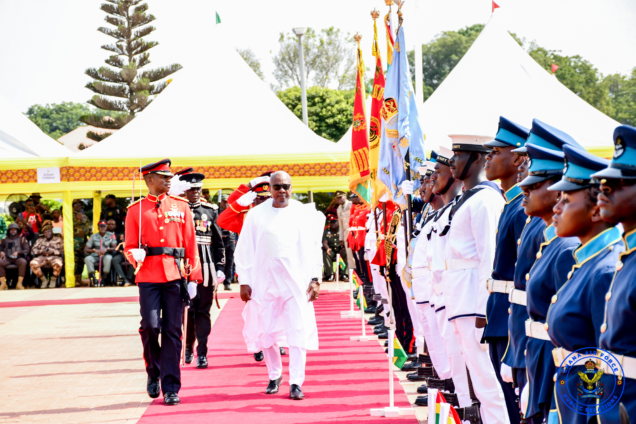
The national celebration has been significantly curtailed and largely relocated to the seat of government at the Jubilee House. The once expansive parade grounds have been replaced by a smaller ceremony attended by fewer officers of the Ghana Armed Forces, limited dignitaries, and little or no marching by school children. The lighting of the perpetual flame, a symbolic ritual that still connects the present to the historic midnight of independence, continues. Yet the scale and spectacle of the celebration have been deliberately reduced.
The explanation, we are told, is cost.
Under the leadership of John Dramani Mahama, the scaled-down approach is part of a broader effort to reduce public expenditure. Even the usual decentralised celebrations across the regions were held in a noticeably minimalist fashion.
But something remarkable happened this year.
Although the formal state celebration was modest, the spirit of independence appeared to migrate beyond the official grounds. It moved into the streets, the pubs, the markets, and most interestingly, into the wardrobes of the people.
This year, Independence Day was everywhere.
Across the country, Ghana-themed jerseys and T-shirts flooded the public space. Everywhere one went. In neighbourhoods, entertainment centres, restaurants, and social gatherings, one was likely to find nearly eighty per cent of the crowd dressed in red, gold and green. The colours were bold, vibrant and celebratory. The yellow, in particular, seemed to dominate the palette, bright, unapologetic, and joyful.
Even more striking was the resurgence of the fugu, the traditional smock of northern Ghana.
In the weeks leading up to Independence Day, fugu seemed to appear everywhere. What was once seen primarily as an occasional or an attire worn ‘predominantly’ to showcase the culture of the northern part of the country, suddenly became mainstream fashion across the country. Young people wore it to work, to events, to social gatherings and proudly on Independence Day itself.
It all began when President John Dramani Mahama, who hails from northern Ghana and is known for wearing the fugu, drew attention to the attire during a state visit to Zambia (not discounting the role that former President Jerry John Rawlings played in popularising the fugu wear at national events).
The garment sparked curiosity and social media banter between Ghanaians and Zambians, and the conversation soon evolved into calls for Wednesdays to be observed as a day for wearing fugu. Around the same time, the President’s visit to Zambia also triggered discussions about the cultural identity and origins of the smock, further amplifying interest in the garment in the weeks leading up to Independence Day.
Within two weeks, fugu had become a national fashion statement.
By the time March 6 arrived, the streets of Ghana were filled not only with Ghana-themed jerseys and T-shirts but also with fugu, worn proudly by young and old alike.
In effect, the people had created their own independence celebration.
And perhaps that was the most striking feature of Ghana at 69: the enthusiasm of the youth.
For a country that has, in recent years, experienced economic turbulence and social anxiety, the atmosphere this year felt different. There was an unmistakable calm in the air. A sense, even if momentary, that people had decided to set aside the burdens of national challenges and simply celebrate the beauty of the country they belong to.
It felt as though the atmosphere itself had absorbed the theme of the celebration ‘Building Prosperity, Restoring Hope'.
For one day, many Ghanaians appeared willing to forget the daily frustrations- the economic pressures, the uncertainties, and even the recent public outrage surrounding issues in the health sector following troubling incidents of medical negligence earlier this month.
Instead, Ghanaians embraced something deeper: the shared identity of being Ghanaian. Of course, symbolism alone cannot solve national problems. While the current government has embarked on fiscal restraint to stabilise the economy, and while some signs of relief are gradually emerging in different sectors, these improvements have not necessarily translated fully into the everyday marketplace where most Ghanaians feel the weight of economic reality.
Yet hope has a way of revealing itself in subtle ways.
This year’s Independence Day offered a glimpse of that hope.
It was visible in the excitement of young people proudly wearing Ghana’s colours. It was evident in the renewed appreciation for indigenous culture, expressed through the widespread embrace of fugu. And it was present in the spontaneous celebrations that filled entertainment spaces across the country.
But hope, if it is to mean anything, must be harnessed.
The optimism written on the faces of many Ghanaians this Independence Day must not remain a fleeting emotional moment. It must be translated into deliberate national action. The country must move beyond symbolism toward building the systems and structures that support the everyday Ghanaian.
Healthcare that works. Accessible social services, economic stability, sustainable job opportunities, and fair and dignified remuneration. These are the real foundations of national pride.
Ghanaians clearly love their country. The display of patriotism this year leaves little doubt about that. But patriotism cannot be confined to the wearing of Ghana-themed jerseys, T-shirts, fugu or even kente.
True patriotism must be experienced in daily life.
It must be reflected in institutions that function, systems that serve the people, and governance that places the well-being of citizens at its centre.
As Ghana marks 69 years of independence, the challenge before us is simple but profound: to transform the visible pride on our streets into tangible progress in our national life.
Because the real celebration of independence will not be found only in what we wear on 6th March.
It will be found in how well Ghana works for the Ghanaian.
Latest Stories
-
Narcotics Control Commission opens applications for cannabis cultivation and management licences
59 seconds -
PAC Chair Abena Osei-Asare to recuse herself from GH¢68.7bn audit probe — PAC Member
11 minutes -
Carney inches closer to majority, as fourth MP defects to Liberals
13 minutes -
Gov’t condemns drone incident near Dubai airport that injured two Ghanaians
17 minutes -
GH¢68.7bn audit irregularities deliberate, not administrative lapses — Crime Analyst
25 minutes -
Ablakwa reveals Ghana’s role in US-Nigeria Christmas Day strikes on ISIS targets
26 minutes -
Iran cannot participate in FIFA World Cup, sports minister says
29 minutes -
CSOs engage Parliament to strengthen anti-corruption efforts
29 minutes -
Redefining Leadership: Pearl Nkrumah’s story of resilience and impact
36 minutes -
Agyemang-Manu was arrested over Sputnik V vaccine deal, he’ll face charges — Kwakye Ofosu
55 minutes -
FDA investigates alleged use of plastic in frying plantain chips
1 hour -
Yango Ghana marks IWD 2026 with empowering chit-chat, gifts for female partners and couriers
1 hour -
PAC to probe GH¢68.7bn audit irregularities thoroughly — Akwasi Konadu assures
1 hour -
Afenyo-Markin accuses Majority of blocking Minority motions in Parliament
1 hour -
Ghana’s Volleyball rise highlighted at CAVB Zone III Championship
1 hour