

Audio By Carbonatix
The Government of Ghana is committed to reshaping a better future for the people of Ghana, Africa, and the diaspora, the Minister of Foreign Affairs, Samuel Okudzeto Ablakwa, has said.
Speaking at the Diaspora Summit in Accra on December 20, the minister said it was on the back of this that the government was sharing with its friends in need and not always receiving.
“We make all efforts to ensure that our foreign policy is never defined by how much we can take from others, but rather it is guided by how much love and support we can share with others,” he said.
Common Ancestry
Mr Ablakwa affirmed that although Africans had been dispersed across the world due to slavery and colonisation, it was important that all Africans recognised their existence today formed part of the resilience and prayers of the ancestors.
“We are here today because of the prayers of those ancestors. We are bound by a shared history and the spirit of resilience. We are committed to reshaping a better future for Africa and for all people of African descent,” he said.
Mr Ablakwa indicated that the summit must serve as a platform for all members of the diaspora to come together to deepen their voice on confronting historical and contemporary injustices through reparative justice and find solutions to their common concerns.
He said over the course of the past four centuries, there were numerous attempts to separate Africans, but such attempts had ultimately failed, saying it was for this reason that the government considered the diaspora as its 17th region and pursued a foreign policy of unwavering and unadulterated solidarity.
Summit
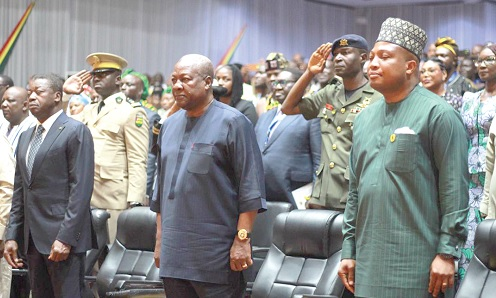
The Diaspora Summit, which was hosted by President John Dramani Mahama, brought together a host of dignitaries across Africa and members of the diaspora.
Present at the event were: the President of the Council of Ministers of Togo, Faure Gnassingbe; the African Union (AU) High Representative for Silencing the Guns, Dr Mohammed Ibn Chambas; the Secretary of the Africa Continental Free Trade Area (AfCFTA), Wamkele Mene.
Also gracing the occasion were the president and founder of Ben Crump Law, Benjamin Lloyd Crump; Chairperson of the Genocide, Apology, and Reparations Technical Committee of Namibia, Steven Isaack; the director-general of UNESCO, Prof. Khaled El-Enany, among others.
The summit aims at reigniting Pan-Africanism as a guiding framework for engaging diaspora communities in the development and progress of the country. It also focuses on fostering strategic partnerships between the government, the diaspora, the private sector, and development agencies.
It also aims at strengthening cultural and historical bonds through Pan-African initiatives and identity-driven programmes, among others
Honouring Ancestors
Mr Ablakwa underscored that participants must ensure history recalls the summit as the moment when Africans moved beyond rhetoric to coordinated action and unreservedly demanded justice for the greatest sin against humanity.
He added that the summit must also serve as a platform where Africans honoured their ancestors by “insisting that their lives be recognised, that their pain and suffering be remembered, and that their dignity be restored.”
The Foreign Affairs Ministers affirmed that though they may be the answers to the prayers of the ancestors, the next generation must be the “beneficiaries of our refusal to be defined by the wounds of the past and our strength to join forces as one global African country with a collective purpose.”
Africa-Diaspora Unity
Dr Ibn Chambas said Africa is organising for justice through institutional reform, strategic partnerships, and coordinated advocacy, adding that the AU has laid the groundwork for a sustained and credible reparations agenda.
He said the achievements of this year by the AU demonstrate that Africa is no longer merely asking for justice; the AU will continue to address the remaining gaps, particularly in institutional capacity, financing, and national-level implementation.
Dr Ibn Chambas added that addressing these gaps would require sustained political leadership, deeper member-state engagement, and continued partnership with the diaspora.
He affirmed that the summit should not be seen as an isolated event but as a critical building block, a very critical framework that offered an opportunity to align national initiatives, diaspora strategies, and AU frameworks into a coherent architecture for justice, unity, and development.
He encouraged participants to approach the summit with ambition and purpose so that its outcomes would contribute meaningfully to advancing reparative justice, strengthening African-Diaspora bonds, and realising the aspirations of Agenda 2063.
Dr Ibn Chambas commended the government for its leadership, vision, and unwavering commitment to Africa-Diaspora unity through the Diaspora Summit.
Latest Stories
-
Armed men reportedly storm Adjen Kotoku Onion Market amid tensions
7 minutes -
Tecco Mensah writes: Why football fans must look beyond statistics
49 minutes -
Police recover stolen Honda CR-V in Kumasi within 48 hours
1 hour -
Apetorku Gbodzi 2026 Festival opens in Dagbamete with development focus
2 hours -
President Mahama arrives in Lyon to co-chair One Health Summit
2 hours -
Beverly View Plus Hotel draws crowds amid coastal Easter rush in Volta
2 hours -
Maiden Zongo Festival held in Wa amid calls to tackle drug abuse among the youth
2 hours -
FDA warns of fake HIV test kits on Ghanaian market
3 hours -
Africa urged to build resilient health systems as donor support tightens
3 hours -
Easter gesture: Ablakwa settles medical bills for 85 North Tongu constituents
4 hours -
Africa must harness its population strength—Titus-Glover
4 hours -
Visa-free access doesn’t mean unlimited stay – Lom Ahlijah
5 hours -
From Golgotha to Kwahu: The Easter Migration of the Faithful and the Faithless
6 hours -
How the Ghanaian onion traders’ standoff with Nigeria unfolded and threatened local supply
6 hours -
No compensation for demolished structures on 24-Hour Economy market lands — Gov’t to structure owners
6 hours