

Audio By Carbonatix
There are defining moments in a nation’s democratic journey when silence becomes dangerous, when lingering questions about power, money, and accountability can no longer be deferred. Ghana stands at such a crossroads.
As the cost of electoral politics continues to escalate, public concern is mounting over the growing influence of money on political competition and outcomes. What was once a gradual shift has become a pressing national issue, demanding urgent reflection and decisive reform.
Since the return to constitutional rule in 1992, Ghana has built a reputation for competitive elections and peaceful transfers of power. Yet beneath that success story lies a persistent challenge: weak regulation of campaign and political financing. Election seasons are increasingly defined by extravagant spending, opaque funding sources, and intense pressure on public officeholders to recoup political investments once in power. These dynamics have fueled public mistrust and raised questions about whose interests the political system ultimately serves.
It is within this context that the Centre for Democratic Development (CDD-Ghana), working with the National Commission for Civic Education (NCCE) and supported by the Foreign, Commonwealth & Development Office (FCDO), has initiated a series of regional public engagements on what it calls a Draft Campaign and Political Financing Model Law. The discussions will take place across 10 selected regions as part of broader efforts to address longstanding gaps in Ghana’s political finance regime.
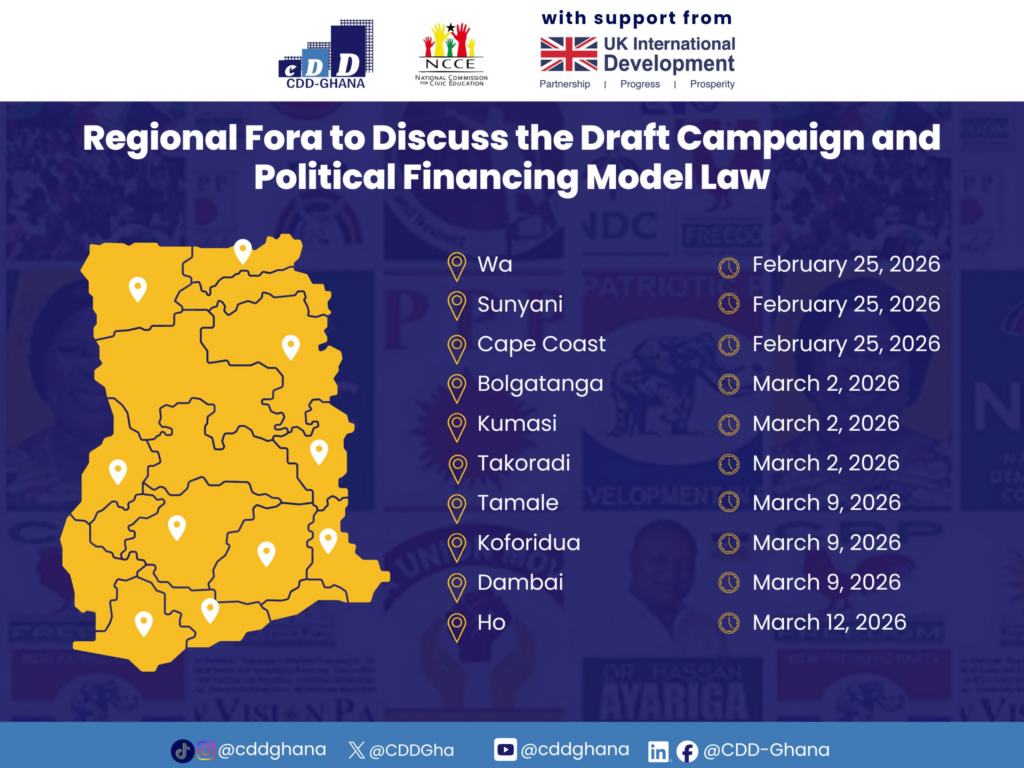
At the centre of the conversations are questions many Ghanaians have quietly asked for years: who pays for political campaigns, what expectations accompany that funding, and how those relationships affect decision-making in government. With no comprehensive ceilings on campaign expenditure and limited enforcement of disclosure rules, critics argue that political competition has gradually tilted in favour of those with access to significant financial resources.
The regional engagements will bring together political party representatives, civil society actors, traditional leaders, youth and women’s groups, academia, media practitioners, and ordinary citizens. Their focus is on the rising cost of elections and the consequences for accountability, governance, and public trust. Participants will examine how unchecked campaign spending can distort political competition, marginalise grassroots participation, and weaken oversight once elections are over.
The Draft Model Law under discussion will propose reforms aimed at tightening expenditure controls, setting clearer limits on political donations, strengthening transparency and disclosure requirements, and improving enforcement mechanisms. Advocates argue that without such measures, Ghana risks entrenching a system in which political power is increasingly shaped by wealth rather than ideas, competence, or public service.
Beyond the legal proposals, the engagements will underscore a broader democratic principle that governing political competition must reflect public consent. By opening up the debate beyond elite policy circles, organisers say the process allows citizens to interrogate, refine, and influence reforms that could reshape how politics is financed in Ghana.
Public confidence in democratic institutions, analysts note, is closely tied to perceptions of fairness. When money appears to dominate politics, trust in leaders and institutions tends to erode. Conversely, sustained citizen engagement and credible reforms can strengthen democratic legitimacy and reinforce accountability.
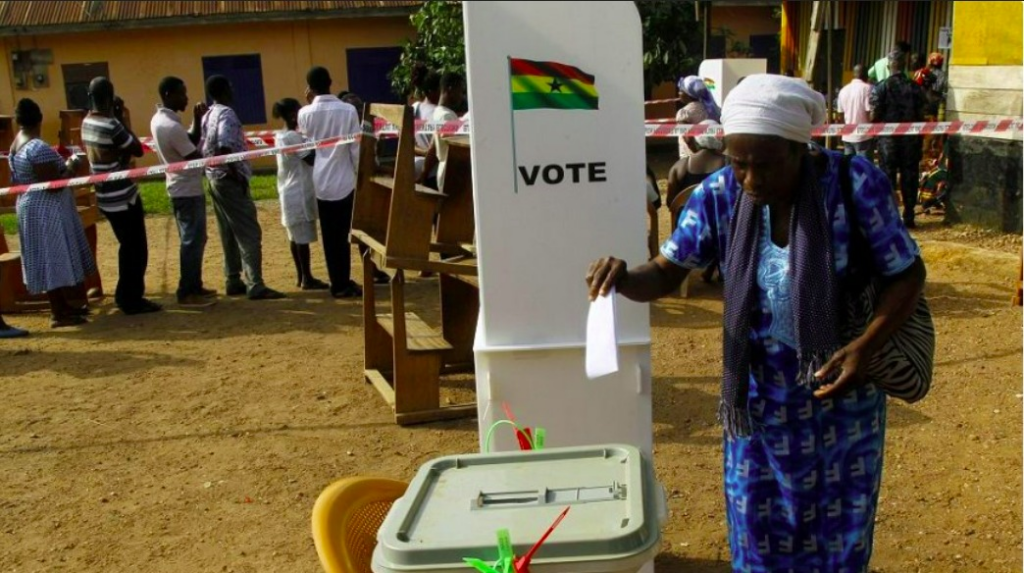
As Ghana prepares for future electoral cycles, the debate over political financing is becoming harder to ignore. The direction the country chooses, whether to confront the cost of politics or allow existing practices to deepen, will have lasting implications for governance, equity, and democratic resilience.
CDD, in collaboration with its media partner, the Multimedia Group Limited, will work to promote visibility, analysis, and updates on the regional engagements and broader political finance debates as the national conversation on the future of Ghana’s democracy continues.
Latest Stories
-
Walter Mosley visits W.E.B. Du Bois Centre in Accra: A New York Secretary’s homecoming story on where Du Bois spent his final years.
27 minutes -
MTN set to deploy 5G services after winning spectrum licenses worth US$202m
3 hours -
NPP national elections: 3,000–4,000 police to handle security, traffic in Kumasi – Karbo
5 hours -
Atta Akyea fumes as Manhyia MP is to spend another night in EOCO custody
5 hours -
SSNIT says La Beach clearance was to protect hotel investments, beaches to remain public
6 hours -
APSU congratulates St Augustine’s College after back-to-back National Investment Quiz wins
6 hours -
Renewed flood intervention at Mallam Junction raises hopes among residents, businesses
7 hours -
St Augustine’s College retain National Investment Quiz title after nail-biting grand finale
7 hours -
Education infrastructure investment will drive Banda’s development – Ahmed Ibrahim
7 hours -
Teacher unions strike: Gov’t presents fresh proposals as talks end inconclusively
8 hours -
51,000 teachers’ promotion arrears to be validated for October payment – Education Minister
8 hours -
Kwabena Boamah appointed Board Chair for Impact Investing Ghana
9 hours -
Striking teacher unions to meet Fair Wages and Salaries Commission on October 6
9 hours -
EOCO working with AG to arraign Nana Baffour Awuah before weekend court
9 hours -
Duraplast reassures customers after fire, announces October 5 reopening
9 hours