

Audio By Carbonatix
The Ghana Standards Authority’s decision to enforce the Pre-Export Verification of Conformity programme for used vehicles from October 1, 2026, is a step in the right direction.
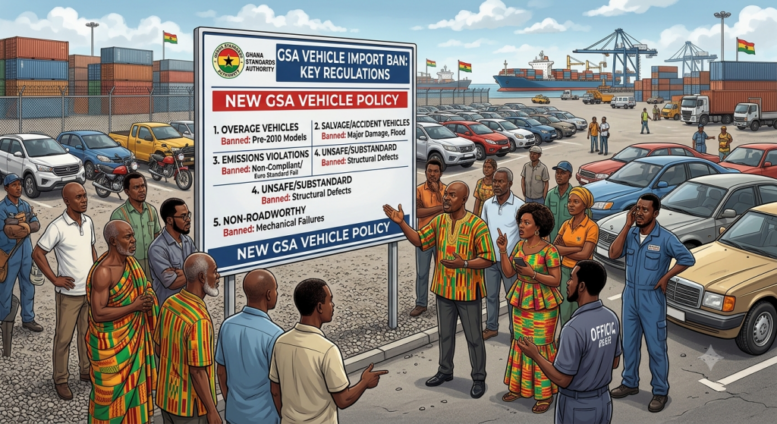
Ghana cannot continue to accept vehicles with severe structural damage, flood histories, fire damage or questionable origins simply because they can be purchased cheaply. Under the new programme, imported used vehicles must comply with Ghana Standard GS 4510 before shipment. Vehicles more than 10 years old, originally manufactured as right-hand drive, assembled from spare parts or carrying major structural damage will not qualify.
The intention is sound. Ghana needs a safer, better-regulated and more transparent automotive market. Consumers deserve protection from “Painty na mi ntor” vehicles that may look attractive after cosmetic repairs but have compromised chassis, safety cages, electrical systems or crash protection.
However, describing the policy as the solution that will make “everything else fall into place” oversimplifies the challenge.
An automotive industry is an ecosystem. Regulation is only one component. Affordability, vehicle financing, taxation, local assembly, after-sales support, technical skills, roadworthiness enforcement and consumer education must all work together.
Vehicle age is not the same as vehicle condition
The proposed 10-year limit is easy to administer, but age alone is not always an accurate measure of safety or quality.
A properly maintained 12-year-old vehicle with a complete service history may be in better condition than a neglected six-year-old vehicle with hidden accident damage. The new pre-export inspection system is therefore potentially more important than the age limit itself.
Inspections must be detailed enough to identify flood damage, poor structural repairs, tampered identification numbers and compromised safety systems. At the same time, vehicles with minor and professionally repairable damage should not automatically be treated like dangerous salvage vehicles. The GSA has indicated that repairable vehicles may still be accepted where they can be restored to roadworthy condition.
The objective should be to keep unsafe vehicles out, not simply to keep old vehicles out.
Make room for special-interest vehicles
The policy also needs a clearly defined exemption for special-interest vehicles.
Classic, vintage, exotic, enthusiast and motorsport vehicles do not belong in the same category as ordinary ageing commuter vehicles imported primarily because they are cheap. Mr. Osei Kwame Despite should still be able to bring in cars for The Despite Automotive Museum.
A well-preserved classic Mercedes-Benz, a historic Volkswagen, a limited-production Ferrari, an enthusiast Japanese performance car or a purpose-built competition vehicle may be more than 10 years old by definition. Some may be several decades old.
These vehicles are imported in very small numbers. They do not pose a serious threat to local vehicle assembly, nor do they significantly affect the average age of Ghana’s daily transport fleet. On the contrary, they support automotive heritage, tourism, car shows, specialist restoration businesses, motorsport and technical education.
There should therefore be a controlled collector and competition vehicle category covering:
Classic and vintage vehicles of recognised historical interest, limited-production exotic vehicles, enthusiast vehicles with verifiable provenance, and vehicles imported specifically for sanctioned motorsport, exhibitions or museums.
This should not become a loophole for importing ordinary worn-out vehicles. Applicants must provide documentation, undergo strict inspection and satisfy all applicable structural and roadworthiness requirements. The exemption should apply to the age restriction, not to safety. Some of these vehicles do not need to be registered to run on the streets anyway.
Enforcement must not create another bottleneck
The greatest test of this policy will not be the announcement. It will be its implementation.
Pre-export inspections must be rigorous, independent and consistent across exporting countries. Inspection companies must be accredited, regularly audited and held accountable for vehicles they certify.
The process must also be transparent. Importers should know the applicable fees, documentation requirements, inspection timelines and appeals process before purchasing or shipping a vehicle.
Without these safeguards, the system could create delays, uncertainty and discretionary power. Those conditions often produce unofficial payments and corruption.
Ghana must avoid building a certification process in which vehicles technically comply with the rules but are delayed because someone has not been “seen”, while genuinely non-compliant vehicles find their way through the system because someone knows the right person.
Certification records should be digital and verifiable. Fees should be published. Decisions should be traceable. There should also be a clear appeals mechanism for disputed inspections.
The planned Vehicle Dealer Information System, which is expected to connect information held by the GSA, DVLA, insurers, Interpol and security agencies, could significantly improve traceability if implemented properly.
Local assembly must offer a realistic alternative
Restrictions on older used vehicles cannot be discussed separately from Ghana’s local assembly programme.
The Ghana Automotive Development Policy was designed not only to improve vehicle standards but also to establish a competitive automotive industry, create skilled employment and introduce asset-based financing to make locally assembled vehicles affordable.
However, the removal of the VAT exemption for locally assembled vehicles at the beginning of 2026 has weakened that affordability objective. Industry players say exposing locally assembled vehicles to the effective 20 per cent VAT charge has made their products less competitive and slowed production.
It sends a mixed signal to restrict the affordable end of the used-vehicle market while simultaneously removing an incentive that helped locally assembled new vehicles compete.
Local assembly should not be protected merely for the sake of putting vehicles together in Ghana. Assemblers must be encouraged to deepen local content, develop skills, create sustainable jobs and gradually move from basic assembly towards meaningful manufacturing.
In return, government must provide stable, predictable support that enables these companies to offer vehicles at prices ordinary businesses and households can realistically afford.
No one should be buying a new car with cash in 2026
This may sound provocative, but the point is simple: in a modern automotive economy, vehicle ownership should not depend almost entirely on whether a buyer can raise the full purchase price at once.
Ghana needs a government-supported, privately operated vehicle leasing and asset-financing system with strong local participation.
Banks, pension funds, insurance companies, local investors, assemblers and authorised dealers should be able to participate in a properly regulated leasing market. Buyers should have access to transparent monthly payments, fair interest rates, clear ownership terms and reliable insurance.
The government does not necessarily have to buy cars for people. Its role should be to reduce risk, establish the legal framework, support credit guarantees where appropriate and encourage long-term local funding.
Leasing could give households and businesses access to newer, safer and more efficient vehicles without requiring huge upfront cash payments. It would also create a dependable market for locally assembled vehicles, support fleet renewal and improve maintenance because leased vehicles are usually subject to scheduled servicing and insurance requirements.
The Auto Policy itself already recognises the importance of asset-based financing. That part of the policy must now move from paper to reality.
A good policy must balance three interests
Ghana is right to improve the quality of vehicles entering the country. We should not become a dumping ground for flood-damaged, dangerously repaired or structurally compromised vehicles.
But a successful automotive policy must balance three interests: safety, affordability and industrial development.
Ignore safety and consumers suffer. Ignore affordability and citizens are priced out of mobility. Ignore local industry and Ghana remains permanently dependent on imports.
The 10-year restriction and pre-export inspection programme can become important parts of a stronger automotive sector. But they require careful refinement, firm and transparent supervision, special provisions for legitimate collector and motorsport vehicles, renewed support for local assembly and a credible vehicle-leasing system.
The objective should not simply be to make it more difficult for Ghanaians to buy older cars.
It should be to make it easier for them to acquire better cars.
***
Edward Boateng Opoku, known as Eddie Poku, is an automotive enthusiast and the creative force behind Ryde Channel on YouTube. His channel features in-depth car and motorcycle reviews, profiles of auto enthusiasts, and coverage of automotive events. Engaged in the automotive industry, Eddie actively participates in discussions about cars and motorcycles. Connect with him on YouTube at Ryde Channel, LinkedIn at www.linkedin.com/in/edwardopoku2018, and visit www.rydechannel.com for more.
Latest Stories
-
Nearly GH¢6m spent to fix Kpong-Tema transmission lines to improve water supply – GWL
2 minutes -
Dr Olukoya-backed MFM rules Nigerian women’s basketball
4 minutes -
THE LAW 101: Before you fly that drone
7 minutes -
Wa West DCE, MP hand over and commission health, education, and hospitality projects
11 minutes -
Drone ownership does not give unrestricted right to fly anywhere – Anyenini
16 minutes -
GFA confirms two-legged format for FA Cup final
18 minutes -
GWL assures of efforts to improve water supply in Tema, Ashaiman amid shortages
31 minutes -
Community 25 residents demand answers over two-month water shortage
48 minutes -
Ampem Darkoa Ladies and Hasaacas Ladies clash in 2026 Women’s Champion of Champions
54 minutes -
Business dies when luxury takes over leadership
1 hour -
No family should lose everything to save a loved one – GMTF administrator
1 hour -
Bawumia has the dignity to lead and the vision Ghana needs – Gabby
1 hour -
GOC, GFA chart Olympic qualification roadmap for Black Queens, Black Meteors
1 hour -
Absa InspireMe 2026 highlights opportunities for women-led business growth
1 hour -
The only thing that flows regularly is THE BILL
2 hours