

Audio By Carbonatix
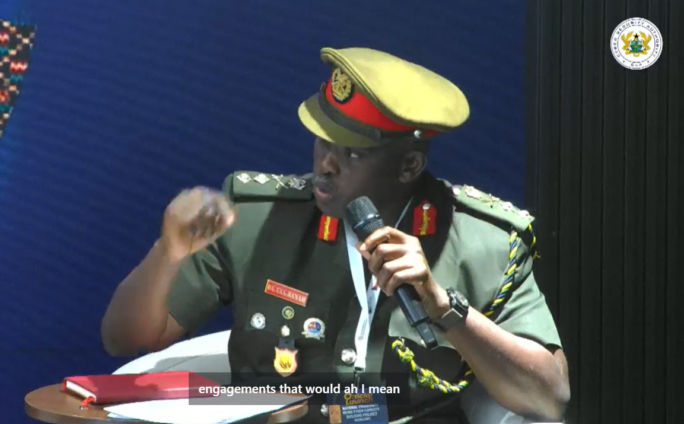
Major General Dr Timothy Tifucro Ba-Taa-Banah, Director of the National Counter Terrorism Fusion Centre, has described terrorist financing as the "oxygen" that sustains violent extremism, warning that organised crime networks are increasingly channelling funds to terrorist groups through sophisticated cyber tools.
Speaking during a panel discussion at the launch of the National Community Media Cyber Capability Building Project (NCMCCBP) at the NCA Tower in Accra, he stressed that disrupting terrorist financing would significantly weaken extremist organisations.
"If we are able to take away from them the oxygen from their system, terrorism will collapse. And what is the oxygen? The oxygen is money," he said.
Major General Ba-Taa-Banah explained that transnational organised crime and terrorism have become closely intertwined, with criminal enterprises providing financial lifelines to extremist groups.
"Remember, there is a symbiotic relationship between transnational organised crime and terrorism. So much of the funding that goes into organised crime will end up in the hands of terrorists," he warned.
He said terrorist organisations require substantial resources to procure equipment, sustain operations and recruit members, adding that they have developed increasingly sophisticated methods of generating and transferring funds through cyber-enabled platforms.
"They have developed sophisticated ways of getting funding to them," he noted, adding that terrorists also rely on advanced cyber tools to finance their operations.
The Counter Terrorism Fusion Centre Director further cautioned that the threat posed by terrorism extends beyond physical attacks, as extremist groups increasingly seek to influence people's beliefs and attitudes.
"It goes beyond the physical nature of the individual. In fact, they work on the psyche of our citizens," he said.
He observed that Ghana's youthful and digitally connected population has become a key target for extremist recruitment and radicalisation efforts, noting that more than 40 per cent of the country's population falls within the youth demographic.
Major General Ba-Taa-Banah emphasised that addressing the evolving threat requires a coordinated national response involving security agencies, government institutions, the media and the public.
"We need everybody's effort to be able to scale," he said, while commending the ACDT, the Cyber Security Authority and the sector ministry for spearheading the initiative.
The National Community Media Cyber Capability Building Project forms part of Ghana's broader efforts to strengthen cyber resilience, counter online threats and enhance national preparedness against terrorism and violent extremism.
Latest Stories
-
From despair to dance: Family of nurse Salomey Baffoe rejoices after GH¢100k bail granted
3 minutes -
Kejetia Phase III pricing talks loom as government moves to restart stalled works
40 minutes -
Nchiraa Yam festival: Two killed, 14 injured as police restore calm
47 minutes -
I draw inspiration for my songs from Reggae music – Lyrical Joe
48 minutes -
AI must not replace human judgment in public spending – BoG Governor
51 minutes -
Ghana should withdraw from 2027 AFCON – Kojo Addae Mensah
1 hour -
Team Ghana departs Accra for Angola ahead of Karting Africa Trophy
1 hour -
AIT President Prof Clement Dzidonu urges lifelong learning as AI reshapes work and education
1 hour -
FWSC to meet striking teacher unions on Tuesday
1 hour -
NPP won’t force candidates to step down – Miracles Aboagye
1 hour -
Black Stars: Building in the sinking sands
1 hour -
Low inflation on paper, high cost of living: How Presidents Mahama and Trump are facing stark economic reality
2 hours -
NPP will negotiate with popular non-politicians to secure winnable candidates – Miracles Aboagye
2 hours -
Only 5% of Ghanaians can afford housing without support – Gov’t
2 hours -
Nigeria launches rescue after military plane crashes with 32 aboard
2 hours