

Audio By Carbonatix
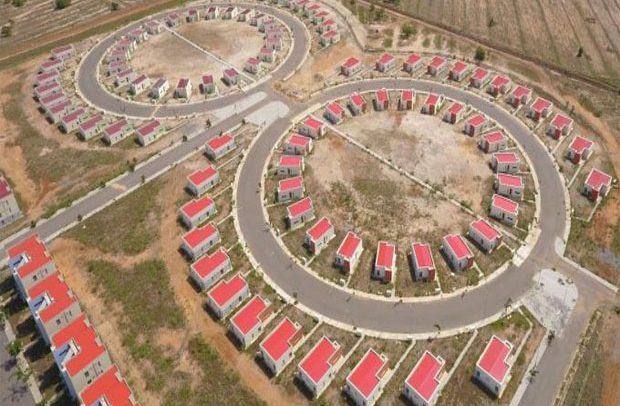
Economist, Professor Godfred Bokpin, says the government’s intention of handing over the Saglemi housing project to a private developer only goes to prove that the country is not serious about inclusivity and social progression.
According to him, it has become clear that the government uses these so-called pro-poor housing projects to self-serve at the expense of the poor Ghanaians in whose name the projects are conceived.
He noted that successive governments have failed to show any commitment whatsoever in addressing issues that affect the poor “because from the conceptualisation and the pricing mechanism, it is above the means of the poor.
“So it’s almost clear that these houses are going to the middle class and the upper middle class themselves. So we only use the poor as a face shield to hide our real intention to enhance our own agenda. When you put all these things together you see a country that is just not serious about inclusivity and social progression,” he said on JoyNews’ Newsfile, Saturday.
His comment follows the Works and Housing Minister, Francis Asenso-Boakye's justification of government’s decision to sell the 1,506 units Saglemi Housing project.
He stated that an amount of about US$46 million is needed to provide water, electricity, and storm drains, funds the country cannot raise at this current moment.
According to the Minister, the units built by the NDC government in 2012 were inhabitable, hence the reason for selling the project to a private sector developer.
Prof. Bokpin stated that for a country that does not have enough revenue to sink 200 million dollars in a project and then abandon it simply demonstrates a country that is not serious, “it typifies a country that doesn’t appreciate that resources are scarce and that those scarce resources have alternative uses, and that the extent to which you maximise the alternative uses of scarce resources, that’s what makes the difference between the rich and the poor.”
“So if you spend close to 200 million dollars over these years, you’re not turning it around, then it means that you’re not being efficient at using your limited or scarce resources for the benefit of the common good,” he said.
Latest Stories
-
Asos hackers took more personal details than first revealed, BBC finds
54 minutes -
Fort Hood shooter’s execution by firing squad will be livestreamed, Pentagon says
1 hour -
Chrysler Building to get its crown restored after being sold
1 hour -
Infantino re-election boost as Concacaf chief will not stand
1 hour -
Everton’s Sherif fined for breaching betting rules
2 hours -
Suspended fine for Xhaka over Covid-19 certificate
2 hours -
Businessman dragged to court over GH¢480,000 fraud
2 hours -
Pregnant woman and husband found dead in a room at Anloga-Kportorgboe
2 hours -
Man, 87, jailed 20 years for defiling nine-year-old girl at Ofankor
2 hours -
Maresca says ‘feeling is fantastic’ among Man City squad
2 hours -
Sam George warns FBI Director against taking sole credit for Ghana cybercrime operation
2 hours -
Foreign capital no passport to Ghana’s informal retail market – GIPA CEO
3 hours -
E&P model should be seen as a blueprint for building local mining giants – GIPA Boss
3 hours -
Govt’s decision to reduce nurse training long overdue – GRNMA
3 hours -
Ghana needs emergency health fund to respond swiftly to outbreaks – SEND Ghana
3 hours