

Audio By Carbonatix
A country’s Gross International Reserves (GIR) includes the US dollar value of holdings of foreign exchange, special drawing rights, reserves position in the IMF, and gold at the end of a given period.
In simple terms, the GIR is a country’s safety net against unforeseen international payment difficulties.
However, in a span of 2 years, Ghana has lost a whopping $6.3 billion worth of GIR. This is according to the Bank of Ghana’s Summary of Economic and Financial Data report.
Details of the report indicate that Ghana had about $11.4 billion (an all-time high) in GIR as of August 2021. This has depleted to just $5.09 billion as of August 2023 representing about a 55.4% depletion rate in 2 years.
In terms of import cover, the nations’ remaining GIR can last for only 2.4 months (12 weeks) of import cover as compared to the 5.2 months (22 weeks) in August 2021.
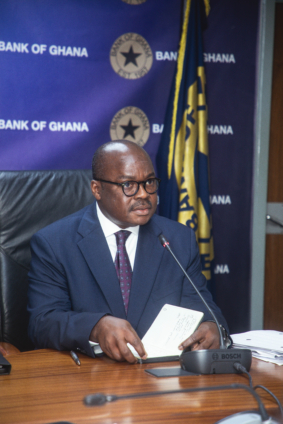
The Governor for the Bank of Ghana, Ernest Addison, recently indicated that the Bank of Ghana has been able to save $2 billion of its reserves due to the suspension of interest payments on external debt by the government.
This means that the country’s reserve would have been in a worse situation if Ghana were paying its interest on external debt.

The IMF Executive Board on May 17th, approved an SDR 2.242 billion (about US$3 billion) 36-month Extended Credit Facility (ECF) arrangement for Ghana.
This decision enabled an immediate disbursement equivalent to SDR 451.4 million (about US$600 million). The rest is expected to be disbursed in tranches every six months, following program reviews approved by the IMF Executive Board.
Prior to the approval the country was required to undertake both domestic and external debt restructuring programs to alleviate the mounting debt service burden on its economy.
The nation initiated a domestic debt restructuring program with an 85% participation rate, as reported by the Ministry of Finance. This initiative resulted in debt service savings, amounting to GHS 34 billion.
Ghana is also in talks with external creditors to restructure about $20 billion of its debt with an external debt service savings target of about $10.5 billion.
Latest Stories
-
Let’s give OSP time to mature, not to scrap it – Hassan Tampuli
3 minutes -
Nigeria convicts 386 Islamist militants in mass trials
8 minutes -
Djibouti president wins election with 97.8% of vote, state media says
13 minutes -
We don’t have mandate to deduct tax from rent allowance of security services personnel – Interior Ministry clarifies
27 minutes -
Ablakwa receives Presidential Special Envoy on Reparations to advance global agenda
44 minutes -
Christina Koch becomes first woman to travel around the moon on Artemis II
55 minutes -
Epstein survivors’ calls to meet King Charles and Queen harder to ignore as US visit approaches
1 hour -
UN Secretary-General names Ghana’s Anita Kiki Gbeho as South Sudan envoy
1 hour -
Mali withdraws recognition of Sahrawi Republic, backs Morocco’s autonomy plan
1 hour -
Gov’t distributes over 8,500 laptops to One Million Coders project
1 hour -
Julius Debrah, ‘man to beat’ as NDC’s James Agbey dismisses Musah Dankwah’s polls
1 hour -
GPRTU in Savannah Region to protest alleged eviction in Damongo
2 hours -
Re: Reinsurance does not replace process — A response to the SIGA–SIC defence
2 hours -
Gender Ministry supports Harriet Amuzu in ongoing abuse case
2 hours -
AG joins plaintiff to scrap OSP ?: We should be mindful of the mischief in this – Bobby Banson
2 hours