

Audio By Carbonatix
A country’s Gross International Reserves (GIR) includes the US dollar value of holdings of foreign exchange, special drawing rights, reserves position in the IMF, and gold at the end of a given period.
In simple terms, the GIR is a country’s safety net against unforeseen international payment difficulties.
However, in a span of 2 years, Ghana has lost a whopping $6.3 billion worth of GIR. This is according to the Bank of Ghana’s Summary of Economic and Financial Data report.
Details of the report indicate that Ghana had about $11.4 billion (an all-time high) in GIR as of August 2021. This has depleted to just $5.09 billion as of August 2023 representing about a 55.4% depletion rate in 2 years.
In terms of import cover, the nations’ remaining GIR can last for only 2.4 months (12 weeks) of import cover as compared to the 5.2 months (22 weeks) in August 2021.
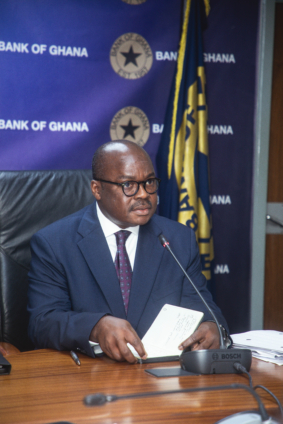
The Governor for the Bank of Ghana, Ernest Addison, recently indicated that the Bank of Ghana has been able to save $2 billion of its reserves due to the suspension of interest payments on external debt by the government.
This means that the country’s reserve would have been in a worse situation if Ghana were paying its interest on external debt.

The IMF Executive Board on May 17th, approved an SDR 2.242 billion (about US$3 billion) 36-month Extended Credit Facility (ECF) arrangement for Ghana.
This decision enabled an immediate disbursement equivalent to SDR 451.4 million (about US$600 million). The rest is expected to be disbursed in tranches every six months, following program reviews approved by the IMF Executive Board.
Prior to the approval the country was required to undertake both domestic and external debt restructuring programs to alleviate the mounting debt service burden on its economy.
The nation initiated a domestic debt restructuring program with an 85% participation rate, as reported by the Ministry of Finance. This initiative resulted in debt service savings, amounting to GHS 34 billion.
Ghana is also in talks with external creditors to restructure about $20 billion of its debt with an external debt service savings target of about $10.5 billion.
Latest Stories
-
Journalists look back on a decade of breast cancer reporting in Ghana
15 minutes -
President Mahama ends Resetting Ghana tour of Ahafo Region
2 hours -
African negotiators seek delivery of climate commitments at COP31
2 hours -
BoG develops AI rules for financial sector
2 hours -
‘Big Push’: Government assures contractors of prompt payments
2 hours -
Court fines miner for breaking into gold buying shop
2 hours -
Tarkwa court jails labourer for three years over GH¢123,000 theft
3 hours -
GAEC must retain nuclear scientists for Ghana’s nuclear ambitions – Minister
4 hours -
Man reportedly mistaken for game and shot by hunter dead in forest
4 hours -
19-year-old mason jailed 15 years for defiling seven-year-old pupil
4 hours -
Ghana’s banking sector assets rise 20.47% to GH¢500.2bn – BoG Governor
4 hours -
22 injured as Sprinter bus overturns at Sege after tyre burst
4 hours -
UN housing expert urges Ghana to strengthen Rent Control Department amid housing affordability concerns
4 hours -
Delta-BCI partnership reaches 166,000 people with breast cancer education
4 hours -
Power restoration fault suspected in Kumasi Central Market fire
10 hours