

Audio By Carbonatix
President John Mahama says Ghana must urgently boost domestic financial mobilisation if it wants a strong and sustainable education system.
He warned that long-term progress cannot depend on external support alone.
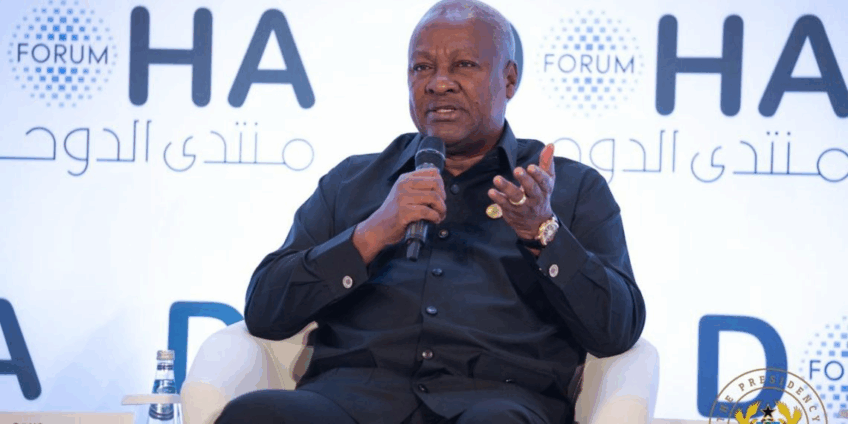
Speaking at the 2025 Doha Forum in Qatar, he said international assistance still matters, but real transformation requires reliable internal funding driven by national ownership.
He pointed to the Ghana Education Trust Fund as proof that Ghana can finance its own priorities when it chooses to do so.
He said the 2.5% VAT contribution on goods and services shows how local resources can sustain the education sector.
“At a point in time, we realised that education was a key sector to Ghana’s progress and development, and so as a nation we decided to contribute to everything we purchase 2.5% VAT, and that goes into the Ghana Education Trust Fund.
"That fund alone is able to mobilise sufficient revenue,” he told the gathering.
President Mahama said Ghana must strengthen its domestic revenue systems to cut over-reliance on donors.
He said consistent internal financing is necessary for school infrastructure, learning materials, and the expansion of tertiary education.
He also turned attention to the country’s agricultural challenges. He said Ghana must overhaul its farming systems to match fast-changing climate patterns.
He stressed that the era of depending mainly on rain-fed agriculture is over. He called for major investment in irrigation to protect farmers and secure food production.
“We need to adapt our agriculture to a new reality. That means we must put more land under irrigation.
"Poor farmers will not be able to afford the cost that comes with it, and that is why my government has decided to embark on appropriate and affordable irrigation for the farmers,” he said.
The President said improved irrigation will raise productivity, create rural jobs, stabilise food supply, and strengthen climate resilience.
His remarks at the Doha Forum reflected Ghana’s wider development vision, which centres on domestic resource mobilisation, education reforms, and a modern agricultural system built to withstand global climate pressures.
Latest Stories
-
We can tackle multiple priorities – Sam George defends Anti-LGBTQ Bill push
5 minutes -
Statement: Ghana Chamber of Mines’ Response to Claims in Joe Jackson’s “Ananse Stories about the Economy of Ghana”
7 minutes -
GES opens 2026 teacher recruitment for licensed B.Ed graduates
9 minutes -
Ghana must value skilled trades, build resilient learners — Ibn Chambas
17 minutes -
Ghana must rethink education around relevance, resilience and responsibility — Ibn Chambas
20 minutes -
Prince Harry faces defamation lawsuit from charity he co-founded
22 minutes -
South Korea deploys thermal cameras to track escaped zoo wolf
24 minutes -
Calls for royal meeting with Epstein survivors grow ahead of US visit
27 minutes -
Ibn Chambas advocates blend of technology and human values in education
28 minutes -
UMA improves healthcare access in Asutifi North with GH₵700k ‘Kim Taylor Legacy’ Walkway
33 minutes -
Scholarships Authority and Fanaka University offer sponsorship for procurement and supply chain studies
36 minutes -
Bisa Kdei drops new single ‘Go N Look’ featuring Medikal
43 minutes -
Benin facing rising terrorism in north as French military presence faces growing criticism
44 minutes -
UEW Public Lecture Series 2026: Education debate ‘about the soul of Ghana’s future’ — Dr Ibn Chambas
45 minutes -
EU fingerprint and photo travel rules come into force from today
1 hour