

Audio By Carbonatix
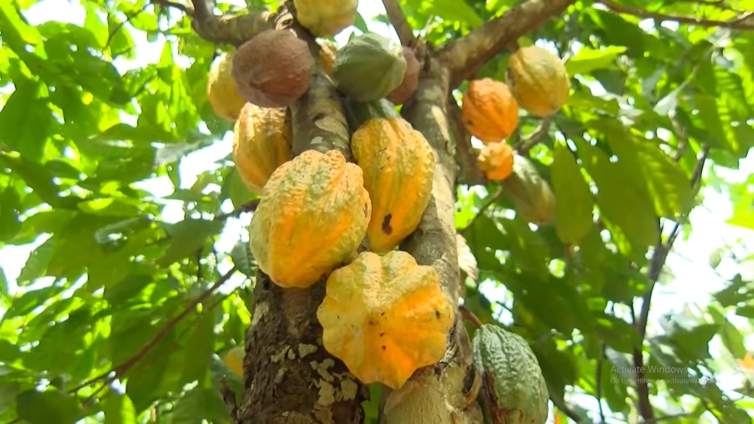
Ghana’s COCOBOD will use part of a $200 million World Bank loan to rehabilitate plantations destroyed by the cocoa swollen shoot virus, which causes drops in yields and kills trees, the regulator’s deputy Chief Executive in charge of operations said on Thursday, February 15, 2024.
The disease has wiped off about 500,000 hectares of farmlands and reduced cocoa output from the West African nation, the world’s second biggest cocoa producer after neighbour Ivory Coast.
Ghana’s output declined to 600,000 metric tons last year after peaking at 1.048 million tons in the 2020/21 season, as the cocoa swollen shoot virus, aging plantations, illegal mining and smuggling took a toll on the sector.
A total of $132.8 million of the loan secured by the government last year and the counterpart funding will finance Cocobod’s rehabilitation of farms and help to enhance knowledge on the virus strains, a project information document showed.
“The rehabilitation will take a minimum of five years to start getting economic production,” Cocobod’s Emmanuel Opoku told Reuters, adding that efforts had been hampered by the country’s economic crisis and the board’s limited funds.
The board will take over disease-infested farms, cut and replace sick cocoa trees, aiding growth to a fruiting stage before handing them back to farmers.
In 2018, Cocobod used part of a $600 million Africa Development Bank (AfDB) loan to rehabilitate aging plantations and those affected by the disease.
But the programme, originally meant to cover 156,000 hectares of plantations, was caught up in Ghana’s worst economic crisis in a generation during which inflation spiralled and the cedi currency depreciated sharply, Opoku said.
He said the AfDB facility benefited more than 88,000 hectares of farmlands, of which 40,000 hectares were ready to be given back to farmers in “the coming days”.
Alhassan Bukari, president of the country’s Cocoa, Coffee and Sheanut Farmers’ Association, told Reuters that rehabilitation efforts needed to be aggressive as many farmers were affected.
Ghana’s graded and sealed cocoa arrivals fell by 35% between the start of this season on Sept. 1 and Jan. 31 this year due to the intensity of the seasonal dry Harmattan wind and what Cocobod described as production.
Latest Stories
-
Ghana to begin camping with 12 athletes after Accra Open Championships – Bawa Fuseni
21 minutes -
Anthony Joshua declines showdown with Tyson Fury but admits they ‘probably’ clash next
34 minutes -
Tyson Fury dominates Makhmudov, calls out Joshua next
53 minutes -
I have supported highway authority financially to fix roads in my constituency – A Plus
2 hours -
US, Iran fail to reach peace agreement after marathon talks in Pakistan
2 hours -
ECG kicks off Phase Two of transformer upgrades at Lashibi; brief outages expected
3 hours -
Port crises loom as 11,000 drivers threaten four-day strike
4 hours -
A source of excellence across generations – Vice President Opoku-Agyemang lauds Mfantsipim
5 hours -
(Photos) Mfantsipim School launches historic 150th anniversary
5 hours -
Knights and Ladies of Marshall group backs Catholic Bishops’ stance on anti-LGBTQ+
6 hours -
Bright Simons writes: All the Filla in the Ibrahim Mahama/E&P – Gold Fields Saga
6 hours -
Monetise Idiocy In Ghana
6 hours -
The Ghanaian prophet and the mysterious death of his scottish wife Charmain Speirs
7 hours -
Nearly 400 sentenced in Nigeria for links to militant Islamists
8 hours -
Ghana’s recovery supported by gold strength despite global oil price pressures – Standard Bank Research
8 hours