


Audio By Carbonatix
Fitch Solutions has maintained that Ghana will reach a staff-level agreement with the International Monetary Fund (IMF) by the first quarter of 2023.
This will mean that the country could secure a programme from the Fund by the end of quarter 1, 2023 or the second quarter of 2023.
Some economists and experts were anticipating that the country could reach a staff-level agreement with the Fund before the end of 2022 to pave way for a programme by the first quarter of 2023.
But in its latest paper on “Division within Ghana's Ruling Party to Weigh on Political Stability”, the international research firm also said should the Finance Minister, Ken Ofori-Atta, be replaced, negotiations with the IMF would likely remain largely unaffected.
“While Ofori-Atta remained opposed to an IMF bailout – we believe that he would take a more accommodative approach towards negotiations with the Fund. As such, we believe that a change of finance minister would most likely not impact the timeline of IMF negations and we would retain our view that a staff-level agreement will be reached in Q123 [quarter 1, 2023]”, it explained.
Government to face additional pressure from frequent protests
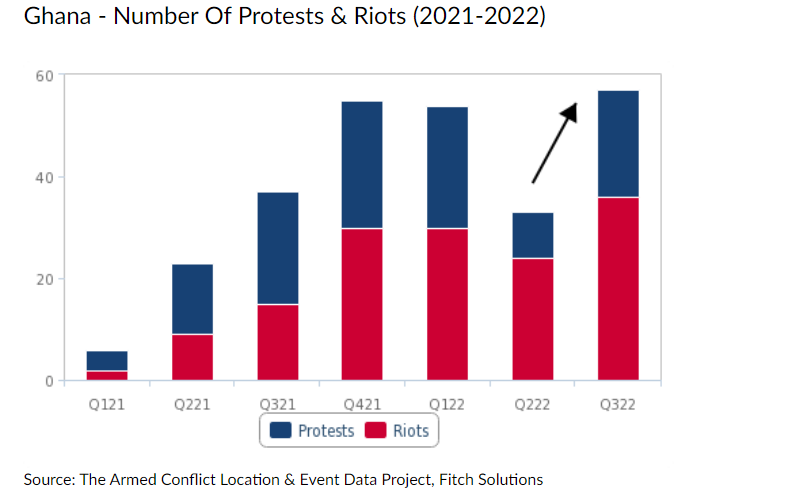
Furthermore, it said the government will face additional pressure from more frequent protests and industrial action.
“Worsening living standards amid rising consumer prices – inflation reached 40.4% year-on-year in October 2022, the highest reading since 2001 – and tighter monetary conditions have led to a 72.7% quarter-on-quarter increase in protests and riots across in quarter 3 2022. The country has also seen large industrial action in recent months, including a three-day retail strike in Accra in October [2022]".
Inflation to remain elevated, weighing on living standards
Fitch Solutions also expects inflation to remain elevated in the months ahead.
“Given that inflation is primarily driven by currency weakness, we expect price growth to remain elevated in the months ahead. Indeed, significant capital and financial account outflows caused by weakening investor sentiment will continue to weigh on the currency”.
“Our view is further informed by the fact that previous periods of significant exchange rate weakness in Ghana all lasted roughly 12-14 months, suggesting that the cedi will continue to depreciate into quarter 1, 2023 (the current sell-off started in January 2022). This will keep inflation high, weighing on living standards and eroding support for the government”.
Latest Stories
-
(Photos) Mfantsipim School launches historic 150th anniversary
23 minutes -
Knights and Ladies of Marshall group backs Catholic Bishops’ stance on anti-LGBTQ+
1 hour -
Bright Simons writes: All the Filla in the Ibrahim Mahama/E&P – Gold Fields Saga
2 hours -
Monetise Idiocy In Ghana
2 hours -
The Ghanaian prophet and the mysterious death of his scottish wife Charmain Speirs
3 hours -
Nearly 400 sentenced in Nigeria for links to militant Islamists
3 hours -
Ghana’s recovery supported by gold strength despite global oil price pressures – Standard Bank Research
3 hours -
Methodist Church hails Mfantsipim@150; calls for “fresh consecration” to excellence
3 hours -
‘Excellence is our inheritance’ – Nana Sam Brew-Butler hails Mfantsipim’s 150-year reign in leadership
4 hours -
Kwaku Azar writes: A-G vs OSP
4 hours -
Mfantsipim–Adisadel rivalry built excellence, not division – Sam Jonah
4 hours -
Vice President launches Mfantsipim’s 150 years of shaping Ghana’s greatest mind
4 hours -
I assure Otumfuo, Mahama will join him to commission KNUST Teaching Hospital by end of this year – Haruna Iddrisu
5 hours -
Barcelona dominate derby to extend La Liga lead
5 hours -
Gov’t to roll out free special education for persons with disabilities from July 1 – Education Minister
5 hours