

Audio By Carbonatix
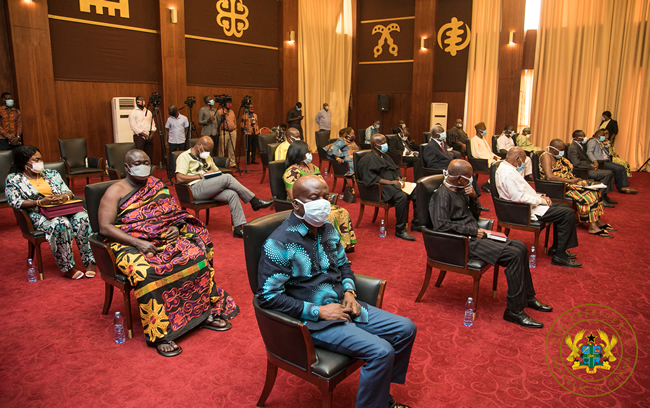
In Ghana, the Council of State is often described as a council of elders—a group of wise heads tasked with guiding the president through the thorny thickets of governance.
Established under Article 89 of the 1992 Constitution, this 31-member body is meant to provide guidance and advice to the president, parliament, the judiciary, and other state institutions on issues of national importance.
But as the country holds elections for new members, many Ghanaians are left wondering: is this council a powerhouse of influence or merely a ceremonial echo chamber?
The council’s composition is a curious mix of elected and appointed members. Sixteen regional representatives are elected by delegates from district assemblies, while the president appoints 11 members and, in consultation with parliament, selects three high-profile figures: a former Chief Justice, a former Inspector General of Police, and a former Chief of Defence Staff. Rounding out the group is the President of the National House of Chiefs, who serves as a de facto member.
In total, 14 of the 31 members—45% of the council—are directly or indirectly appointed by the president, raising questions about its independence.
This structure has not gone unchallenged. In 2011, the Constitutional Review Commission, set up by the National Democratic Congress (NDC) under President John Atta Mills, submitted its review report.
While the committee recommended maintaining the council, it also proposed reducing the president’s appointees from 11 to 5 to enhance its independence. The government, in its white paper, accepted the recommendation to retain the council but rejected the reduction of presidential appointees, leaving the balance of power unchanged.
The council’s tenure lasts until the end of the president’s term, ensuring continuity but also tying its fate to the executive’s political cycle.
Its role, however, is far from ceremonial. The council is consulted on key decisions, including the appointment of the Bank of Ghana Governor, the Chief Justice and Supreme Court Justices, the Inspector General of Police, and the Chairperson of the Electoral Commission.
It also advises on presidential pardons, diplomatic appointments, the removal of certain public officials, and legislative bills.
Yet, for all its advisory responsibilities, the council’s influence is not absolute. The Supreme Court has ruled that while the president is required to seek the council’s advice on certain matters, they are not bound to follow it. In other words, the council can advise, but the president can politely—or not so politely—ignore.
This has led critics to argue that the council risks becoming a rubber stamp, especially given the significant number of presidential appointees. Supporters, however, see it as a stabilizing force, offering experienced counsel and a layer of oversight in a young democracy.
As Ghana continues to strengthen its democratic institutions, the role of the Council of State remains a topic of lively debate. Is it a vital check on presidential power, or merely a ceremonial body with a fancy title?
The answer may lie in how future presidents choose to engage with it—or how often they choose to ignore it. For now, the council remains a curious blend of tradition and politics.
Latest Stories
-
Women farmers need tailored pensions – Zanetor
29 seconds -
MP, MCE provide street bulbs and solar panels to lighten Evaloe Adjomoro-Gwira constituency
2 minutes -
ECG upgrades infrastructure, assures reliable, stable power supply
3 minutes -
Aggrieved cocoa farmers urge Parliament intervention
9 minutes -
Ghana launches first maternal mental health policy
12 minutes -
Mahama issues three calls to action at One Health Summit
17 minutes -
KNUST secures $2.3m funding for research activities
21 minutes -
Ayigboe residents fear disaster as ECG delays repairs on live faulty cables
26 minutes -
PIAC urges investment as oil production falls
29 minutes -
Heath Goldfields seals $2.8bn Trafigura deal to revive Bogoso-Prestea
53 minutes -
Trump says US military to stay around Iran; threatens action if Tehran fails to comply with deal
1 hour -
Only 6% insured locally – Prof. Gyampo exposes cracks in import regime
1 hour -
Thousands of containers lost at sea – GSA’s Prof Gyampo warns importers are exposed to risk
2 hours -
Keep the money in Ghana – Gov’t enforces local cargo insurance
2 hours -
US Army veteran charged with leaking classified information to journalist
2 hours