

Audio By Carbonatix
Ghana’s economy expanded by 4.5% in July 2025, according to the latest Monthly Indicator of Economic Growth (MIEG) released by the Ghana Statistical Service (GSS).
The figure represents a slowdown from the 8.3% growth recorded in July 2024, signaling a moderation in the pace of economic activity despite continued expansion across key sectors.
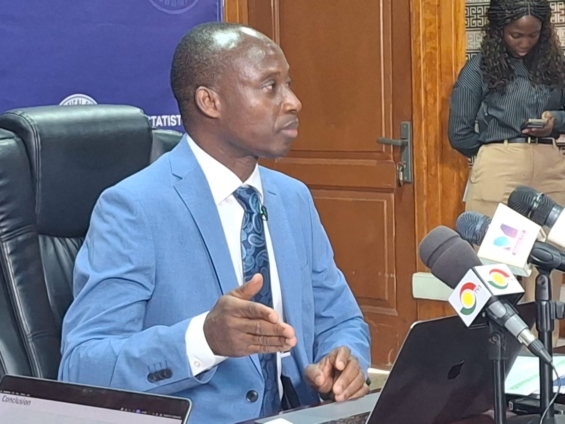
Speaking at a media briefing, Government Statistician, Dr. Alhassan Iddrisu, explained that the MIEG serves as a high-frequency measure of economic performance, providing an early signal on the direction of Ghana’s economy.
Built on the same framework as the quarterly GDP, he said the MIEG tracks monthly changes in the country’s economic activity to support timely policy and investment decisions.
“The economy continued to expand in July 2025, though at a slower rate compared to the same period last year,” Dr. Iddrisu noted.
The data showed that the Services sector maintained its strongest performance recording 6.4% growth in July 2025, up from 4.5% in July 2024.
The sector contributed the largest share (58.4%) to the overall MIEG growth, underlining its sustained dominance in Ghana’s economic structure.
The Agriculture sector also posted an impressive growth, expanding by 8.0% in July 2025, a significant rebound from 2.4% in July 2024.
This acceleration, according to the report, reflects increased output and productivity in crop and livestock production, contributing 37.1% of the total MIEG growth for the month.
In contrast, Industry slowed sharply, with growth of just 0.1% in July 2025, down from 17.7% a year earlier.
The sector’s contribution to overall growth stood at 0.9%, suggesting a marginal expansion driven largely by modest performance in manufacturing and construction.
According to the GSS, the latest figures point to continued resilience in services and agriculture, but also highlight structural weaknesses in Ghana’s industrial base, which remains vulnerable to high production costs and reduced external demand.
It emphasised that the MIEG will continue to serve as a vital tool for tracking short-term shifts in the economy and informing policy interventions aimed at stabilising growth and supporting sectoral recovery.
Latest Stories
-
The hypocrisy must stop; pass Anti-LGBTQ+ Bill now – Alhassan Tampuli to Mahama
4 minutes -
Imprisonment should be rehabilitative, not punitive – Ghana Prisons boss at UNGA
26 minutes -
Ga Adangbe traditional priests petition Mahama over McDan aviation licence revocation
37 minutes -
Anti-LGBTQ Bill: NDC’s arrogance is worrying – Hassan Tampuli
47 minutes -
Let’s give OSP time to mature, not to scrap it – Hassan Tampuli
51 minutes -
Nigeria convicts 386 Islamist militants in mass trials
56 minutes -
Djibouti president wins election with 97.8% of vote, state media says
1 hour -
We don’t have mandate to deduct tax from rent allowance of security services personnel – Interior Ministry clarifies
1 hour -
Ablakwa receives Presidential Special Envoy on Reparations to advance global agenda
2 hours -
Christina Koch becomes first woman to travel around the moon on Artemis II
2 hours -
Epstein survivors’ calls to meet King Charles and Queen harder to ignore as US visit approaches
2 hours -
UN Secretary-General names Ghana’s Anita Kiki Gbeho as South Sudan envoy
2 hours -
Mali withdraws recognition of Sahrawi Republic, backs Morocco’s autonomy plan
2 hours -
Gov’t distributes over 8,500 laptops to One Million Coders project
2 hours -
Julius Debrah, ‘man to beat’ as NDC’s James Agbey dismisses Musah Dankwah’s polls
2 hours