

Audio By Carbonatix
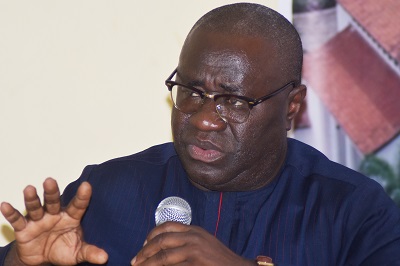
The Head of Academic Affairs and Research at the Kofi Annan International Peacekeeping Training Centre (KAIPTC), Professor Kwesi Aning has revealed that Ghana is not adequately prepared to withstand any terrorist attack.
According to the security expert, the country's planned preparedness against terrorist attack is 'zero'.
Speaking in an interview with Benjamin Akakpo on the AM Show on Tuesday, he explained that his assertion is based on the outcome of a research undertaken by his outfit.
He noted that there is a lot of work that needs to be done to ensure that the country does not become victimised in the event of a terrorist attack.
"Between July and September, 2020, I traveled round every single border post in this country and wrote the United Nation's report on conflict vulnerability in Ghana, focusing particularly on the six northern regions.
That painted a dire picture of unpreparedness, of empty rhetoric, of a penchant for waxing lyrical and not placing the logistics in place. I went to Kumbungu, I went to Pusiga, I went to Paga, I went to Hamile [and] I was in Bawku. Level of preparedness is zero", he stated.
Professor Aning added that, based on his findings he further discovered that, Ghana is a 'net exporter of the instruments and the infrastructure for violence'.
This he said requires the attention of all relevant stakeholders, in order to safeguard the peace and security of the country.
His comments were on the back of a recent research by Promediation which revealed that more than 200 Ghanaians have been integrated into about four notorious jihadist groups operating in West Africa.
After undergoing training in the Sahel, these young recruits are sent back to their villages of origin to engage in religious proselytising, thereby posing a security threat to the country.
These jihadist groups could ultimately take root in certain locations in the northern regions of Ghana due to their ability to recruit local people who are trained to execute their orders.
“Ghana appears particularly exposed because of its proximity to the cascades region of Burkina Faso and northern Cote d’Ivoire.
Indeed, the growing presence of katibas – in particular GSIM-JNIM – in the Cascades region during 2021, as well as the intensification of a strategy of attacks and settlements against neighbouring Cote d’Ivoire, make northern Ghana an ideal cross-border withdrawal and control zone for armed groups.
This is especially true since these areas, which are plagued by a high level of banditry, offer access to very attractive illegal resources such as cattle rustling and clandestine gold mining”, the research report stated.
Earlier, a security analyst, Dr. Ishmael Norman had also stated that Ghana is susceptible to terrorist attacks just as the countries currently experiencing it.
According to him, there are many underlying factors that can easily trigger terrorist attacks in the country, which include; poor living conditions of the people and corruption.
“As a country, we should not ignore the fact. We are just as susceptible to terrorist attacks as Nigeria or Togo or any country in the sub-region, because there are many underlying reasons why a group of bandits or terrorists will attack this state. T
The economic situation is very bad, there is a lot of corruption at the highest level of government and all of these are annoying, aggravating situations that can make people take the law into their own hands and do bad things” he said in June this year.
Following the latest report, some security analysts, including Professor Aning and Adib Saani have proffered a number of suggestions, which they believe can help deal with any insurgencies.
Meanwhile, government's operation 'See Something, Say Something', is still in force to help mitigate any disturbances in the country.
The campaign, which was launched by the National Security in May this year, is to encourage citizens to report suspicious acts of terrorism.
The aim of this campaign, among other reasons, is to get citizens highly alert and report suspicious characters in the wake of terrorism threats suspected by security analysts.
It forms part of the operational strategy in collaborating efforts between security agencies and the citizens to safeguard the borders of the country.
This national security strategy is also expected to see a joint security action in response to security concerns from citizens in order to protect the territorial borders and find a formidable approach in tackling national security threats across the country.
Latest Stories
-
Monetise Idiocy In Ghana
5 minutes -
The Ghanaian prophet and the mysterious death of his scottish wife Charmain Speirs
50 minutes -
Nearly 400 sentenced in Nigeria for links to militant Islamists
1 hour -
Ghana’s recovery supported by gold strength despite global oil price pressures – Standard Bank Research
1 hour -
‘Excellence is our inheritance’ – Nana Sam Brew-Butler hails Mfantsipim’s 150-year reign in leadership
2 hours -
Kwaku Azar writes: A-G vs OSP
2 hours -
Mfantsipim–Adisadel rivalry built excellence, not division – Sam Jonah
2 hours -
Vice President launches Mfantsipim’s 150 years of shaping Ghana’s greatest mind
3 hours -
I assure Otumfuo, Mahama will join him to commission KNUST Teaching Hospital by end of this year – Haruna Iddrisu
3 hours -
Barcelona dominate derby to extend La Liga lead
3 hours -
Gov’t to roll out free special education for persons with disabilities from July 1 – Education Minister
4 hours -
Importers and Exporters Association declares full support for Publican AI port system
4 hours -
“We used it to test our officiating officials’ readiness” – Bawah Fuseini after CAA Athletics event
4 hours -
Volleyball emerges as Ghana’s fastest rising sport
4 hours -
National Sports Fund needs strong leadership from the top – Administrator David Wuaku
4 hours