

Audio By Carbonatix
The Ghana Infrastructure Investment Fund (GIIF) is set to play a pivotal role in promoting sustainable financing for housing projects across the country, according to Minister for Works and Housing, Kojo Oppong Nkrumah.
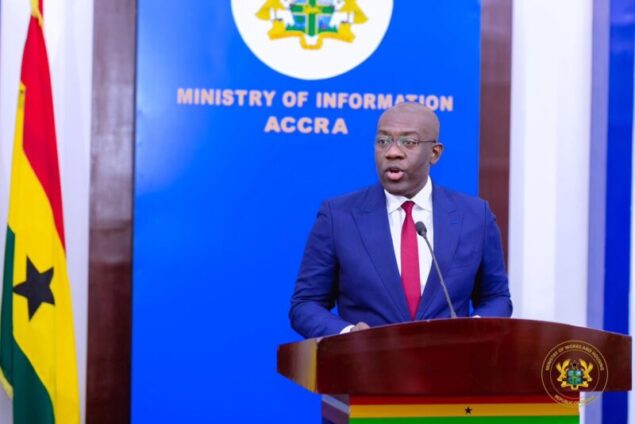
Speaking at a press briefing in Accra on Monday, September 30, the Minister stated government's commitment to addressing Ghana’s housing deficit, which is currently estimated at 1.8 million units.
He highlighted the need for innovative financing solutions to facilitate affordable housing projects, which are crucial in reducing the deficit.
To that end, the GIIF will partner with the Ministry of Works and Housing to develop sustainable financial frameworks that will drive housing development.
“The creation of the Ghana Infrastructure Investment Fund (GIIF) will help raise sustainable resources for nationwide housing projects, which is vital if we are to bridge the housing gap,” Mr Oppong Nkrumah said.
One of the primary strategies of the GIIF will be the establishment of a Public-Private Partnership (PPP) model to encourage private sector participation in housing provision.
This model will offer various incentives, such as land grants and tax breaks, to attract private developers.
In addition to the GIIF’s efforts, the Minister underscored the significance of the National Homeownership Fund (NHF), launched in 2018, to promote affordable housing.
The NHF has collaborated with commercial banks to implement the National Mortgage Schemes, which, during their pilot phase, facilitated the issuance of over 300 mortgages.
Mr Oppong Nkrumah also provided updates on ongoing housing projects.
The stalled Koforidua Affordable Housing Project will soon resume after being handed over to the State Housing Company Limited.
The aim is to accelerate construction while maintaining high standards.
In a separate development, he confirmed that negotiations are underway to hand over the Saglemi Housing Project to a private developer.
This move is expected to ensure the project's completion and the sale of its units without further government investment.
Lastly, the Minister highlighted the District Housing Programme, which is aimed at addressing the housing needs of public sector workers in rural areas, including those affected by the Akosombo Dam spillage.
Through partnerships with traditional authorities, this initiative seeks to secure unencumbered land, thus removing barriers that have long hindered real estate development in such areas.
Latest Stories
-
Chief Justice: Efficient Judiciary essential to reducing business costs
3 minutes -
Bayern grabs 99th-minute winner to cap superb fightback
3 minutes -
Ahmed Ibrahim urges Ghanaians to reflect Easter values in nation-building
6 minutes -
ECG inefficiencies undermining power supply -Mahama outlines reforms
8 minutes -
Lewandowski scores as Barca fight back to defeat Atletico
9 minutes -
Lack of private sector consultation undermining economic growth – Jerry Ahmed Shaib
13 minutes -
Real Madrid seven points adrift after Muriqi’s late Mallorca winner
13 minutes -
Ghana must lead AfCFTA implementation by example – Trade Minister Ofosu-Adjare
18 minutes -
Strong Judiciary key to business confidence – Chief Justice Baffoe-Bonnie
22 minutes -
Mahama announces 60-Hectare irrigation project to boost tomato production
29 minutes -
WPL: Hasaacas Ladies win on last day to set up final with Ampem Darkoa
30 minutes -
Chisora beaten by Wilder in captivating bout
53 minutes -
One dead, six maimed as bloody land feud tears Krachi Nchumuru apart
1 hour -
Missing service member rescued by US forces after jet downed in Iran, Trump announces
2 hours -
Gomoa Easter Carnival: Sarkodie, Kuami Eugene, Tinny, set festival ablaze as Day 3 ends on high note
2 hours