

Audio By Carbonatix
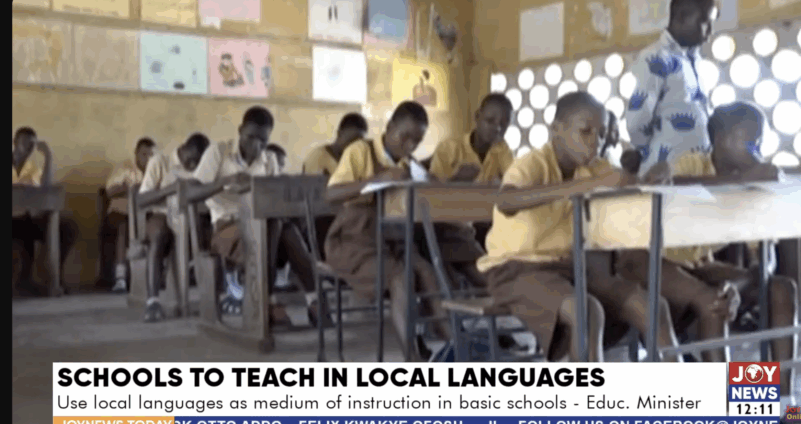
The Ghana National Association of Teachers (GNAT) has welcomed the Education Ministry’s directive to enforce mother-tongue instruction in schools, but says the policy must be accompanied by deliberate measures to train and appropriately deploy teachers.
Speaking on JoyNews, GNAT's president, Isaac Owusu, said simply declaring local language instruction compulsory is not enough if teachers are not adequately prepared to teach in the languages spoken in the communities they are assigned to.
“But for us, what we are looking at is not just a declaration of making the local language compulsory,” he stressed.
“There should be a deliberate policy so that the teachers we train from the colleges of education and the universities have ample time to study and teach these languages.”
He noted that there are currently several Ghanaian languages that are not taught in teacher training colleges, making it difficult to implement the policy effectively.
Beyond training, he said, teacher postings must also consider linguistic relevance to avoid communication barriers in the classroom.
“You don’t post a teacher who speaks Ewe to Mankranso and place a Mankranso teacher in Anloga,” he explained.
“The teacher will find it difficult in terms of the language barrier. These are the things we want the Ministry and GES to collaborate on and take step by step.”
His comments come after the Minister of Education, Haruna Iddrisu, directed the Ghana Education Service (GES) to strictly enforce the use of local languages as a medium of instruction in schools.
According to the Minister, the move is aimed at improving comprehension and learning outcomes, especially at the basic level.
Haruna Iddrisu announced the launch of the Free Tertiary Education Programme for Persons Living with Disabilities, stating that the initiative forms part of broader reforms to strengthen foundational learning.
Isaac Owusu agreed the policy is “in the right direction,” but said its success will depend on coordinated planning among the Education Ministry, GES, and colleges of education.
“We believe this is achievable if the right measures are put in place,” he added.
“We support it, but it must be done properly to benefit the children.”
Latest Stories
-
Autonomy for Controller and Accountant-General’s Department critical for fiscal Governance – CAGD Workers Union
29 seconds -
MML’s MoMo transactions hit GH¢4.1trn in digital finance surge
18 minutes -
Ofori-Atta ready to fight possible US extradition – Frank Davies
50 minutes -
Annoh-Dompreh, Dr Yaw Opoku lead week-long Minority visit to cocoa farmers in Ashanti Region
52 minutes -
Know the taxes abolished in Ghana
53 minutes -
Over 4,000 firearms surrendered during gun amnesty – Interior Minister
60 minutes -
Police arrest 4 microcredit officers over alleged assault at Ashongman Estate
1 hour -
Ashley Cole appointed manager of Serie B side Cesena
1 hour -
GPRTU warns possible transport fare increase over anticipated fuel price hike
1 hour -
Empower female technicians to build Ghana – GhIE President
1 hour -
Ghana and Belarus to begin talks on visa waiver agreement
1 hour -
Ghana opens Culture Week, government pledges heritage protection
1 hour -
Lordina Foundation renovates, equips Anyima Health Centre
1 hour -
Women-led SMEs in Volta Region lament marginalisation in accessing government policies and programmes
1 hour -
Apply, Pay, Pray — The Security Recruitment Lottery Explained
1 hour