

Audio By Carbonatix
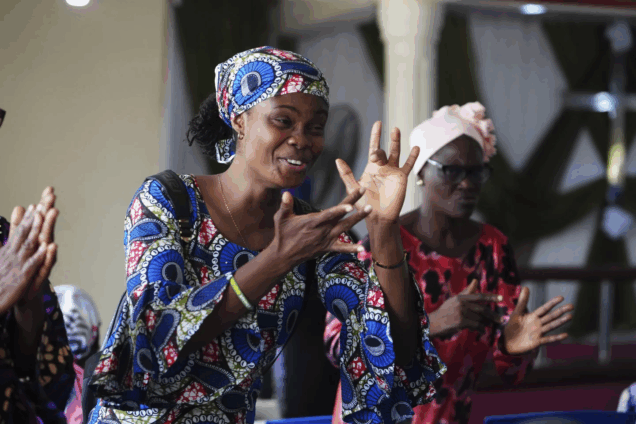
It is like any other church in Nigeria‘s megacity of Lagos. A lectern faces rows of plastic chairs. A biblical quote is written on a beam above. There is a music section with a set of drums. Sash-wearing church wardens move around to enforce order.
But it is also different. For hours, the only sounds are exclamations and thunderous bursts of drums, with their vibrations the cues for when to pray, kneel or respond to the preacher’s calls for “Hallelujah.”
This is a church for deaf people in Somolu, a mixed-income suburb, where about 50 to 60 people worship weekly.
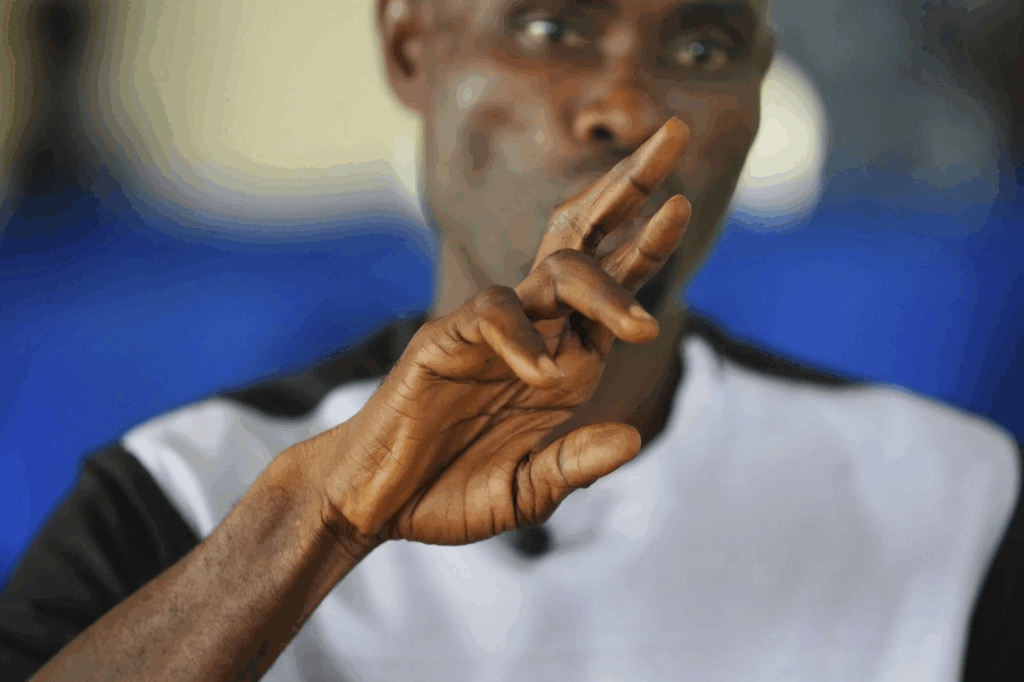
Imoh Udoka, a father of two children, has attended the church for 36 years. He was 9 years old when he contracted meningitis, losing his hearing as well as access to his faith. Most churches in Nigeria do not have accommodation for deaf people.
Then Udoka, now a teacher of sign language, discovered the church via community outreach. “Here in this church, we have access to worship God in our sign language,” he told The Associated Press.
‘God also understands us’
Remi Akinrenmi is one of the pastors. Every Sunday, he mounts the pulpit with charismatic energy to preach in sign language. His big frame makes for a commanding presence.
On one Sunday, he preached about the sinister consequences of jealousy. On another, he preached the importance of faith. Attendees waved their hands above their heads in response to “Praise the Lord.”
Most important for Akinrenmi is that members see the church as a community.
“There was no community for us before the deaf church started,” he said. “Now, we see each other and say, ‘Oh, you are deaf, too. I am also deaf.’ And we are now together and have formed a community.”
God understands every language, he said: “With sign language, God also understands us.”
Disability advocates say that in the absence of inclusive churches and institutions, churches like this and a handful of affiliates in southern Nigeria are crucial, especially in African societies where the perception of people with disabilities is influenced by traditional beliefs. Some see a disability as a divine punishment.
“An exclusive space like this church offers them an opportunity for a safe space to be able to connect and relate,” said Treasures Uchegbu, founder of Speaking Fingers, a sign language advocacy group in Lagos. “They can say, ‘I am not a deaf person just standing alone, I have other deaf people around.’”
How the church came to be
The church organises evangelism outreach programs to other deaf communities in Lagos. It also runs a teaching unit for sign language, a vital tool for understanding the world better, according to Akinrenmi.
Hearing children of church members also attend the classes to better relate to their parents and others, and some hearing students attend church services for immersion learning.
The church started in 1956 in colonial Nigeria as the Christian Mission for Deaf Africans. In today’s Nigeria, an estimated 10 million people out of the population of 220 million are deaf or have difficulty hearing.
There is limited infrastructure in Nigeria for people with disabilities, and laws to improve their welfare and prevent discrimination are barely enforced. Efforts by advocates to push for more inclusive legislation have not materialised. They blame a lack of political will.
Oluwakemi Oluwatoke-Ogunjirin, a 49-year-old worker with the Lagos state government, was born deaf. She attended hearing churches with her family, but always felt lost.
Depending solely on public infrastructure in other parts of life, she struggles to get by. But at the church, she said, she has found a community where she can feel safe and understood.
“The church goes beyond faith; we have people like ourselves that we can talk to as friends,” Oluwatoke-Ogunjirin said.
With the church’s help, she has improved her sign language and can communicate widely, breaking the isolation she grew up with.
“The sign language makes life very easy for us,” she said. “It helps us communicate beyond the church.”
Latest Stories
-
Bitter times for cocoa farmers as chocolate market slumps
6 minutes -
Australians must prove they are over 18 to access porn under new laws
13 minutes -
Ghana not immediately threatened by fuel shortages – Energy Ministry
16 minutes -
Ghana records eight deaths, over 1,000 mpox cases since May 2025 – Health Minister
16 minutes -
X probes offensive Grok chatbot posts as AI safety concerns intensify
18 minutes -
Planet One announces TVET projects worth $327m in three West African countries
25 minutes -
UN Chief condemns attack on Ghanaian peacekeepers in Lebanon, demands accountability
31 minutes -
US-Israeli air campaign hits hundreds of military targets in new wave of Iran strikes
36 minutes -
Ghana must lead Africa in criminalising environmental destruction – Annoh-Dompreh
37 minutes -
US-Israeli war against Iran enters new phase with rise of hardline successor Mojtaba Khamenei
42 minutes -
Kofi Adu Domfeh honoured with Excellence in Climate Journalism and Advocacy Award
43 minutes -
WPL 2025/26: Hasaacas, Ampem Darkoa Ladies close in on another final
45 minutes -
Bole MP donates GHS200,000 to support teacher training college establishment
60 minutes -
Danyame Old Town residents face eviction on a land occupied for 200 years
1 hour -
60% of our water bodies are polluted – Minority Chief Whip pushes Ecocide Law
1 hour