


Audio By Carbonatix
Motorists across Ghana are breathing a sigh of relief as two of the country’s leading oil marketing companies—Goil and Star Oil—announce significant reductions in fuel prices, following the recent appreciation of the Ghanaian cedi against the US dollar.
The price cuts are expected to ease the financial burden on consumers and transport operators who have long called for downward reviews following the cedis strong gains.
Goil rolls back prices across all fuel types
Goil, Ghana’s largest and wholly indigenous oil marketing company, has revised prices downward across its entire fuel range. The new rates are as follows:
- Petrol: now selling at ₵12.52 per litre, down from ₵13.27
- Diesel: reduced to ₵12.98, from ₵13.87
- Premium: slashed to ₵14.34, previously ₵15.27
The move positions Goil as one of the first major players to respond proactively to the improved forex environment.
Star Oil joins price reduction wave
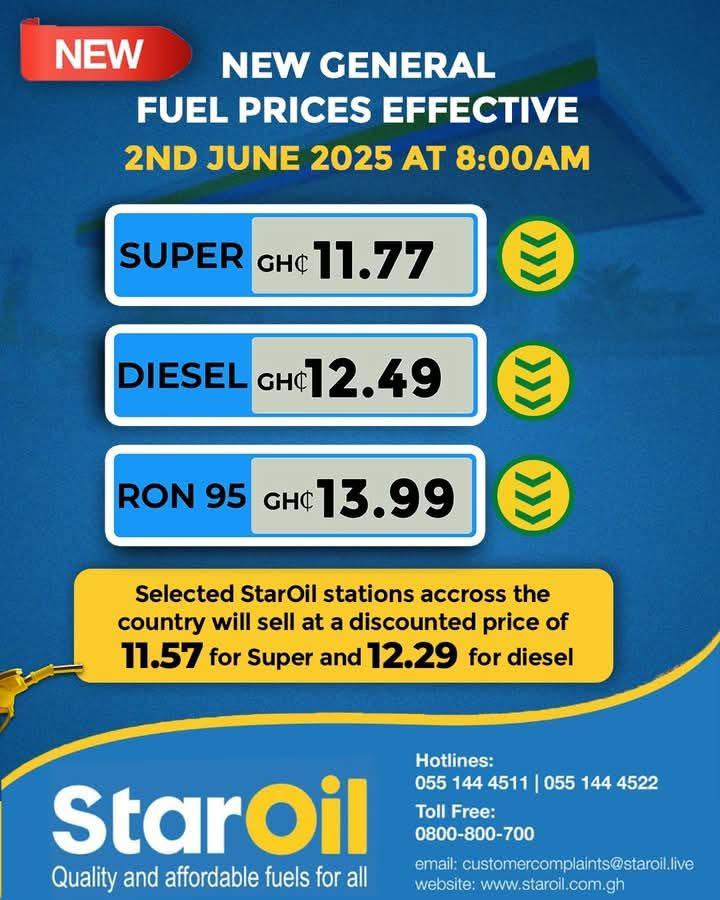
Star Oil has also made notable reductions, though its premium fuel remains unchanged. New prices at Star Oil stations are:
- Petrol: now ₵11.77, down from ₵12.57
- Diesel: now ₵12.49, reduced from ₵13.49
- Premium: holds steady at ₵14.89
This development places Star Oil’s petrol as among the most competitively priced on the market, likely influencing broader pricing trends in the coming days.
Cedi rebound drives change
The reductions come on the back of a strengthening Ghanaian cedi, which has recorded significant gains against the US dollar in recent weeks. As fuel imports are dollar-denominated, the improved exchange rate has provided room for oil marketing companies to lower prices at the pump.
Market watchers say this could signal the start of a broader downward trend in fuel pricing—provided the cedi’s stability is sustained and global crude prices remain relatively subdued.
Relief for consumers, pressure on others
Transport operators and consumers have welcomed the reductions, but are also calling on other oil marketing companies to follow suit to create a level playing field and further drive down transport fares.
Industry insiders suggest that competition and customer pressure may soon push more fuel retailers to adjust their prices accordingly.
Latest Stories
-
Matthew McConaughey trademarks iconic phrase to stop AI misuse
3 hours -
Song banned from Swedish charts for being AI creation
3 hours -
Barcelona reach Copa del Rey quarter-finals
3 hours -
Players need social skills for World Cup – Tuchel
3 hours -
Labubu toy manufacturer exploited workers, labour group claims
3 hours -
Lawerh Foundation, AyaPrep to introduce Dangme-language maths module
4 hours -
US forces seize a sixth Venezuela-linked oil tanker in Caribbean Sea
4 hours -
Votes being counted in Uganda election as opposition alleges rigging
4 hours -
Ntim Fordjour accuses government of deliberate LGBT push in schools
4 hours -
National security task force storms ‘trotro’ terminals to halt illegal fare hikes
4 hours -
U.S. visa restriction development for Ghana concerning – Samuel Jinapor
4 hours -
Uganda election chief says he has had threats over results declaration
4 hours -
Quality control lapses allowed LGBT content into teachers’ manual – IFEST
4 hours -
Akufo-Addo’s name will be “written in gold” in Ghana’s history in the fullness of time – Jinapor
4 hours -
Tread cautiously about financial hedging – US-based Associate Professor to BoG
4 hours