

Audio By Carbonatix
The Minority in Parliament has accused the Mahama administration of recklessly expanding the Gold-for-Reserves programme, blaming the government for what it describes as a US$214 million loss recorded within nine months.
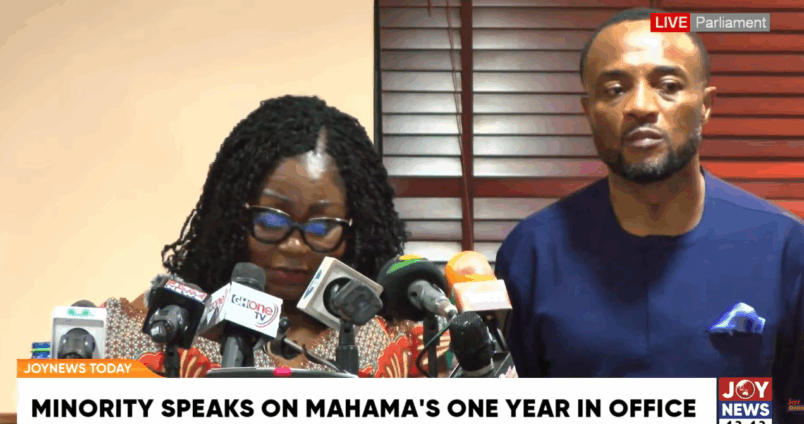
Briefing the press on Thursday, January 8, the Deputy Minority Leader and Member of Parliament for Asokwa, Patricia Appiagyei, said the development represents a major failure in economic governance and oversight.
Describing the situation as a “US$214 million scandal,” Madam Appiagyei argued that the amount, equivalent to about GH¢2.6 billion, could have been used to build hospitals, equip schools and provide storage facilities for farmers, but was instead lost through what she termed a politically connected gold scheme.
She stressed that the Gold-for-Reserves programme was originally conceptualised, designed and implemented by the New Patriotic Party (NPP) government under former President Nana Addo Dankwa Akufo-Addo, and was managed with discipline, transparency and accountability.
“The programme as we designed and implemented it did not lose US$214 million in nine months,” she said, questioning what changed after President John Mahama returned to office.
According to the Deputy Minority Leader, President Mahama inherited a functioning programme but politicised and expanded it recklessly, placing it in what she described as “unprepared and potentially conflicted hands,” with the results now evident.
She cited the International Monetary Fund (IMF) report which, she said, documents losses of US$214 million within nine months, attributed to the operations of GoldBod and the Bank of Ghana.
Madam Appiagyei acknowledged that GoldBod and the Bank of Ghana have denied making any losses, with GoldBod issuing a response on January 3, 2026, emphatically rejecting the claim.
However, she maintained that statements by the Chief Executive Officer of GoldBod, who has said the institution generated over GH¢960 million in revenue against GH¢120 million in expenditure, projecting a surplus of between GH¢700 million and GH¢800 million do not address the core concerns raised in the IMF report.
“These are bold claims, but they do not answer the central issue,” she said, insisting that the government must provide clarity on how a programme once managed without losses has allegedly deteriorated under the current administration.
Latest Stories
-
A source of excellence across generations – Vice President Opoku-Agyemang lauds Mfantsipim
22 minutes -
(Photos) Mfantsipim School launches historic 150th anniversary
45 minutes -
Knights and Ladies of Marshall group backs Catholic Bishops’ stance on anti-LGBTQ+
2 hours -
Bright Simons writes: All the Filla in the Ibrahim Mahama/E&P – Gold Fields Saga
2 hours -
Monetise Idiocy In Ghana
2 hours -
The Ghanaian prophet and the mysterious death of his scottish wife Charmain Speirs
3 hours -
Nearly 400 sentenced in Nigeria for links to militant Islamists
3 hours -
Ghana’s recovery supported by gold strength despite global oil price pressures – Standard Bank Research
3 hours -
Methodist Church hails Mfantsipim@150; calls for “fresh consecration” to excellence
4 hours -
‘Excellence is our inheritance’ – Nana Sam Brew-Butler hails Mfantsipim’s 150-year reign in leadership
4 hours -
Kwaku Azar writes: A-G vs OSP
4 hours -
Mfantsipim–Adisadel rivalry built excellence, not division – Sam Jonah
4 hours -
Vice President launches Mfantsipim’s 150 years of shaping Ghana’s greatest mind
5 hours -
I assure Otumfuo, Mahama will join him to commission KNUST Teaching Hospital by end of this year – Haruna Iddrisu
5 hours -
Barcelona dominate derby to extend La Liga lead
6 hours