


Audio By Carbonatix
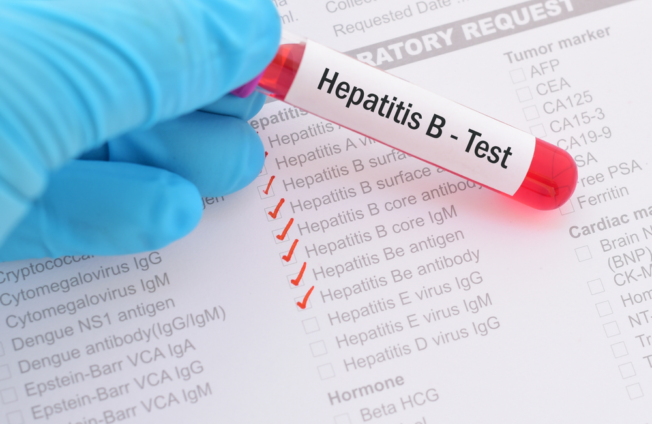
A Senior Research Fellow at the Immunology Department of Noguchi Memorial Institute for Medical Research (NMIMR), Dr Kwadwo Asamoah Kusi, has advocated the provision of a national guideline for testing and diagnosing of Hepatitis ‘B’ in all health facilities.
He said presently there was a challenge with the kind of Risk-Based Testing (RBT) used to test for Hepatitis ‘B’, with every health facility using what was available to them with no standardization.
The Senior Research Fellow said a national guideline was, therefore, needed to ensure standard practice.
Dr Kusi was speaking at a meeting held in Accra on Thursday to assess the implementation of the Hepmal project in Ghana in the last six months.
The Project Titled “Clinical and Immunopathological Consequences of Chronic Hepatitis B and Plasmodium Falciparum- Co-Infections,” seeks to assess the impact of having both Hepatitis B infection and malaria on the health of the liver, as both diseases affect the liver.
It is also expected to serve as a platform to conduct more research into Hepatitis B and gather more evidence to educate the public on the need to check and know their status and get vaccinated.
Dr Kusi, who is also the Programme Coordinator for the HEPMAL project, said the four-year project was funded by the European Developing Countries Clinical Trials Partnership (EDCTP).
“This project is looking at what happens when you have both malaria and Hep B infections in the liver, how one affects the other, thus, if you have a chronic Hepatitis B infection and you get malaria, does it make your situation better or worse and vice-versa,” he added.
He called on the government to put in place measures that would make it compulsory for adults to be vaccinated against HBV.
Director, NMIMR, Professor Abraham Annag, said Ghana needed to put in more efforts to increase coverage on Hepatitis ‘B’ screening and vaccination.
He said the Ghana Health Service ought to consider active testing and vaccination of prisoners against the virus to help break the transmission chain.
Hepatitis ‘B’ is an infection of the liver caused by hepatitis ‘B’ virus (HBV). It can be acute and resolve without treatment. However, some forms can be chronic, and these could lead to cirrhosis and liver cancer.
HBV can cause infection and inflammation of the liver, a person can have HBV and transmit the virus to others without knowing that they have it.
HBV is transmissible when blood, semen, or another bodily fluid from a person with the virus enters the body of an individual who does not have it.
It can be transmitted through sex, childbirth, practicing unsafe tattoo techniques or as a result of sharing needles, syringes, or other drug-injection devices.
Early symptoms include joint pain, fatigue, nausea, vomiting, loss of appetite, abdominal pain, dark urine, clay coloured stools, jaundice, or yellowing of the skin and whites of the eyes.
Latest Stories
-
Asante Gold reports US$345million loss for 2025
1 hour -
Gov’t making progress in clearing $1.7bn power debt – Mahama
2 hours -
Justice is the engine of growth – Chief Justice
3 hours -
Meet us halfway – Trade Minister tasks private sector with AfCFTA success
3 hours -
After more than 14 years at Atletico Madrid, what next for Simeone?
3 hours -
Conquering the World – Building on the foundations laid by Otto Addo
4 hours -
[Watch Live] Kwaw Kese, Kwami Eugene, Tinny, Keche and others thrill fans at Gomoa Easter Carnival
4 hours -
Gomoa Easter Carnival: Experts charge indigenes to own festival to ensure sustainability
5 hours -
Gomoa Easter Carnival: Edem Agbana and Joy Prime fans shower festival with huge endorsements
6 hours -
Gathering of Royals 2026: Empowering women, boosting tomato production
7 hours -
Gov’t to overhaul free zones into manufacturing hubs for local production – Trade Minister
7 hours -
Ghana losing $2.5bn yearly from raw exports – Trade Minister reveals
7 hours -
Mahama unveils plans for Kwahu Airport, Convention Centre
7 hours -
World’s oldest leader, Paul Biya to get a deputy for first time in 43-year rule
8 hours -
Search for missing US airman continues as Trump threatens ‘hell’ if Iran does not reach deal
8 hours