

Audio By Carbonatix
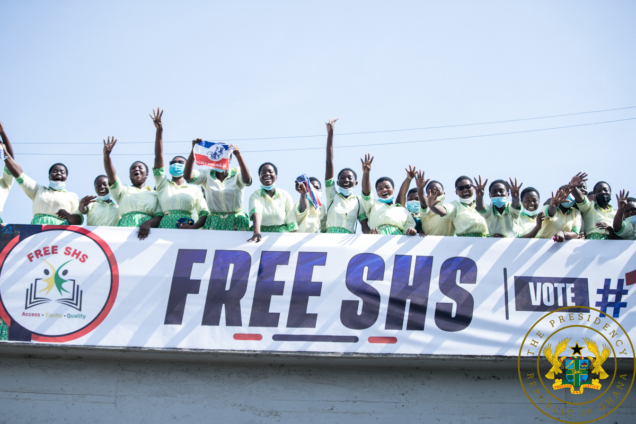
Builsa South MP, Dr Clement Apaak, has questioned government on the use of funds approved for the free Senior High School programme since 2017.
According to the Deputy Ranking Member on the Committee on Education in Parliament, the House has approved over GH₵8 billion since 2017, yet, government has been engaging in borrowing to finance the free SHS programme since its inception.
"To put matters in context, the Parliament of Ghana from 2017-2021 approved in excess of 7 billion (2017 - 400 million; 2018 - 1.2 billion; 2019 - 1.6 billion; 2020 - 2.4 billion; and 2021 - 1.9 billion) for the financing of free SHS. Based on the above, it's justified to ask government to tell Ghanaians how much it has borrowed to finance FSHS, how much of the estimated GH₵170 billion borrowed by the Akufo-Addo-Bawumia government in just about four and half years has been used to finance free SHS?" he said.
Dr. Apaak's assertion follows an article published on www.bloomberg.com in which Minister of State-designate for Finance, Charles Adu Boahen stated that Ghana is planning to raise as much as $1 billion through the sale of sustainable bonds, including Africa’s first social debt to fund a flagship policy to broaden access to education.
In the article titled "Ghana to sell sustainable bonds for up to $1 billion by July", the Minister stated that proceeds from the bond "would help refinance domestic debt used for social and environmental projects, including loans taken to pay for the government’s free senior secondary school policy."
Dr Apaak noted that the Minister's statement was confirmed by Deputy Minister-designate for Finance, Abena Osei Asare who admitted during her vetting that borrowing to finance free SHS could not be bad. In her response to the issue of increasing debt, she told the Appointments Committee of Parliament that despite the fact that the country's debt was rising, borrowing to finance free SHS is prudent.
According to him, the above publication and comments justify his claim that government has been borrowing to fund the free SHS programme and also affirm claims that funding the policy with national revenue, specifically oil revenue, would prove challenging in the medium to long term.
He believes, funding the programme through borrowing is not sustainable since the numbers admitted into schools keep increasing each year and their needs keep increasing as well.
"My candid view is that borrowing to finance FSHS is not sustainable. This is because the student population increases each year. We currently have 1,200,580 students in the public secondary school system, and the numbers will increase next year and every year, naturally, as we keep making babies. The trend is self-evident. For example, at the commencement of the policy in 2017, the student population was 432,780, in 2018 it increased to 613,780, and presently the number is 1,200,580 according to the 2021 budget," he explained.
He further raised concerns over other challenges bedeviling the implementation of the programme including infrastructure, inadequate space, inadequate/poor quality of food among others, and asked government to "consider a more sustainable source of financing the free SHS policy since it is urgent now more than ever because as the student population increases, so will their needs i.e space, food, textbooks, teachers, etc. "
"Even with current budgetary allocations and loans, reports of reduction in quantities/portions of food served to students and its quality, as well as the supply of teaching and learning materials, including books are prevalent. Students complain of inadequate and poor food and the sharing of core textbooks," he said.
"Sustaining and improving our secondary education means the issues of inadequate space and inadequate/poor quality food must be addressed. This will require a national forum of stakeholders to discuss all the challenges, especially a sustainable source of funding free SHS. Obviously, budgetary allocations and loans have been unable to resolve the challenges,
"Rather than being defensive, government must admit the funding challenges. That a national forum is urgently needed if we are to avert the worsening conditions in our secondary schools which cannot be overemphasized," he said.
Latest Stories
-
Mahama nominates 5 to Ghana’s Fiscal Council to strengthen economic oversight
12 minutes -
Enterprise Insurance crowns first “Insure Na Chilli” winner: Jonathan Syme set for ultimate football experience
13 minutes -
Bear with us over temporary outages as ECG begins transformer upgrade programme – Energy Ministry
40 minutes -
President Mahama has not broken promise on anti-LGBTQ bill — Akwatia MP
1 hour -
Education Minister promises swift fix to Aburi Girls’ SHS water crisis
1 hour -
Top Australian soldier charged with war crimes to remain in jail on remand
2 hours -
US journalist Shelly Kittleson released after kidnap in Iraq, officials say
2 hours -
Starmer to visit Middle East after US and Iran reach ceasefire deal
2 hours -
Telcos and regulators are failing Ghana on Mobile Money fraud
2 hours -
Discussions on petroleum taxes review ongoing with Finance Minister – Jinapor
2 hours -
BMW Club Ghana partners National Road Safety Commission for “Stay Alive” Easter road safety campaign
2 hours -
Health Ministry launches World Health Day 2026, urges science-based action
3 hours -
MMFL anchors MTN Group’s fintech push in Ghana
3 hours -
Ghana’s economy shows recovery signs, but risks persist – S&P maintains stable outlook
3 hours -
SWAG commemorates its 8th anniversary with a public lecture
3 hours