


Audio By Carbonatix
The Deputy Finance Minister says government is not surprised about the country’s rising inflation.
Dr John Kumah said the rise is part of the process of rebounding from the effects of the COVID-19 pandemic.
This, he said, is not an exception to only the country, but most countries around the globe are also facing similar challenges.
According to him, the government projected the inflation for the year to be around 10%, but events beyond its control have made it so.
“Yesterday, another announcement came through that the USA is doing 8.5%, the highest in 41 years. I think all these are signals that the economies of the world are actually rebounding out of Covid, and it’s a necessary process to go through from the difficult downturn that we all experienced and so for us, if you look at the projection for the year, we didn’t anticipate to reach thus far.”
“It was plus or minus 8% so we were hoping to hover around 10% or just about that but unfortunately it has gone as high as 23% but we are not surprised because it is part of the rebounding process that almost every economy has to go through to get better.”
On the same difficulties, Finance Minister Ken Ofori-Atta has also attributed rising inflation to factors beyond the government’s control.
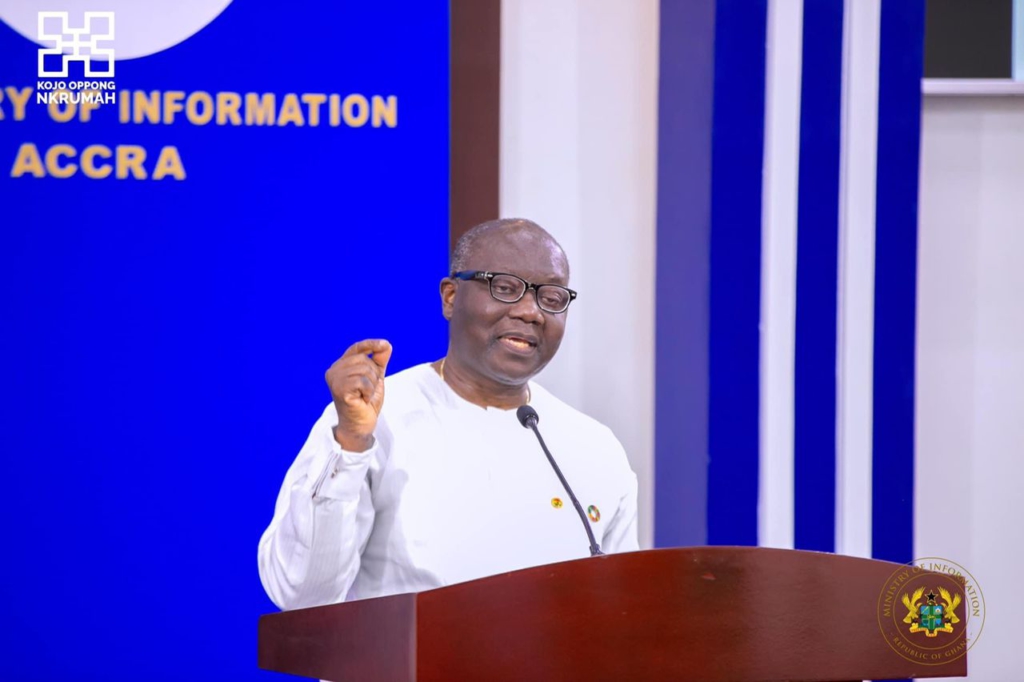
According to him, 41 African countries are currently exposed to the same crisis Ghana faces. These crises he mentioned are “rising food prices, rising energy prices, tightening financial conditions”.
Conditions, he said Finance Ministers on the continent call them the “dreaded three Fs”.
“Today, 41 African economies are severely exposed to, at least, one of three concurrent crises, rising food prices, rising energy prices, tightening financial conditions Finance Ministers now call it the dreaded three Fs; food, fuel, and financial conditions.”
“That is just a ripple through in all Africa, and food prices easily about 34 per cent higher, crude oil prices some 60 per cent higher, and global inflation has risen; we saw our numbers yesterday moved to 23.6 per cent, a good chunk of it being imported inflation.”
He spoke on JoyNews' AM Show on Thursday, May 13.
About the April inflation
The Ghana Statistical Service (GSS) announced on Wednesday, May 11, that the national year-on-year inflation rate was 23.6% in April 2022, which is 4.2 percentage points higher than the 19.4% recorded in March 2022.
This is the highest since January 2004.
According to the GSS, four divisions – Transport (33.5%); Household Equipment and Routine Maintenance (28.5%); Food and Non-Alcoholic Beverages (25.6%), and Housing, Water, Electricity, Gas, and Other Fuels (25.0%) recorded inflation rates above the national average of 23.6% with Transport recording the highest inflation.
National month-on-month inflation from March 2022 to April 2022 was 5.1%.
Whilst Food and Non-Alcoholic Beverages inflation was 26.6%, Non-Food inflation stood at 21.3%.
April 2022 food inflation (26.6%) is higher than both March 2022 food inflation (22.4%) and the average of the previous 12 months (13.5%). Food inflation’s contribution to total inflation, however, decreased from 51.4% in March 2022 to 50.0% in April 2022.
All the 15 food subclasses recorded positive month-on-month inflation, with Fruit and Vegetable Juices recording the highest (15.3%).
For Non-Food inflation, year-on-year inflation, on average, went up again in April 2022 compared to March 2022 (from 17.0% to 21.3%). Only one out of the 12 Non-food
Divisions had the 12 month rolling average to be higher than the year-on-year inflation for April 2022.
Furthermore, the inflation for imported goods was 24.7% higher than the 17.3% recorded for March 2022, while the inflation for locally produced items was 23.0%, up from the 20.0% recorded in March 2022. This is the first time in 29 months that inflation for imported items exceeded domestic inflation.
Government Statistician, Professor Samuel Kobina Anim, called on policymakers to address the rising prices of goods and services in the country.
Upper East records the lowest inflation rate of 18.4%
Meanwhile, the Upper East region recorded the lowest inflation rate of 18.4%. However, the Central region registered the highest inflation rate of 26.7%.
Greater Accra recorded an inflation rate of 25.1%, whereas the Ashanti region recorded an inflation rate of 21.7%.
For the region with the lowest food inflation, the Upper East topped with 18.1%, whilst the Upper West recorded the highest inflation rate of 38.5%.
Latest Stories
-
Ghana housing finance conference adopts communiqué to improve affordable housing access
3 hours -
Special Initiatives Minister urges Wa Technical Institute to enrol more girls as EU-backed solar training lab opens
4 hours -
In the matter of my first year at the Bar
4 hours -
ActionAid Ghana calls for an end to child marriage, greater investment in girls’ rights
4 hours -
Newsfile to tackle World Cup visa scandal, beach demolitions, education strikes, BRICS bid
4 hours -
UK-Ghana Trade & Investment Summit: Trade Resource Centre to help businesses maximise UK-Ghana trade opportunities
5 hours -
Embassy of Denmark celebrates World Maritime Day
5 hours -
Linking LEAP to productive inclusion could cut extreme poverty by 2030 – UNICEF
6 hours -
Trade Ministry backs use of creative arts to rehabilitate prison inmates
6 hours -
Negotiations with government to continue despite strike suspension – GNAT
6 hours -
‘Ghana cannot afford to waste public resources; every cedi has a job’ – Ato Forson
6 hours -
Ghana expects economic boost as World Assemblies of God Congress brings 10,000 delegates to Accra
6 hours -
Joy in Nayilifong as Farouk Aliu Mahama donates 100kVA transformer to improve power supply
7 hours -
Chief Justice urges employers to tackle mental health stigma in workplaces
7 hours -
Analysis: Ghana’s yellow fever numbers reveal a gap between vaccination and protection
8 hours