

Audio By Carbonatix
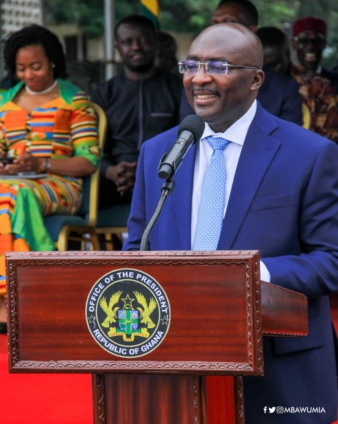
Vice President, Dr Mahamudu Bawumia, says the Government, for the past five years, has been pursuing an inclusive development agenda to ensure holistic growth and progress of all communities across the nation.
He mentioned the Coastal, Middle Belt, Northern and Zongo Development Authorities as the development vehicles the government had established to mitigate the suffering and challenges of the people, especially those in deprived areas.
In addition, educating and empowering the people economically, and providing them with functional skills were the only realistic ways to alleviate extreme poverty and underdevelopment.
Vice President Bawumia said this on Thursday in a keynote address at the second edition of the Annual National Muslim Conference at the National Mosque, Kanda, Accra.
He said the four thematic areas around which the conference revolved – education, health, finance, and economic empowerment – were in conformity with the development goals of the Government, the African Union and the United Nations to address the challenges of unbalanced growth in deprived communities.
It brought together key stakeholders within the Muslim Ummah to discuss ways of developing an action plan and education strategy to achieve those goals and empower the Muslim youth.
It was also intended to galvanise the energies, and human and material resources of the Muslim Community in Ghana to spur growth.
The conference was on the theme: “Towards the coherence and holistic economic empowerment strategy for national development- The Ghanaian Muslim Ummah in Context”.
Vice President Bawumia said: “For our government, bridging the development gap between the less privileged communities and others is important for the overall growth of our country.”
“Ghana will suffer if members of these communities grow and leave others behind. Therefore, the government is working to get rid of any form of exclusion.”
He called for the pursuance of continuous intra-face dialogues and interface engagements with the Christian counterparts to proffer strategies to mitigate the daily challenges facing Ghanaians.
He noted that several studies had established a strong link between education and social mobility and believed that with the right educational policies like the Free SHS, Free TVET and a guarantor free access to loans for tertiary education, a child from any background should not have any barrier to his or her development.
Data shows that the biggest beneficiaries of the Free SHS had been members from deprived communities including the Zongos, witnessing a significant rise in secondary school enrolment.
The Vice President urged the Muslim leaders to take advantage of Science, Technology, Engineering and Mathematics (STEM) and TVET education as a strategy to empower the youth, which underpins the government’s resolve to invest more in that sector.
Latest Stories
-
IMF urges Central Banks to keep inflation in check
13 minutes -
H. Kwasi Prempeh raises concerns over Supreme Court’s handling of OSP constitutionality case
23 minutes -
Global childhood cancer cases soar
23 minutes -
Airline pilots fear retribution over refusing to fly in Middle East, aviators’ group says
24 minutes -
Police intensify security in Bosomtwe communities after deadly clash
32 minutes -
Corporate Income Tax contributes highest to 2025 petroleum revenue
34 minutes -
Ghana less exposed to global oil disruptions — Fitch
37 minutes -
Property rates: Stakeholders advocate digitisation, transparency, …
39 minutes -
Police officer killed in road crash at Atortorkorpe in Ada
40 minutes -
EKMA begins dredging major storm drains ahead of peak rainy season
44 minutes -
US has let in 4,499 refugees since October – all but three were South African
48 minutes -
Child Protection Units to be part of MMDA Performance Assessment
55 minutes -
Pub thief jailed over £2.2m Fabergé theft
1 hour -
Show us the money – COMAC CEO demands full disclosure on ‘dumsor levy’ windfall
1 hour -
Melania Trump denies ties to Jeffrey Epstein and urges hearing for survivors
1 hour