

Audio By Carbonatix
The government has initiated moves to procure 13 tonnes of different varieties of tomato seeds for distribution to tomato farmers across the country.
The seeds are improved varieties with an improved yield profile and an extended shelf life.
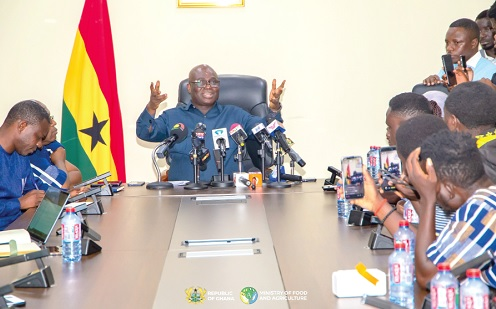
The Minister of Food and Agriculture, Eric Opoku, who announced this at a media engagement in Accra, explained that it formed part of measures to boost the country’s tomato production and reduce importation to the barest minimum.
The intervention has become necessary following a widening gap between national demand and local production.
Demand outstrips production
The annual national tomato requirement is estimated at 806,000 tonnes, while current production stands at around 510,000 tonnes.
The deficit of nearly 300,000 tonnes of tomatoes is often filled through imports.
The minister expressed concern that beyond the supply gap, low productivity per hectare remained a major challenge, stressing that while countries such as Burkina Faso recorded yields of about 18 tonnes per hectare, Ghana averaged only eight tonnes per hectare.
Mr Opoku stressed that addressing the challenge would require a shift from expanding land under cultivation to improving yields through better seed varieties and enhanced farming conditions.
“We must focus on developing high-yielding varieties that can perform well under our ecological conditions,” he said and was optimistic that ongoing collaboration with research institutions would help increase yields to at least 15 tonnes per hectare.
He explained that although Ghana cultivated significant land areas for tomatoes, output remained low due to reliance on rain-fed agriculture and limited irrigation infrastructure.
To address this, Mr Opoku said the government was expanding irrigation systems across key farming zones to ensure all-year-round production.
Vegetable cultivation
Under the Vegetable Development Programme, irrigation projects are being implemented in parts of the Ahafo and Bono regions, where about 60 hectares of land each are being developed with water supply systems to support continuous cultivation.
Mr. Opoku said additional interventions included the rehabilitation of irrigation facilities at Dawhenya, where 500 hectares had been earmarked for tomato production, and Akumadan, where 100 hectares were being prepared for immediate cultivation.
The minister further disclosed that about 250 boreholes were being drilled nationwide to support vegetable farming, particularly in dry-season production areas.
He noted that access to reliable water sources would not only increase yields but also reduce farmers’ dependence on unpredictable rainfall patterns.
Irrigation
Mr Opoku said the country had adequate arable land, but productivity must be maximised through improved inputs and efficient water management systems.
In addition to irrigation, he said, the government was facilitating market access by linking farmers directly to buyers to reduce post-harvest losses, which currently accounted for about 30 percent of production.
He said the combined interventions of improved seeds, expanded irrigation, input support, and market linkages would significantly increase output and stabilise supply.
Mr Opoku assured the public that the measures being implemented would not only address the current shortfall but also position Ghana to achieve long-term self-sufficiency in tomato production.
Latest Stories
-
MCEs, DCEs drilling GH¢100k boreholes nationwide with government approval – Assafuah reveals
28 seconds -
Ghana moves to enact new loans law to enforce discipline
2 minutes -
Ashanti regional U-17 football tournament reaches its thrilling climax this weekend
6 minutes -
Akoti Chief lauds Chirano Sefwiman Foundation, Asante Gold for new teachers’ quarters
11 minutes -
WASS teacher assault case: Court fines three GH₵4,000 each
21 minutes -
TTU makes history as first deaf student graduates with Master’s degree
22 minutes -
Ohemma Pokua Afoa Dankoto II enstooled as Queen Mother of Wenchi
22 minutes -
GhIE identifies use of mixed rock types in collapsed Accra New Town school building
33 minutes -
Ayawaso Central MCE says technical assessment delayed action before New Town collapse
37 minutes -
Weak enforcement behind New Town building collapse – Bureau of Public Safety
51 minutes -
‘Neglect is killing our people’ – NALAG President sounds alarm after Accra New Town building collapse
55 minutes -
Betty Krosbi Mensah urges young women to prepare for leadership, not wait for it
1 hour -
Evidence collection must follow rescue, not debris clearance — GhIE President on Accra New Town buiding collapse
1 hour -
NALAG President writes: When neglect kills in Accra New Town; preventable tragedy
1 hour -
Abandoned La Beach Towers under assessment as engineers probe unsafe structures
1 hour