

Audio By Carbonatix
The government has approved a plan to recapitalise the Graphic Communications Group Ltd (GCGL).
The injection of fresh capital is to enable the wholly state-owned company to run as an independent limited liability (private) company to make critical investments necessary to maximise its potential in the digital media landscape.
Currently, the country’s biggest media establishment, which has chronicled its history and served the population for more than seven decades with credible news and information, generates only enough to meet its operating expenses and needs additional capital leverage for more strategic investments.
The Cabinet, therefore, on June 30, last year approved a recapitalisation exercise through a carefully executed initial public offering (IPO) and subsequent listing of the GCGL allotted shares on the Ghana Stock Exchange (GSE).
Read also: Zoomlion and Graphic Communications launch campaign to name cleanest region in Ghana
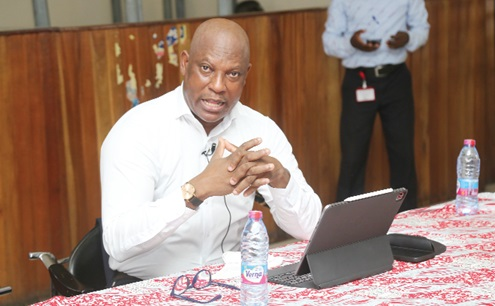
At a special meeting with staff yesterday to clarify the recapitalisation processes, the Managing Director of GCGL, Ato Afful, said after series of negotiations with the shareholder (the government), the Ministry of Information, the Public Enterprises Ministry, the National Media Commission (NMC) and the company’s board, it was agreed that the best option to recapitalise the business was through the floatation of part of the government’s equity in the business on the GSE to raise the needed capital.
“As part of that discussion, we need the Attorney-General’s (A-G’s) advice to enable the process to be properly guided by the law,” Mr Afful said at the special staff meeting at the head office of the company in Accra yesterday.
Staff
The meeting, which was also carried live via Zoom for staff in the regions with packed staff presence, gave the managing director, who was flanked by some executive management members, the platform to explain the rationale for the additional capitalisation to staff for the first time.
Staff also seized the moment to ask all the relevant questions and obtained assurances from executive management whose message stressed that the expected transaction was chosen over a private placement and other recapitalisation options, to reposition the company to deliver on its mandate and sustain its self-financing nature into the future.

Staff at the meeting
The parties are anticipating attractions from institutional investors such as the about GH¢54 billion pension funds, the GH¢15 billion Social Security and National Insurance Trust contributions and the about GH¢39 billion available private funds, as well as unions such as the Trades Union Congress (TUC), the Industrial and Commercial Workers Union (ICU), among others.
Also, foreign institutional (portfolio) investors and retail investors are among the possible investors. Mr Afful stressed that the company, a wholly owned state organisation, required patient capital to undertake the actions it had outlined in its strategic plan anchored on transforming it from a print-oriented entity into a digital-oriented business.
He explained that the change in the outlook of the business had necessitated a shift in business model based on dynamics in the environment which also called for a degree of financial reengineering.
Mr Afful added that the company was not a cash-rich company compared to a telecommunications or financial services entity and that although its buildings could be seen around, they did not convert much in real value.
“The assets are sitting, they don’t convert much in real value unless you have the extra resources to make them count,” he emphasised. Justifying the need to become a listed company, the Managing Director cited Ghana Oil Company (GOIL), GCB Bank and SIC Insurance Company Limited, as listed SOEs that were still profitable and very sustainable.
Roadmap
Following a legal advice from the A-G, a transaction advisor would be appointed to work with the company and its stakeholders to operationalise the share floatation plan. In doing that, Mr Afful said, there would be a clear structure and pathway including revaluation of the company, due diligence, ensuring a proper transaction strategy, the development of a transaction document or prospectus, culminating in an investor roadshow for the IPO and its subsequent listing on the GSE, a process which could take six months.
Latest Stories
-
Black Stars and the Art of Sacking: When the Coach Must Always Go First
4 minutes -
Ghana to roll out digital maps under new land sector reforms
11 minutes -
Ghana not fully ready for World Cup – Sports Minister
16 minutes -
NPA steps up “Stay Back, Stay Safe” campaign in Eastern Region
18 minutes -
Ethical Dilemma in Banking: The Case of a Teller in the Cash Cage
33 minutes -
Emceeing is 20% talk, 80% event management – Kafui Dey
34 minutes -
Supreme Court sets April 21 to hear Wesley Girls’ religious rights case
39 minutes -
UniMAC-IF holds workshop on Vertical Revolution: Mastering micro-dramas for African digital economy
43 minutes -
Pan-African Progressive Front hosts landmark online conference ahead of Geneva Forum
48 minutes -
Civil society is not an adversary of gov’t, but partners in nation-building – Mahama
56 minutes -
Defeamekpor calls for interdiction of Land Ministry’s director of finance
1 hour -
Atebubu Paramount Chief visits NPA boss to strengthen ties
1 hour -
TGMA Group of the Year nominees to be announced this week – Robert Klah
1 hour -
Ex-Effia MP writes: Big Push for infrastructure, Small Push for people
1 hour -
Interior Minister demands probe into GH¢3m payments made outside GIFMIS
1 hour