

Audio By Carbonatix
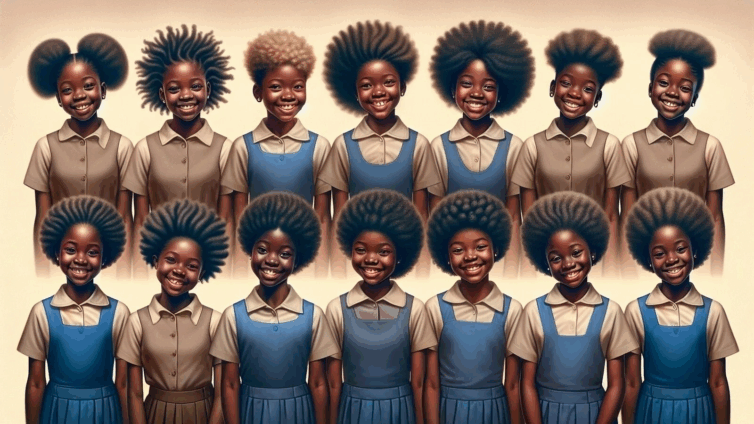
Over the weekend, the Minister for Education, Haruna Iddrisu, instructed the Ghana Education Service to enforce strict hair grooming rules in senior high schools, a directive that has generated significant public discussion. Critics argue that policy attention should focus on substantive reforms rather than appearance. This article situates hair regulation within the wider educational philosophy of uniformity and shows that, when implemented fairly and with rights safeguards, grooming rules can promote social balance, focus, and collective identity.
In Ghana’s secondary schools, students come from households of both limited and substantial means. Where appearance is unregulated, social competition can intensify. Some families finance elaborate hairstyles, while others cannot. The result is what Bourdieu (1984) calls symbolic distinction, where visible markers of taste reproduce subtle hierarchies that undermine equal opportunity, contrary to Article 25(1) of the Constitution of the Republic of Ghana (1992). Schools therefore employ uniformity in dress, grooming, and conduct to level differences and cultivate shared identity.
This aligns with Jackson’s (1968) hidden curriculum, through which schools transmit norms of respect, order, and discipline, and with Durkheim’s view that moral education depends on common standards that bind individuals into a community (Durkheim, 1956). From this perspective, hair rules support belonging and responsibility while dampening status display, conditions that empirically sustain academic achievement.
Empirical work is consistent with this logic. In Ghana, Navei (2025) shows that schools view grooming as central to moral formation and institutional identity, even as tensions emerge when rules meet rights claims. In Kenya, Evans and Ngatia (2021) find that structured appearance policies, including hair codes within uniform provision, increase attendance and reduce peer-status pressures, improving classroom focus. International practice supports the same principle.
Across Britain’s comprehensive schools, Japan’s classrooms, and Singapore’s national system, appearance regulation is common, although not legally mandated or identical in form. The guiding norm of neat and moderate hairstyles is widely institutionalised as part of discipline and school identity. In 2021, the mother of a British-Ghanaian boy, Farouk James, publicly reported challenges securing admission for her son in England because several schools required trimmed hair for boys, illustrating how enduring and contested such expectations can be in otherwise liberal systems.
However, fairness and proportionality are essential. Courts across the region have held that grooming codes cannot override fundamental rights where they intersect with religion or culture. In Antonie v Governing Body, Settlers High School (South Africa, 2002), Ex parte Makeda Mbewe and Ishmael Nansolo v Ministry of Education (Malawi, 2017–2020), and Tyron Iras Marhguy and Oheneba Nkrabea v Achimota School (Ghana, 2021), blanket hair-cutting rules were found unconstitutional when they imposed unequal burdens on students whose natural or dreadlocked hair expressed religious or cultural beliefs. These decisions do not reject grooming as pedagogy; they define its constitutional limits and affirm that equality under religion and culture, not fashion or individual preference, is the legitimate basis for exception.
Hair grooming policies in our schools should therefore be viewed neither as colonial relics nor as instruments of suppression, but as elements of a broader pedagogical tradition aimed at cultivating equality, discipline, and moral purpose. The real challenge is to interpret and enforce hair-grooming rules with sensitivity and proportionality, preserving discipline while upholding the rights and dignity of every learner. Education is meant to shape the mind, not to decorate the mirror.
*****
The writer is a lecturer at the University of Education, Winneba & Former Director-General of the National Council for Curriculum & Assessment.
Latest Stories
-
OnlyFans owner Leonid Radvinsky dies at 43
5 hours -
Nigerian police arrest 15 after viral videos of alleged sexual assault at festival
5 hours -
Ethnic, political exclusion, not theology alone drives Muslim sectarian violence in Ghana, KNUST study finds
5 hours -
Semenyo reports to Black Stars camp after Carabao Cup win
6 hours -
Journalism out loud: Defending truth in a divided world
11 hours -
Heath Goldfields partners local firm, receives new mining fleet to revive Bogoso-Prestea mine
11 hours -
Korle-Bu overcrowding driven by broken referral system, not just bed shortage – Doctors
11 hours -
MC Portfolio named red carpet host for 2026 Ghana Music Awards USA
11 hours -
Oda-Akyem Swedru road develops dangerous potholes
11 hours -
U.S. Embassy explains Visa process for Ghanaians ahead of World Cup
12 hours -
Viral video on emergency care at Korle-Bu Teaching Hospital is ‘authentic’ – Emergency Medicine Residents
12 hours -
Ahmad Abdul-Samad, Rachael Quarcoo dominate 1st quarter All Ghana Badminton Championship
12 hours -
ActionAid calls for strong partnerships to advance water, gender, and climate justice
12 hours -
DVLA begins nationwide clampdown on expired DV plates from March 24
12 hours -
Ghanaian Commonwealth Youth Leader meets King Charles III, pushes for youth economic empowerment
13 hours