

Audio By Carbonatix
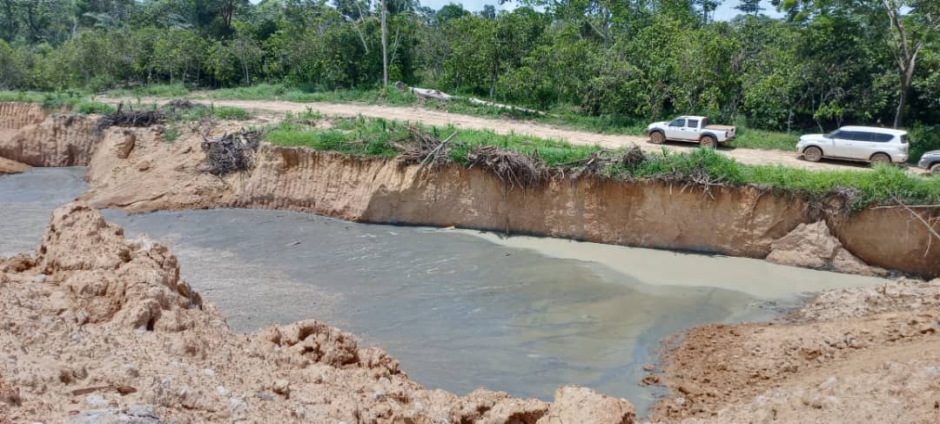
Activities of illegal small-scale miners have made the Aboabo stream found in the Asutifi district of the Bono Ahafo region dangerous to the health of residents.
That is one of the findings from a study by the materials engineering department of the Kwame Nkrumah University of Science and Technology.
The study which assessed the impacts of illegal small-scale mining activities on the water quality was published in the journal of Earth Sciences Malaysia.
Samples of the stream water, sediments and plants around the stream were collected from three points which were the upstream, mid-stream and downstream for analyses.
Apart from the high cloudiness of the river, the scientists found contaminations with harmful bacteria like E-coli and heavy metals like Mercury.
“Faecal coliforms and E-coli readings exceed the permissible limit of 5 NTU and 0 MPN/100ml respectively as required by Ghana’s Environmental Protection Agency and World Health Organisation (WHO).
“Total suspended solids readings at the midstream were higher than the permissible limit. However, levels of total dissolved solutes and dissolved oxygen recorded, were below the limit.
“The sediments were also heavily polluted with Mercury, Arsenic and Cadmium,” lead scientist, Ebenezer Asante Boafo Brobbey, said.
There was, however, a ray of hope as the scientist found plants like the Christmas bush scientifically known as Alchornea cordifolia could salvage mercury from the river.
“Alchornea cordifolia, Chromolaena odorata and Spigella anthelmia growing within the stream were taken to assess their efficiency in removing the heavy metals from the stream. It was observed that the plants species had bioaccumulation factor (BF) greater than 1 for cadmium.
“Alchornea cordifolia was the only plant with BF greater than 1 for mercury. The plants species are potential hyper accumulators for mercury and cadmium hence are suitable for phytoremediation,” he said.
The scientists are advising the residents to desist from using these untreated streams as a source of drinking water to prevent any future bacterial epidemics.
They again advice that effluents from the illegal mining activities be diverted from entering the stream.
Waste rock dumps should be sited far away from the stream to avoid contamination by run-off water from the waste rocks.
Latest Stories
-
Nearly 2,000 displaced, schools damaged as windstorm wreaks havoc in Gushegu
3 minutes -
Ghana’s Derrick Kohn to work under Marie-Louise Eta as she becomes first woman to coach men’s Bundesliga team
8 minutes -
Accra Open Championships conclude with strong performances ahead of African Championships
15 minutes -
Ghana to begin camping with 12 athletes after Accra Open Championships – Bawa Fuseni
36 minutes -
Anthony Joshua declines showdown with Tyson Fury but admits they ‘probably’ clash next
49 minutes -
Tyson Fury dominates Makhmudov, calls out Joshua next
1 hour -
I have supported highway authority financially to fix roads in my constituency – A Plus
2 hours -
US, Iran fail to reach peace agreement after marathon talks in Pakistan
3 hours -
ECG kicks off Phase Two of transformer upgrades at Lashibi; brief outages expected
3 hours -
Port crises loom as 11,000 drivers threaten four-day strike
4 hours -
A source of excellence across generations – Vice President Opoku-Agyemang lauds Mfantsipim
5 hours -
(Photos) Mfantsipim School launches historic 150th anniversary
5 hours -
Knights and Ladies of Marshall group backs Catholic Bishops’ stance on anti-LGBTQ+
6 hours -
Bright Simons: All the Filla in the Ibrahim Mahama/E&P – Gold Fields Saga
7 hours -
Monetise Idiocy In Ghana
7 hours