

Audio By Carbonatix
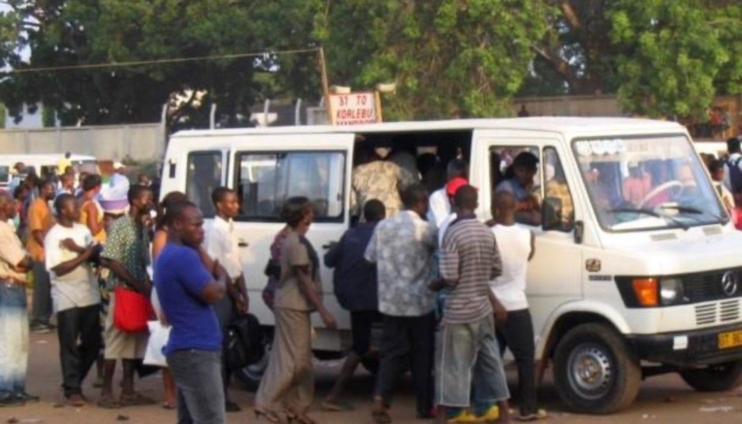
As transport becomes scarce and fares surge beyond approved rates in the evenings, a group of young men in Kumasi has taken it upon itself to protect commuters from what they describe as routine exploitation by some commercial drivers.
The group, known as the ‘Sua Nyansa’ Movement, operates at major lorry stations, junctions and roadside stops across the city, particularly between 6:30pm and 9:00pm, when commuters struggle most to find vehicles home.
“Sua Nyansa” — an Akan phrase meaning “learn sense” or “be sensible” — reflects the group’s message to drivers accused of charging excessive fares and engaging in the widespread “short-short” transport system.
Speaking to JoyNews, Yaw Boakye, a tailor and member of the movement, said collective action became necessary after individual protests failed to stop the practice.
“We used to fight in vehicles individually, but the problem never stopped. Drivers kept charging beyond the approved fares, especially to market women and men, so we decided to come together and face it collectively,” he said.
Members of the group work as tailors, traders and artisans during the day but volunteer their evenings to monitor transport fares and intervene when commuters are overcharged.
According to Balak, one of the movement’s co-founders, the evening scarcity of vehicles gives drivers the upper hand.
“That scarcity gives drivers the opportunity to choose where they want to go and how much they want to charge. When we ask them to take the normal fare, many refuse to cooperate, and some of our members have even been attacked while defending commuters,” he explained.
The group says its activities are driven by years of frustration with a system they believe unfairly targets traders and vulnerable commuters, particularly market women.
At Kejetia Market, the movement enjoys strong backing from traders. Agyekum Kuffuor, who sells beads and traditional ornaments, said his involvement was inspired by concern for older commuters.
“Drivers have been cheating our parents for long. So we decided that as long as we are in town in the evenings, we will fight for normal fares for our parents,” he said.
His mother, Mrs Williams, admitted she was initially worried about his safety but later became supportive.
“As a mother, I used to be scared. I always advised him to be careful,” she said, adding that her fears eased after seeing support from the Police and the Kumasi Metropolitan Assembly (KMA).
Another trader, Bright, who serves as the group’s Public Relations Officer, stressed that the movement is not against drivers earning a living.
“We are not against drivers working. Our concern is the intimidation through inflated transport fares. Commuters know the approved fares to their destinations, yet some drivers still charge more,” he said.
He noted that the situation worsens after 6:00pm, when many station vehicles stop operating, leaving commuters at the mercy of “short-short” drivers. Bright called on government authorities to introduce more buses or alternative solutions to ease evening transport challenges.
Beyond transport advocacy, the ‘Sua Nyansa’ Movement has expanded into community service, recently organising a Sanitation Day and Health Walk that began at the Manhyia Palace, drawing support from residents and local authorities.
Despite resistance from some drivers, the group says it remains committed.
“Not all drivers accept it when we demand the normal fare. But we will continue to stand with market women, men and commuters,” Balak insisted.
As night falls and Kumasi commuters search for their final ride home, the presence of the ‘Sua Nyansa’ Movement has become a reassuring sight — a reminder that, at least for a few hours each evening, someone is watching and ready to say firmly and collectively: “Sua nyansa.”
Latest Stories
-
Strong Day 1 turnout sets tone for Day 2 of Republic Bank-JoyNews Habitat Fair Clinic
29 minutes -
Ghana Army warns new soldiers against social media misuse, uniform abuse
35 minutes -
AMA calls for science-led action to tackle environmental health risks in Accra
48 minutes -
He entered at eight. He is now 16: Ghana’s children growing up in prayer camps
5 hours -
‘Development must not always begin from Accra’ — Anwelle Foundation launched in Jirapa
5 hours -
PKO trio eye victories at Odwira Festival
7 hours -
346 Ghana Navy recruits pass out after 26 weeks of intensive training
7 hours -
Newsfile to discuss EOCO-MP arrest, drug trafficking, speech arrests and $235m water debt
8 hours -
JoyNews gets results as listeners raise GH¢40,000 to help 17-year-old student with cerebral palsy attend SHS
8 hours -
Vice President calls for stronger local pharmaceutical production to reduce medicine imports
9 hours -
The brewing tension at KNUST; Beware the Ides of October….
9 hours -
Health Ministry moves to integrate traditional medicine into mainstream healthcare
9 hours -
550 pupils in Kintampo South get educational lifeline as ‘Seeds of Hope’ reaches farming communities
10 hours -
Opoku Mensah urges Christian Council, House of Chiefs to speak up on democratic freedoms
10 hours -
Teacher unions’ strike: Minority demands immediate payment of teacher arrears, 20% deprived area allowance
10 hours