

Audio By Carbonatix
The Ghana Academy of Forensic Sciences has raised serious concerns about the handling of the remains of the eight people who died in the tragic military helicopter crash on August 6.
The academy's president, Dr Pet-Paul Wepeba, has lambasted the authorities' response, describing the transportation of the victims' bodies in sacks as "undignified" and a dangerous breach of established protocols.
Speaking on Eyewitness News on Friday, August 8, 2025, Dr Wepeba expressed his dismay at the sight of the high-profile victims' bodies being handled in such a manner.
"When it comes to the bodies that were transported, they are humans, for heaven’s sake. For that matter, the situation where they were put in sacks and transported is not a good practice; it doesn’t add up,” he stated.
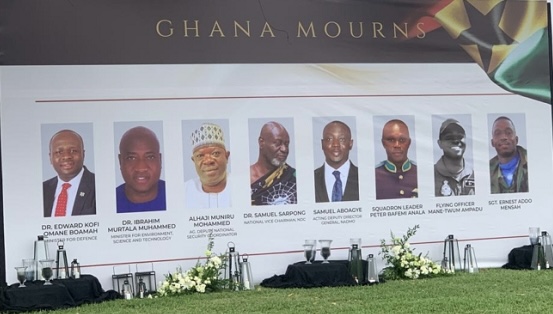
They were accompanied by Muniru Mohammed, Acting Deputy National Security Coordinator; Samuel Aboagye, a former parliamentary candidate; and Samuel Sarpong, Vice Chairman of the NDC.
Tragically, the military crew members, Squadron Leader Peter Bafemi Anala, Flying Officer Manin Twum-Ampadu, and Sergeant Ernest Addo Mensah, also lost their lives in the crash.
Dr Wepeba explained that both international standards and existing Ghanaian protocols mandate the use of specific equipment for such circumstances.
"International best practices, or even in our country, dictate that when situations of this nature occur, we have body bags which come with zips and do not leak. That is dignity. But that wasn’t done,” he stressed.
Beyond the lack of dignity afforded to the deceased, Dr Wepeba warned of a potential public health crisis.
He highlighted that the remains, despite being severely burnt, could still harbour dangerous pathogenic organisms.
This poses a significant risk of infection to those who handled the bodies without proper protective gear.
“There are pathogenic organisms that may have gotten to these individuals who carried them. So, there is some degree of public health hazards associated with it,” he added.
The forensic expert attributed this critical failure to a broader lack of local capacity in managing disaster victim recovery.
He called on key state institutions to improve their emergency preparedness.
"If we had the proper capacity, and there are institutions such as NADMO, police, and the others, they would know what to do when situations such as these arise,” he said.
Latest Stories
-
Apetorku Gbodzi 2026 Festival opens in Dagbamete with development focus
9 minutes -
President Mahama arrives in Lyon to co-chair One Health Summit
16 minutes -
Beverly View Plus Hotel draws crowds amid coastal Easter rush in Volta
16 minutes -
Maiden Zongo Festival held in Wa amid calls to tackle drug abuse among the youth
39 minutes -
FDA warns of fake HIV test kits on Ghanaian market
1 hour -
Africa urged to build resilient health systems as donor support tightens
1 hour -
Easter gesture: Ablakwa settles medical bills for 85 North Tongu constituents
3 hours -
Africa must harness its population strength—Titus-Glover
3 hours -
Visa-free access doesn’t mean unlimited stay – Lom Ahlijah
3 hours -
From Golgotha to Kwahu: The Easter Migration of the Faithful and the Faithless
4 hours -
How the Ghanaian onion traders’ standoff with Nigeria unfolded and threatened local supply
4 hours -
No compensation for demolished structures on 24-Hour Economy market lands — Gov’t to structure owners
5 hours -
Financial Institutions must back local enterprises to spur growth – Deputy Minority Whip
5 hours -
Photos: Gomoa Easter Carnival 2026 ends in a burst of colour and celebration
5 hours -
Gomoa Easter carnival ends in colour as fashion, music and celebrity appearances light up final night
5 hours