

Audio By Carbonatix
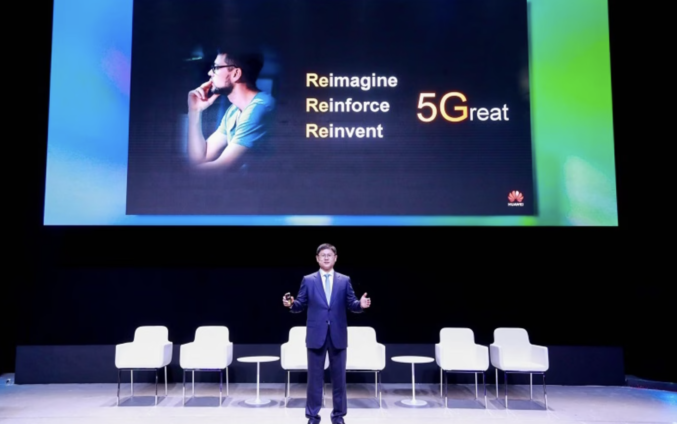
At MWC Barcelona 2023, Huawei showcases leading technologies, new business opportunities, and industry progress in the 5.5G era.
The company aims to work with carriers and industry partners around the world to further the evolution of ICT infrastructure, lay the foundation for the 5.5G era, and build on the success of 5G for even greater prosperity.
At the event, Huawei presents five major characteristics of the 5.5G era: 10 Gbit/s experience, all-scenario IoT, integrated sensing and communication, Level 4 autonomous driving network, and green ICT.
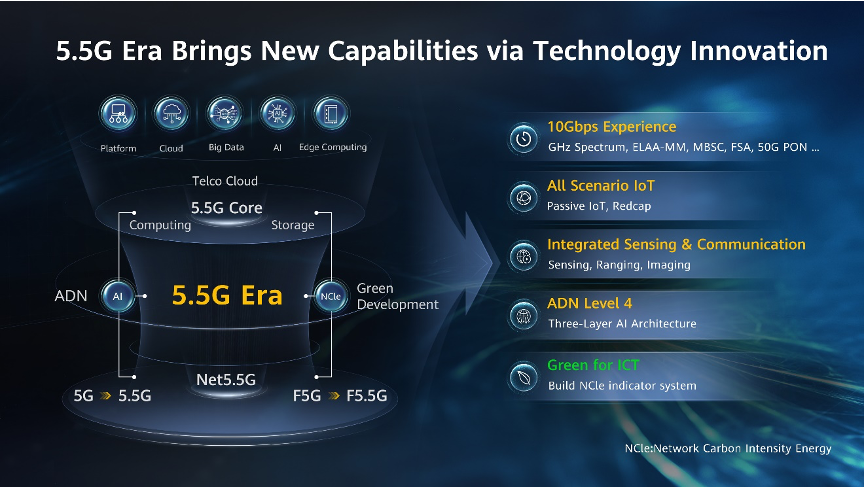
Technological innovation in the 5.5G era will bring operators a 10-fold increase in network performance over 5G.
- 10 times higher experienced speeds: The peak rates experienced by mobile and home broadband users will increase from 1 Gbit/s to 10 Gbit/s, ensuring better experiences in immersive and interactive services.
- 10 times more connections: Passive IoT technology enables an increase in the number of connected things from 10 billion to 100 billion.
- 10 times more deterministic: There will be a 10-fold improvement in latency, positioning accuracy, and reliability.
- 10 times higher energy efficiency: CO2 emissions per terabyte of data transmitted on a mobile network will be reduced 10 times.
- 10 times more intelligent: Autonomous driving networks (ADN) will be upgraded from level 3 to level 4 autonomy, with 10 times more efficient network O&M.
5.5G can help operators open up five new business frontiers and drive a 100-fold increase in new business opportunities.
Frontier 1: Explosion in services with immersive and interactive experiences
3D applications, such as 3D online malls, 24K VR gaming, and glasses-free 3D video, will become mainstream. Services with immersive experiences emerged in the 5G era, but in the 5.5G era, services with both immersive and interactive experiences will become commonplace. With continuous breakthroughs in device technologies and a boom in content, the number of online users of immersive and interactive services in the 5.5G era is expected to exceed 1 billion, a 100-fold increase.
Frontier 2: Further enabling industry digitalisation
As 5G private networks become increasingly capable, their scope of application will expand by 10 times, and the value of each connection in key applications will increase by even more than that. We predict that the number of 5G private networks deployed will increase from 10,000 today to 1 million by 2030. Fibre connections are extending from homes and enterprises to production lines and even production equipment.
Frontier 3: Cloud applications entering a new era, creating new opportunities for network connectivity
Cloud-based and multi-cloud enterprise applications are becoming a new trend. Cloud applications will need real-time, reliable, and easily accessible connectivity, bringing new opportunities to transmission networks, whether they are between edge cloud nodes, between edge cloud nodes and central clouds, or between enterprises and the cloud.
Frontier 4: Cellular networks cover all IoT applications and passive IoT enables 100 billion connections
Passive IoT technology is extending mobile connectivity from high-speed active solutions to ultra-low-speed passive ones. Passive IoT tags can transmit data, and can also be used for positioning and on temperature sensors. Such tags can be used in a wide variety of scenarios, such as automated inventory of warehouse items, agriculture and livestock development, and positioning of personal items. Currently, more than 30 billion passive IoT tags (based on technologies like RFID) are consumed a year. As more industries go digital, the number of passive IoT tags used every year is expected to reach 100 billion.
Frontier 5: From communication to integrated sensing and communication, facilitating new services
5.5G networks with sensing capability can be used extensively in scenarios like a smart city road traffic services and perimeter sensing, making urban infrastructure more efficient and intelligent. For example, in rainy or foggy weather, 5.5G networks can automatically detect obstacles or abnormalities on the road and notify drivers through the maps in their cars one kilometre in advance, making transportation safer.
In July 2022, Huawei released its vision of "Innovation, Lighting up the 5.5G Era". At this year's MWC, together with operators and industry partners around the world, Huawei will explore innovative services and new business opportunities of the approaching 5.5G era.
MWC Barcelona 2023 runs from February 27 to March 2 in Barcelona, Spain.
Latest Stories
-
Prudential Life settles GH¢100,000 medical bills under its PRUCares Valentine Experience Initiative
2 hours -
Wa West Picnic: Peter Lanchene Toobu champions peace, health and unity in landmark celebration
2 hours -
Dr Mensah Market flooded after downpour in Kumasi
2 hours -
Armed men reportedly storm Adjen Kotoku Onion Market amid tensions
3 hours -
Tecco Mensah writes: Why football fans must look beyond statistics
4 hours -
Police recover stolen Honda CR-V in Kumasi within 48 hours
5 hours -
Apetorku Gbodzi 2026 Festival opens in Dagbamete with development focus
5 hours -
President Mahama arrives in Lyon to co-chair One Health Summit
5 hours -
Beverly View Plus Hotel draws crowds amid coastal Easter rush in Volta
5 hours -
Maiden Zongo Festival held in Wa amid calls to tackle drug abuse among the youth
5 hours -
FDA warns of fake HIV test kits on Ghanaian market
6 hours -
Africa urged to build resilient health systems as donor support tightens
6 hours -
Easter gesture: Ablakwa settles medical bills for 85 North Tongu constituents
8 hours -
Africa must harness its population strength—Titus-Glover
8 hours -
Visa-free access doesn’t mean unlimited stay – Lom Ahlijah
8 hours