

Audio By Carbonatix
The 2024 flagbearer of the governing New Patriotic Party (NPP), Dr Mahamudu Bawumia, has pledged to realign government expenditure to prioritise the private sector as a key driver of growth if he is elected president.
This strategic shift aims to foster economic development by leveraging the potential of private enterprises.
As Vice President and Head of the Economic Management Team (EMT), Dr Bawumia highlighted the challenges posed by excessive government borrowing to fund projects.
He noted that such borrowing exerts significant pressure on the country's fiscal stability and adversely affects key micro-economic indicators.
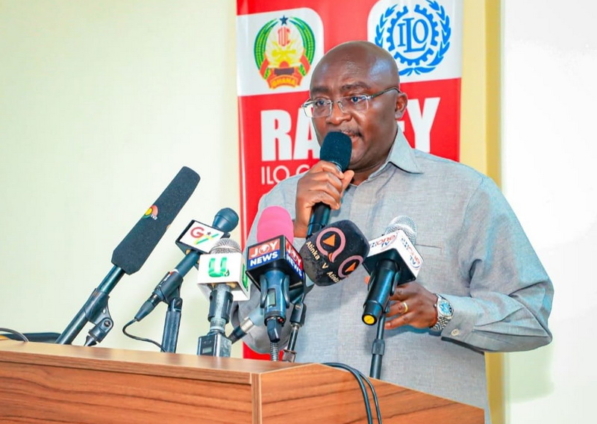
Dr Bawumia shared these insights during a meeting with the leadership of the Labour Union Forum in Accra on Wednesday.
He underscored the importance of addressing the macroeconomic issues to prevent negative repercussions on the micro-economic level.
Emphasising the global implications of economic mismanagement, Dr Bawumia stressed that unresolved macroeconomic challenges inevitably trickle down to impact everyday economic conditions.
His proposed focus on the private sector is designed to create a more resilient and robust economy, capable of withstanding both domestic and international pressures.
“So, when I talk about the government, how it’d reduce the cost of living and create space as far as the fiscal is concerned is very key."
“One of the things that we have done over the years is that the size of government has grown. Some people say it has grown too large but it has grown and the government seems to want to do so much in the economic space, build all the roads, build all the hospitals and everything. In so doing, there is a burden that comes on the government and government is therefore in the process looking to either increase taxes or increase borrowing to do that."
“One of the key things I want to bring about is essentially to realign the government expenditure and bring a part of it towards the private sector,"he said.
Dr Bawumia further remarked that the nation has the capacity to deliver numerous services without resorting to significant increases in government spending.
“The more government expenditure we increase, ultimately we have to tax more or borrow more and when we have to do that, we create less space to increase the condition of service of workers.
“If you have to spend a lot of resources on paying interest on loans and so on, you end up with less that is available for the people who are doing the work,” he added.
Latest Stories
-
Anthony Joshua declines showdown with Tyson Fury but admits they ‘probably’ clash next
7 minutes -
Tyson Fury dominates Makhmudov, calls out Joshua next
27 minutes -
I have supported highway authority financially to fix roads in my constituency – A Plus
2 hours -
US, Iran fail to reach peace agreement after marathon talks in Pakistan
2 hours -
ECG kicks off Phase Two of transformer upgrades at Lashibi; brief outages expected
2 hours -
Port crises loom as 11,000 drivers threaten four-day strike
3 hours -
A source of excellence across generations – Vice President Opoku-Agyemang lauds Mfantsipim
4 hours -
(Photos) Mfantsipim School launches historic 150th anniversary
5 hours -
Knights and Ladies of Marshall group backs Catholic Bishops’ stance on anti-LGBTQ+
6 hours -
Bright Simons writes: All the Filla in the Ibrahim Mahama/E&P – Gold Fields Saga
6 hours -
Monetise Idiocy In Ghana
6 hours -
The Ghanaian prophet and the mysterious death of his scottish wife Charmain Speirs
7 hours -
Nearly 400 sentenced in Nigeria for links to militant Islamists
7 hours -
Ghana’s recovery supported by gold strength despite global oil price pressures – Standard Bank Research
7 hours -
Methodist Church hails Mfantsipim@150; calls for “fresh consecration” to excellence
8 hours