

Audio By Carbonatix
The International Monetary Fund has further lowered Ghana’s growth rate to 1.2%, from the July 2023 forecast of 1.6%.
This is the second time the Fund has revised Ghana’s Gross Domestic Product (GDP) growth for this year.
In April 2023, the Fund predicted a 2.8% growth rate for Ghana in its World Economic Outlook (WEO) Report.
The World Bank had also slightly lowered the country’s growth rate forecast for this year to 1.5%, according to its October 2023 Africa Pulse Report.
The Fund again cited fiscal slippages as a result of high debt and budget deficit, reducing government spending in infrastructure and investments, as major reasons.
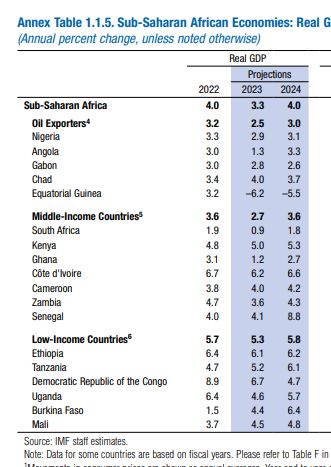
In 2024, the Fund projected a 2.7% expansion of the Ghanaian economy, far lower than the pre-pandemic average of 5%.
Global economy recovers slowly
Meanwhile, the global economy continues to recover slowly from the blows of the pandemic, Russia’s invasion of Ukraine, and the cost-of-living crisis.
In retrospect, the resilience has been remarkable.
“Despite the disruption in energy and food markets caused by the war, and the unprecedented tightening of global monetary conditions to combat decades-high inflation, the global economy has slowed, but not stalled. Yet growth remains slow and uneven, with growing global divergences. The global economy is limping along, not sprinting”, the report stated.
Global growth will slow from 3.5% in 2022 to 3.0 this year and 2.9% next year, a 0.1 percentage point downgrade for 2024 from our July projections.
This remains well below the historical average.
Risks
The report furthered that while some of the extreme risks—such as severe banking instability—have moderated since April 2023, the balance remains tilted to the downside.
“First, the real estate crisis could deepen further in China, an important risk for the global economy. The policy challenge is complex. Restoring confidence requires promptly restructuring struggling property developers, preserving financial stability, and addressing the strains in local public finance”, it stated
Western sanctions on Russian crude oil exports have had mixed effects: export flows of Russian oil have remained fairly steady, and its price discount relative to Brent oil has shrunk over time—Russian oil is trading above the $60 price cap imposed by the Group of Seven (G7) countries—as the size of the non-Western-aligned oil tanker fleet carrying Russian oil has increased, and as Russia appears to have set up its own maritime insurance
Second, commodity prices could become more volatile under renewed geopolitical tensions and disruptions linked to climate change.
Since June, oil prices have increased by about 25%t, on the back of extended supply cuts from OPEC+ (the Organization of the Petroleum Exporting Countries plus selected nonmembers) countries.
Food prices also remain elevated and could be disrupted further by an escalation of the war in Ukraine, causing important hardship for many low-income countries. This, of course, represents a serious risk to the disinflation strategy
(from $96.4 in 2022) and continue to fall in coming years, to $72.7 in 2026 (Figure 1.SF.1, panel 2). The International Energy Agency expects oil demand to increase by 2.2 mb/d, reaching 102.2 mb/d in 2023, outstripping supply in the second half of the year. Uncertainty around this price outlook is elevated (Figure 1.SF.1, panel 3). Upside price risks stem from additional OPEC+ production cuts, a military escalation in the Black Sea, and insufficient investment in fossil fuel extraction. Downside price risks stem from a widespread global economic relapse, a slowdown in Chinese oil demand, and faster penetration of electric vehicles
Latest Stories
-
Ethical Dilemma in Banking: The Case of a Teller in the Cash Cage
2 minutes -
Emceeing is 20% talk, 80% event management – Kafui Dey
3 minutes -
Supreme Court sets April 21 to hear Wesley Girls’ religious rights case
8 minutes -
UniMAC-IF holds workshop on Vertical Revolution: Mastering micro-dramas for African digital economy
12 minutes -
Pan-African Progressive Front hosts landmark online conference ahead of Geneva Forum
17 minutes -
Civil society is not an adversary of gov’t, but partners in nation-building – Mahama
25 minutes -
Defeamekpor calls for interdiction of Land Ministry’s director of finance
29 minutes -
Atebubu Paramount Chief visits NPA boss to strengthen ties
29 minutes -
TGMA Group of the Year nominees to be announced this week – Robert Klah
34 minutes -
Ex-Effia MP writes: Big Push for infrastructure, Small Push for people
35 minutes -
Interior Minister demands probe into GH¢3m payments made outside GIFMIS
38 minutes -
Ex-Defence Ministry procurement director to face prosecution over GH¢4.8m scandal
53 minutes -
Gov’t committed to finishing Tema Motorway by 2027, says Agbodza
60 minutes -
OSP under threat from political interference — Kissi Agyebeng calls for constitutional protection
1 hour -
T.I. Ahmadiyya SHS, Kumasi, celebrates 75 years of excellence
1 hour