


Audio By Carbonatix
Afrobeat traces its origin to 1920s Ghana, when traditional West African styles came together with jazz and other genres to create a new form of rhythmic and vocal expression. Identifiable for its horns, percussion and chanting, Afrobeat songs are lengthy, infectious and made for dancing.
But it was the provocative and prolific Nigerian musician Fela Kuti who spread the sound to the world, from the 1960s until his death in 1997. To this day, Kuti remains synonymous with the genre, as does his message of pan-Africanism, post-colonialism and liberation -- especially potent during a time when African nations were becoming independent from European rule.
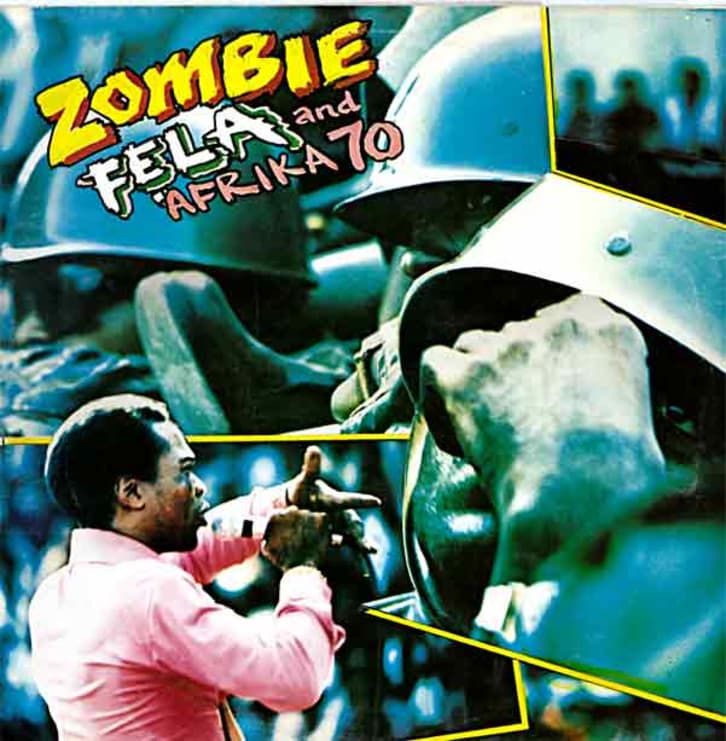
To Kuti and many of his contemporaries and fans, Afrobeat wasn't just a musical style: It was a movement.Kuti's political views were boldly reflected in his album covers, which saw satire, traditional and modern symbols, and stories from Kuti's own life collaged together with hand-drawn illustrations and heavily stylized typography.
Much like the music itself, the cover art was dynamic and impossible to ignore, and became part of Afrobeat's global image.
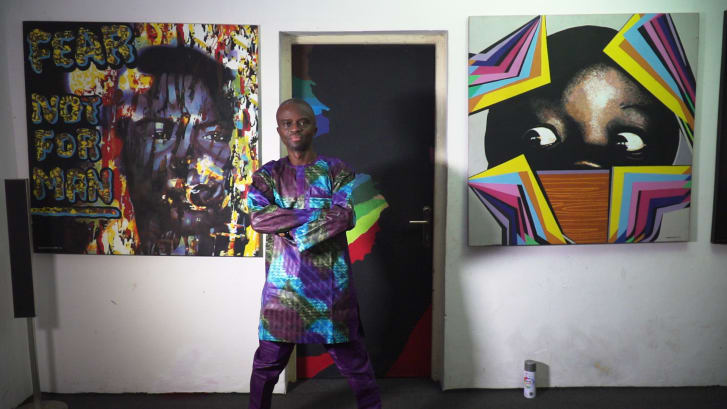
The most memorable of these are attributed to one man: Lemi Ghariokwu. The self-taught Nigerian artist, who first met Kuti -- 17 years his senior -- when he was fresh out of secondary school in 1973, was responsible for the bold graphics that accompanied hits like "Beast of No Nation," "Zombie" and "No Bread." (He previously spoke to CNN at length about his most iconic covers.)
"I designed 26 covers while he was alive and created a movement of the art and the music. So that collaboration between the aural and visual aesthetics," the artist, who goes by Lemi, told CNN during a recent interview at his Lagos studio. "I laid the template for that."
Lemi always knew he'd be an artist; he remembers napping and doodling his way through math class as a child. While he excelled in sciences, he resisted pressure from his father, a plant worker with a primary school education, to become an engineer.
"A child comes like an empty cassette, a blank CD. So parents, out of love and sometimes sheer ignorance, they enforce their dream on the child. It's like parents force religion on every child," he said. "So my dad had a dream... but art was my passion."

After finishing secondary school, Lemi knew he was done with formal education, denouncing the system as an "education for servitude" set up by colonial powers. Instead of going to university, he bought books that expanded his view of history, spirituality, politics, metaphysics and art -- at Kuti's suggestion.
"His key point was... if you go through that miseducation system, you will lose your originality and your identity," Lemi, who called Kuti his mentor, said. "Fela advised, 'Read, study on your own. Pick what you want. Read about the so-called great masters.' That's what I did. I bought books and I took my path."
While his mother was always supportive, Lemi says his choice of career initially confounded his friends and upset his father. But he held strong, and found a way to use his art to explore the political ideas he was learning about and discussing with Kuti.
Over the course of his career, Lemi, who describes his style as "Afro-art Beat," has designed more than 2,000 album covers. But he also has a thriving graphic design and fine art practice, and has exhibited in Lagos, New York and London. What unites his work is a sense of political purpose and duty.
"I work with revolutionaries. I adore their warrior spirits. All my heroes are warrior spirits," he said, listing Kuti, Malcolm X, Peter Tosh and Patrice Lumumba, among others, as inspiration. "I'm not a warrior spirit. I'm an evolutionary... As an evolutionary I believe we need to package things properly, work on them. Now, with time, it will grow."
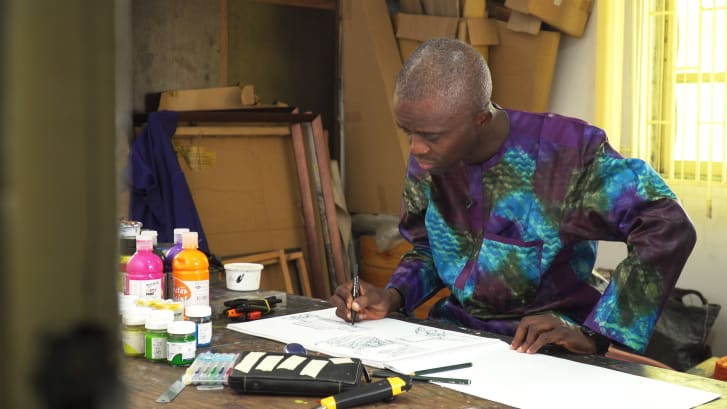
What conscientious artists like him can contribute, Lemi believes, goes beyond just selling music or paintings.
He speaks with admiration of artists like the late South African singer Miriam Makeba and Nigerian performer Burna Boy, who use their work and platform to spread awareness about the political and social times they inhabit. True iconoclasts, he suggests, offer necessary divergent perspectives at times when social discourse is dominated by political or religious majorities.
"Rebellion is (art's) purpose," Lemi said. "We can learn a lot about society from art and artists, creatives generally, because their purpose is to serve, to tell a story, the narrative, from our own environment... It's like writing down history."
Latest Stories
-
Producer price inflation stood at 1.4% in February 2026
4 hours -
NPLs remain key risk to banking industry – BoG
4 hours -
Consumer confidence, business sentiments improve – BoG
4 hours -
BoG assures cedi stability despite Middle East crisis
4 hours -
Sony removes 135,000 ‘deepfakes’ of its artists’ music
5 hours -
Winston Yeboah Danso supports Fafali Girls with GH₵10,000 donation ahead of Street Child World Cup
5 hours -
Oil nears $110 a barrel after gas field strike
5 hours -
Ghana’s economy now resilient enough to withstand external shocks – Mahama
5 hours -
Cocoa price adjustment painful but necessary to sustain sector – COCOBOD CEO
5 hours -
No single African country will be treated in a manner that is preferential or advantageous – Patrice Motsepe
6 hours -
Removal of GH₵1 levy won’t automatically lower pump prices – Arko Nokoe
6 hours -
Decision to strip Senegal of AFCON title reflects independence of institutions – CAF President
6 hours -
Energy Committee Vice Chair assures Ghanaians on stability amid fuel prices
7 hours -
Mahama hails 48 Engineer Regiment after successful disaster recovery mission in Jamaica
7 hours -
Rising crude prices expose flaws in ‘One Ghana Cedi’ levy – NPP MP
7 hours