

Audio By Carbonatix
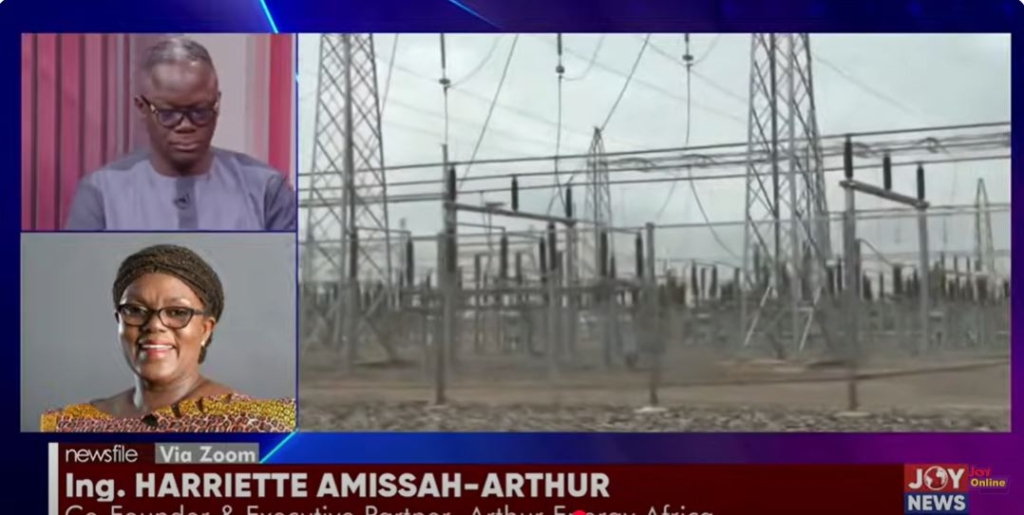
Co-Founder and Executive Partner of Arthur Energy Africa, Harriette Amissah-Arthur, has attributed Ghana’s recurring power sector crisis to longstanding inaction and poor accountability rather than solely financial constraints.
Speaking in an interview on JoyNews' Newsfile on Saturday, May 17, the expert stressed that the root of the energy sector’s problems lies in a failure to take deliberate, structured action over the years.
"I think that if you look at what has been happening over the decades now, the problems we're facing with our power sector are a combination of inaction on our part as Ghanaians," she noted.
Her comment comes after the Energy Minister John Jinapor warned of an imminent nationwide power crisis, revealing that Ghana has less than three days of liquid fuel left to operate its power plants.
Appearing before Parliament’s Energy Committee, he stated that the country urgently requires over GH¢1.1 billion to procure fuel and settle a $1.7 billion debt owed to Independent Power Producers (IPPs). He also noted that Karpower, a key power provider, has threatened to halt operations if payments are not made promptly.
According to Madam Amissah-Arthur, the energy sector has operated with a flawed model that neglects basic business principles, such as cost recovery and accountability.
She criticised the current system, which fails to track energy consumption across sectors or quantify subsidies for critical public services like hospitals and educational institutions.
Madam Amissah-Arthur argued for intentional policy decisions where such facilities are clearly identified and the cost of subsidising them is shared transparently among other consumers.
“Every unit of power must be accounted for,” she insisted. “Operators should be able to tell us how much power goes into street lighting, educational institutions, or hospitals, and how much is lost due to non-payment or technical issues. Right now, everything is lumped together, and we’re just guessing.”
The Co-Founder and Executive Partner of Arthur Energy Africa also highlighted overlooked areas of loss in the sector, such as inefficiencies in procurement and the purchase of power capacity at costs above international benchmarks.
“Globally, we have benchmarks for power procurement. If we're paying above that, we need to justify it with clear reasons,” she added.
Latest Stories
-
Paramount boosts Warner Bros offer to rival Netflix in takeover bid
49 minutes -
Death toll from Brazil floods rises to 46; 21 people still missing
1 hour -
US will not allow Venezuelan government to pay Maduro’s legal fees, lawyer says
1 hour -
US denies visas to Cuban baseball officials ahead of international tournament
1 hour -
Islamist militant attacks on Niger, Benin and Nigeria border zone soaring, research shows
2 hours -
Bill Gates ‘took responsibility’ over Epstein ties in staff meeting, foundation says
2 hours -
Real Madrid win ‘for everyone who stands against racism’
2 hours -
Galatasaray hold off Juventus in epic extra-time thriller
2 hours -
Vinicius Jr scores as Real Madrid beat Benfica
2 hours -
World Cup security concerns over funding freeze
2 hours -
Two SWESBUS students remanded for two weeks over assault on Obrachire SHS student
4 hours -
Accra Circuit Court grants alleged robber, receiver bail of GH¢50K each
4 hours -
Fake soldier in GH¢192K fraud case granted bail
5 hours -
Nkwanta South police retrieves over 7,000 parcels of India hemp following Jasikan Court order
5 hours -
Six Aggrey Memorial students arrested over assault on Adisadel student
5 hours