

Audio By Carbonatix
The State of Israel has expressed disappointment in the Government of Ghana for abstaining from a vote supporting a declaration that Iran is in breach of its nuclear non-proliferation obligations.
On Thursday, 12 June 2025, the 35-member Board of Governors of the International Atomic Energy Agency (IAEA), chaired by Ghana, adopted the resolution for the first time in almost 20 years, raising the prospect of Iran being reported to the United Nations Security Council.
According to the resolution text, as seen by Reuters, “[The board] finds that Iran’s many failures to uphold its obligations since 2019 to provide the Agency with full and timely cooperation regarding undeclared nuclear material and activities at multiple undeclared locations in Iran … constitutes non-compliance with its obligations under its Safeguards Agreement with the Agency.”
This decision follows years of tension between the IAEA and Iran—tensions that worsened after then U.S. President Donald Trump withdrew from the Iran nuclear deal in 2018, leading to the collapse of the agreement. The vote comes amid heightened geopolitical strain, with the U.S. evacuating personnel from the Middle East and Mr Trump warning of growing danger in the region, reiterating that Washington will not allow Iran to acquire nuclear weapons.
Diplomatic sources at the closed-door IAEA meeting confirmed that the resolution, sponsored by the United States, United Kingdom, France and Germany, passed with 19 votes in favour, 11 abstentions, and 3 against—Russia, China and Burkina Faso.
Read Also: IAEA board declares Iran is in nuclear breach
Israel’s response on Ghana
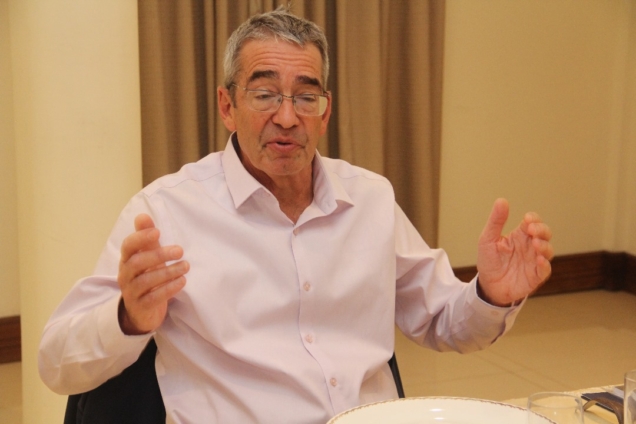
Reacting to Ghana’s decision in an interview with some journalists at his residence in Accra, the Israeli Ambassador to Ghana, Sierra Leone and Liberia, Mr Roey Gilad, voiced his government’s dismay. He said Israel had counted on Ghana, described as a longstanding friend, to support the resolution.
“Ghana abstained in the vote at the IAEA. Eventually, 19 States voted that Iran is in non-compliance with its nuclear programme. We’ve lobbied Ghana very strongly to support the resolution, yet Ghana abstained,” Ambassador Gilad said during a press engagement at his residence in Accra.
He described Iran’s nuclear activities as a global threat and called on Ghana to reconsider its traditional non-aligned stance in such critical matters.
“Iran is completely for the destruction of the Jewish sovereign State of Israel—a State Ghana has considered a good friend since 1957. We thought this was one place where Ghana could express its support for Israel and vote for the non-compliance. It did not happen, and we’re disappointed,” the ambassador added.
Although Ghana’s abstention is in line with the IAEA convention, where the Chair of the Board typically abstains from voting, Ambassador Gilad believes this was a missed opportunity.
“The formal reason is that Ghana is the Chair of the Board of the IAEA, but we felt this is something so crucial to Israel that it warranted an exception,” he stated.
Rethinking Non-Alignment
Ambassador Gilad stressed that Israel respects Ghana’s sovereign decision-making, but urged a re-evaluation of Ghana’s non-aligned policy—particularly when global security is at stake.
“As much as we have full respect for the sovereign decision-making process in Ghana, including the Foreign Affairs Ministry, we believe that the traditional policy of non-alignment that has existed here since 1957 under Nkrumah should be reconsidered.”
“We do it in Israel day in and day out. We check ourselves and our policies constantly. I humbly say that rethinking non-alignment could be healthy for Ghana too,” he added.
No Impact on Bilateral Relations
Despite the setback, Ambassador Gilad was quick to assure that it would not damage the strong Ghana-Israel relations.
“This is not going to cast a heavy shadow on our relations, but we cannot ignore it. We believe in mature relationships, and mature partners must be able to openly discuss and address disagreements. We’ve done it before, and we’ll do it again,” he concluded.
The IAEA, founded in 1957, is the UN’s specialised agency responsible for promoting the peaceful use of nuclear energy while working to prevent the spread of nuclear weapons.
Latest Stories
-
Journalists look back on a decade of breast cancer reporting in Ghana
21 minutes -
President Mahama ends Resetting Ghana tour of Ahafo Region
2 hours -
African negotiators seek delivery of climate commitments at COP31
2 hours -
BoG develops AI rules for financial sector
2 hours -
‘Big Push’: Government assures contractors of prompt payments
2 hours -
Court fines miner for breaking into gold buying shop
3 hours -
Tarkwa court jails labourer for three years over GH¢123,000 theft
3 hours -
GAEC must retain nuclear scientists for Ghana’s nuclear ambitions – Minister
4 hours -
Man reportedly mistaken for game and shot by hunter dead in forest
4 hours -
19-year-old mason jailed 15 years for defiling seven-year-old pupil
4 hours -
Ghana’s banking sector assets rise 20.47% to GH¢500.2bn – BoG Governor
4 hours -
22 injured as Sprinter bus overturns at Sege after tyre burst
4 hours -
UN housing expert urges Ghana to strengthen Rent Control Department amid housing affordability concerns
4 hours -
Delta-BCI partnership reaches 166,000 people with breast cancer education
4 hours -
Power restoration fault suspected in Kumasi Central Market fire
10 hours