

Audio By Carbonatix
Former Israeli Prime Minister Benjamin Netanyahu is on the brink of a dramatic comeback, after partial results showed he was on course to win a majority in parliament with the far right's help.
With 84% of votes from the general election counted, Mr Netanyahu's bloc is set to win 65 out of 120 seats.
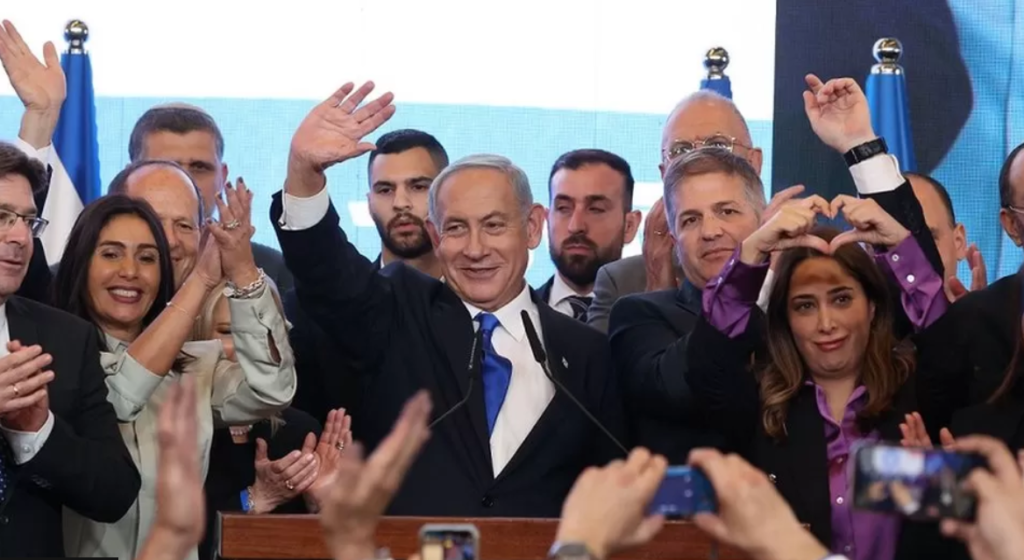
"We are close to a big victory," he told jubilant supporters in Jerusalem.
However, he will be dependent on the support of the ultra-nationalist Religious Zionism party.
Its leaders, Itamar Ben-Gvir and Bezalel Smotrich, have gained notoriety for using anti-Arab rhetoric and advocating the deportation of "disloyal" Arab politicians or civilians.
Mr Ben-Gvir was a follower of the late, explicitly racist, ultra-nationalist Meir Kahane, whose organisation was banned in Israel and designated as a terrorist group by the United States. Mr Ben-Gvir himself has been convicted of incitement to racism and supporting a terrorist organisation.
Last month, Mr Ben-Gvir hit the headlines when he was filmed pulling out a gun after being targeted with a stone thrown by Palestinians while visiting a predominantly Arab area of occupied East Jerusalem, and calling for police to shoot the culprits.
Speaking to reporters on Wednesday, Mr Ben Gvir promised to "work for all of Israel, even those who hate me".
Mr Netanyahu, accompanied by his wife Sara, appeared at his Likud party's election night venue at 03:00 local time (01:00 GMT) on Wednesday to thunderous applause.
"We have won a huge vote of confidence from the people of Israel," he told his cheering supporters.
Hours earlier, when exit polls predicted that Mr Netanyahu's bloc would win 61 or 62 seats, the room had been a scene of celebration as people jumped up and down, waved flags and chanted his nickname, Bibi. One man repeatedly blew a shofar, or ram's horn, a ritual instrument used by some Jewish people at times of special significance.
At his party's camp in Tel Aviv however, current Prime Minister Yair Lapid told his supporters that "nothing" was yet decided and his centre-left Yesh Atid party would wait for the final results.
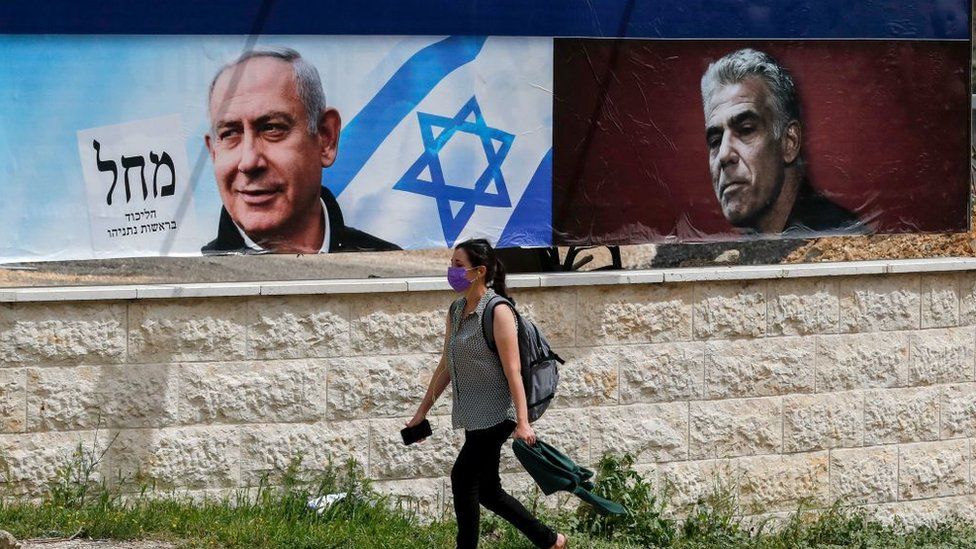
Mr Netanyahu, 73, is one of Israel's most controversial political figures, loathed by many on the centre and left but adored by Likud's grassroots supporters.
He is a firm supporter of Israel's settlement-building in the West Bank, occupied since the 1967 Middle East war. Settlements there are considered illegal under international law, though Israel disputes this.
He opposes the creation of a Palestinian state in the West Bank and Gaza Strip as a solution to the Israel-Palestinian conflict - a formula supported by most of the international community, including the Biden administration in the US.
Mr Netanyahu is also currently on trial for alleged bribery, fraud and breach of trust - charges he fiercely denies. His possible partners in a Likud-led coalition government have said they would reform the law, in a move which would bring a halt to his trial.
According to the partial results, Likud stands to be the biggest party, with 31 seats, commanding a majority with the support of nationalist and religious parties.
Yesh Atid, which led the coalition which brought down Mr Netanyahu in elections last year, is projected to win 24 seats.
Religious Zionism appears to have won 14 seats, which would make it the third largest party.
"It will be better now," said Religious Zionism supporter, Julian, at the party's venue in Jerusalem.
"When [Religious Zionism politician Itamar Ben-Gvir] will be minister of public security, it will be even better - he'll bring back security to the people of Israel. That's very important."
However, political scientist Gayil Talshir, from the Hebrew University of Jerusalem, warned that if the exit polls "reflect the real results, Israel is on its way to become Orban's Hungary", recently branded an "electoral autocracy" by the EU.
If Mr Netanyahu can secure a majority, it will stave off the prospect of a sixth election in just four years after analysts predicted deadlock.
It would mark a remarkable turnaround for Mr Netanyahu, whose political future was widely written off after Mr Lapid formed an unlikely alliance of ideologically diverse parties to take power in June 2021, with the uniting aim of making it impossible for Mr Netanyahu to form a government.
At the time, Mr Netanyahu vowed to bring it down as quickly as possible and one year later the coalition government concluded it could not survive and collapsed after resignations meant it no longer had a majority.
Latest Stories
-
FABAG commends Ato Forson’s over removal of 20% excise duty on locally manufactured fruit juices
2 minutes -
HIV stigma discourages testing, prevention and treatment in Ghana – Ghana AIDS Commission
4 minutes -
Blocking cocaine probe lends weight to claims of political protection for traffickers – Assin South MP
8 minutes -
NPP Vice Chair race: I may be the youngest, but most experienced – Nana B
10 minutes -
Last UK and US troops leave Iraq as anti-Islamic State mission ends
10 minutes -
Don’t stay home idle, embrace entrepreneurship while awaiting posting – Unemployed nurses urged
22 minutes -
Aayalolo buses not speeding on contra-flow lanes – GAPTE assures commuters
25 minutes -
Effia MP calls for Kurt Okraku’s removal, overhaul of Ghana football structure
26 minutes -
CAS hearing on AFCON final appeal by Senegalese Football Federation set for October 8
26 minutes -
STC fares to go up by up to 8% this week – Deputy MD
27 minutes -
Photos: Accra-Kumasi bypasses get new lease of life as contractors return to site
27 minutes -
Man allegedly swallows five SIM cards to conceal evidence after arrest
28 minutes -
After three finals, Ayikuma Methodist Basic School finally lifts National Juniors Challenge trophy
28 minutes -
Black Stars management ignored players’ health conditions ahead of Gambia game – Ernest Thompson alleges
29 minutes -
Ghana is 5th largest crypto market in sub-Saharan Africa; annual transactions around $21bn
30 minutes