

Audio By Carbonatix
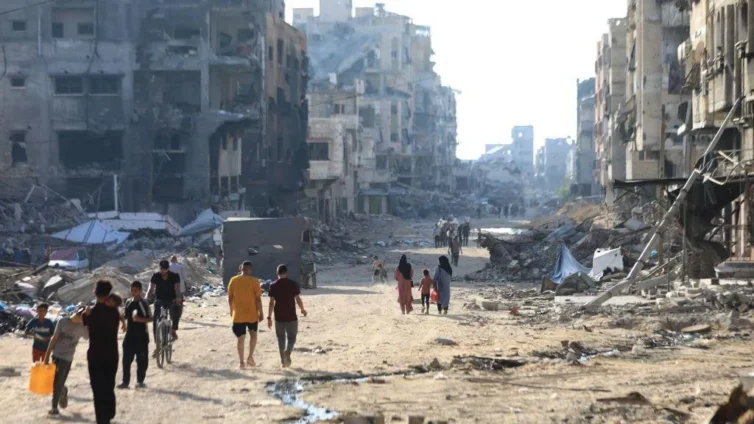
The Israeli military has told all residents of Gaza City to evacuate south to the central Gaza Strip, amid intensified operations in the north.
Leaflets dropped by aircraft instruct "everyone in Gaza City" to leave what is described as a "dangerous combat zone" via designated safe routes - marked as two roads that lead to shelters in Deir al-Balah and al-Zawaida.
The UN has said it is deeply concerned about evacuation orders being given. It is the second time since the war began that Gaza City as a whole has been asked to evacuate.
Over the past two weeks, Israeli forces have re-entered several districts where the military believes Hamas and Palestinian Islamic Jihad fighters have regrouped since the start of the year.
Hamas has said Israel’s renewed activity in the city is threatening to derail negotiations over a potential ceasefire and hostage release deal, which resumed on Wednesday in Qatar. The talks are being attended by the intelligence chiefs of Egypt, the US and Israel, as well as the prime minister of Qatar.
Top Hamas official Hossam Badran told AFP that Israel "is trying to pressure negotiations by intensifying bombing operations, displacement, and committing massacres".
Israeli Prime Minister Benjamin Netanyahu emphasised Israel’s commitment to a deal as long as its “red lines are preserved”.
'I will not leave'
There are estimated to be more than a quarter-of-a-million people still living in Gaza City.
Some were observed evacuating to the south after the Israeli military dropped leaflets there urging them to leave, which an Israel official later told the BBC was a recommendation rather than an instruction.
Others, though, were not willing to leave.
"I will not leave Gaza [City]. I will not make the stupid mistake that others have made. Israeli missiles do not differentiate between north and south,” resident Ibrahim al-Barbari, 47, told the BBC.
“If death is my fate and the fate of my children, we will die with honour and dignity in our homes,” he said.
The Palestinian Red Crescent said it had received calls from some residents who were unable to leave their homes because of the intensity of the bombing.
"The information coming from Gaza City shows residents are living through tragic conditions. [Israeli] occupation forces continue to hit residential districts, and displace people from their homes and refuge shelters," it said.
In a statement issued earlier on Wednesday, the Israel Defense Forces (IDF) said its troops had "conducted a counterterrorism operation" overnight against Hamas and PIJ fighters who were operating inside a headquarters of the UN agency for Palestinian refugees (Unrwa) in Gaza City.
The troops had opened a “defined corridor to facilitate the evacuation of civilians” from the area before they entered the structure and “eliminated terrorists in close-quarters combat”, it added.
There was no immediate comment from Unrwa.
The IDF also said it had killed dozens of fighters in Gaza City's eastern Shejaiya district and dismantled an underground tunnel route over the past day.
Speaking in the Israeli parliament on Wednesday, Defence Minister Yoav Gallant said that 60% of Hamas fighters had been killed or wounded since Israel’s offensive began. The BBC could not independently verify these figures.
On Tuesday, the UN Human Rights Office said it was "appalled" by IDF orders for residents to evacuate to "areas where Israeli military operations are ongoing and where civilians continue to be killed and injured".
It also warned that the Deir al-Balah area was already seriously overcrowded with Palestinians displaced from other areas of Gaza and that there was little infrastructure and limited access to humanitarian assistance.
The Israeli military launched a campaign in Gaza to destroy the Hamas group in response to an unprecedented attack on southern Israel on 7 October, during which about 1,200 people were killed and 251 others were taken hostage.
More than 38,295 people have been killed in Gaza since then, according to the territory's Hamas-run health ministry. Its figures do not differentiate between civilians and combatants, but it had reportedly identified 14,680 children, women and elderly people among the dead by the end of April.
Latest Stories
-
Drug money allegedly finances Ghana’s political parties and real estate – Global Organised Crime Index
3 minutes -
NSA outlines seven steps for successful posting and validation of national service personnel
4 minutes -
GPRTU taskforce clamps down on unapproved fares at Kasoa
5 minutes -
Prime Insight: Making room for meaningful national conversations on Joy Prime
16 minutes -
FABAG commends Ato Forson’s over removal of 20% excise duty on locally manufactured fruit juices
23 minutes -
HIV stigma discourages testing, prevention and treatment in Ghana – Ghana AIDS Commission
25 minutes -
Blocking cocaine probe lends weight to claims of political protection for traffickers – Assin South MP
29 minutes -
NPP Vice Chair race: I may be the youngest, but most experienced – Nana B
31 minutes -
Last UK and US troops leave Iraq as anti-Islamic State mission ends
31 minutes -
Don’t stay home idle, embrace entrepreneurship while awaiting posting – Unemployed nurses urged
43 minutes -
Aayalolo buses not speeding on contra-flow lanes – GAPTE assures commuters
46 minutes -
Effia MP calls for Kurt Okraku’s removal, overhaul of Ghana football structure
47 minutes -
CAS hearing on AFCON final appeal by Senegalese Football Federation set for October 8
47 minutes -
STC fares to go up by up to 8% this week – Deputy MD
48 minutes -
Photos: Accra-Kumasi bypasses get new lease of life as contractors return to site
48 minutes