

Audio By Carbonatix
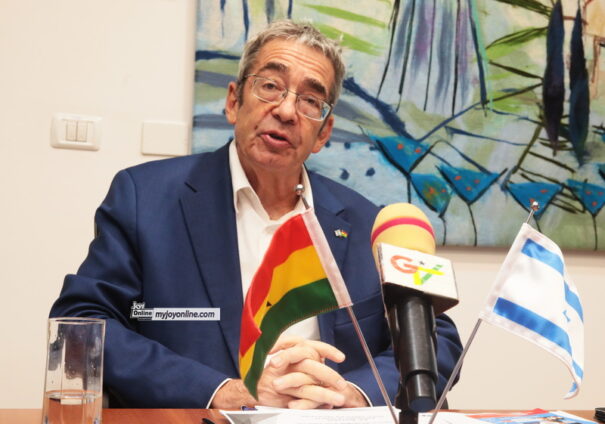
Israeli Ambassador to Ghana, Liberia and Sierra Leone, H.E. Roey Gilad, has described President John Dramani Mahama's description of the war in Gaza as genocide as a mistake, insisting Israel is fighting terrorist organisations, not the Palestinian people.
At a press conference in Accra on Wednesday to provide updates on the Middle East and its implications for Ghana, Gilad said: "President John Mahama's description of the Gaza war as genocide is a mistake.
The Ambassador was responding to President Mahama's address to the 80th United Nations General Assembly in New York on September 25, where Mahama condemned the bombardment and blockade of Gaza and also his recent interview on a Turkish TV channel, TRT World
Mahama told world leaders: "Hundreds of thousands of women and children are being forced into starvation and suffering for no reason other than the fact that they are Palestinian.
Gilad pushed back, saying the situation is "more complex than portrayed" and that genocide is not the correct legal or factual term. “We do not deny that what is happening in Gaza is a tragedy.
But we have to put it in the right context.
The biggest enemy of the Palestinian people is Hamas," he told journalists, according to reports of the briefing . He explained that Gaza is only about 40 kilometres long, wedged between Israel and Egypt, and it was from there that Hamas launched the October 7, 2023 attack.
Taking advantage of Israel's lack of preparedness, Hamas temporarily occupied an area larger than Gaza itself, and it took Israeli forces several days to push them back.
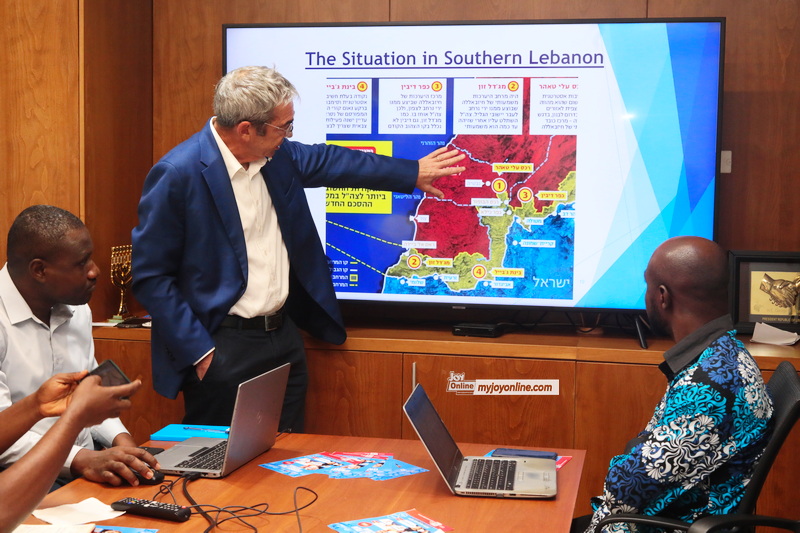
Today, he said, the map has changed. Israel controls the eastern section, while Hamas controls the western section between the yellow line and the Mediterranean Sea. Hamas fighters, he said, had been pushed out of Rafah and Khan Younis and taken shelter among one million civilians in Gaza City. “We must acknowledge that Israel did not succeed in completely dismantling Hamas during the war that followed.
Hamas remains active and is attempting to re-establish itself," Gilad admitted.
His core message was Israel's condition for peace: disarmament. "We are prepared to withdraw to the international border in exchange for the disarmament and decommissioning of Hamas.
If Hamas insists on retaining its weapons, Israel will not withdraw completely.
"We succeeded in pushing Hezbollah fighters north of the Litani River.
Israeli forces remain deployed in the buffer area.
Unless Hezbollah disarms, Israel will not withdraw fully. “Gilad said Israel learnt a painful lesson on October 7: "Once bitten, twice shy." He said Israel can no longer afford to be naïve.
The Ambassador opened the briefing with a calm assessment: "Fortunately, there is no war currently in the Middle East." He said the briefing, nearly six months after the previous one, was necessary because conflicts in the region continue to affect Ghana, mainly economically and to some extent politically.
He argued Israel's main challenge is not neighbouring states Egypt and Jordan, or even Syria and Lebanon, but non-state actors operating within the region."The main source of instability is Iran," he said. Since the current Iranian regime came to power in February 1979, it has publicly committed to ending the Jewish and Zionist sovereign state, which it considers illegitimate.
Iran, he explained, pursues this through the Iranian axis — relying on Shiite groups: Houthis in Yemen who continue to target Israel and disrupt shipping, Shiite militias in Iraq, and Hezbollah in Lebanon, an Iranian proxy whose objective is to undermine Israel.
Disruptions there affect many countries, including Ghana, by driving up transportation costs.
The Houthis, he stressed, receive support and direction from Iran.
But Gilad also pointed to what he called positive developments: the weakening of Iran's influence in Syria after the fall of the Assad regime. Syria is now acting more independently and has begun dialogue with Israel. With Lebanon, he said, Israel and Lebanon are holding discussions, with meetings in Washington and Italy, and may reach an agreement, possibly even a peace agreement. “Our problem is not with Lebanon as a state. It is with Hezbollah, a terrorist organisation based in Lebanon that continues to threaten Israel from our northern border," he said.
Unlike Gaza, where the Palestinian Authority remains weak, Lebanon has a functioning government, though not strong enough to control all territory.
The Lebanese government also wants to address Hezbollah because it is a challenge to Beirut itself.
The IDF is gradually releasing areas to the Lebanese Army.
He said Ghana has a battalion of about 1,000 soldiers serving with UNIFIL — 10,000 personnel — in southern Lebanon.
Many senior officers at Burma Camp have served one or two years there.
UNIFIL's mandate ends December 31, 2026.
Gilad praised Ghanaian troops as professional and serious, but said UNIFIL command as a whole has not always fulfilled its responsibilities, and Hezbollah frequently exploited its limitations.
He explained that Ghana is influential in Africa and the international community and maintains relations with Iran.
He urged Ghana to be part of international efforts to pressure Iran to exercise restraint, stop interfering in internal affairs, and end destabilising activities.
According to him a similar concerns have been expressed by the US and moderate Gulf states — Oman, UAE, Saudi Arabia, Bahrain, Kuwait and Qatar — all of which enjoy strong relations with Ghana. "Bearing in mind Ghana's friendships with Israel, Saudi Arabia, UAE, Qatar and other regional partners, we believe Ghana should support international efforts to pressure Iran," he said.
But for Ambassador Gilad, the genocide label is dangerous because it misreads intent. Israel's intent, he argued, is self-defence and return of hostages, not destruction of a people.
What Ghana needs to focus on, he implied, is not rhetoric but the real economic threat: Iranian-backed disruptions in Hormuz and Bab el-Mandeb that hit Ghana's fuel import bill.
Latest Stories
-
Tiptoe Lane’s tech takeover: The story behind Ghana’s booming informal phone market
45 minutes -
Abanga vows to use social media to counter NDC messaging ahead of 2028 elections
47 minutes -
Okai Mintah seeks Sabah Zita Benson’s support for NDC National Youth Organiser bid
1 hour -
Okai Mintah vows to strengthen NDC campaign machinery ahead of 2028
1 hour -
Mother of four and Jasikan teacher among new Telecel M’ahitti Promo winners
1 hour -
International Youth Shakers Conclave 2026 set to bring global young leaders to London
1 hour -
Gov’t is committed to addressing teachers’ conditions of service, deprived-area allowance – Education Minister
1 hour -
GoldBod’s structure encouraging galamsey – Afenyo-Markin
1 hour -
Tullow starts selling Jubilee, TEN crude to Ghanaian refineries
1 hour -
Local Government Service authorises rationalisation, redistribution of staff
1 hour -
PURC assures consumers of working to ensure quality services in Northern Region
1 hour -
Ghana develops US$4.28bn water financing framework
2 hours -
Christian Council calls for protection of mission schools’ religious identity
2 hours -
Mahama holds discussions with India’s External Affairs Minister
2 hours -
Even when you cough, they come after you — Abanga accuses Mahama govt of criminalising free speech
2 hours