

Audio By Carbonatix
The number of people in Japan aged 100 or older has risen to a record high of nearly 100,000, its government has announced.
Setting a new record for the 55th year in a row, the number of centenarians in Japan was 99,763 as of September, the health ministry said on Friday. Of that total, women accounted for an overwhelming 88%.
Japan has the world's longest life expectancy, and is known for often being home to the world's oldest living person, though some studies contest the actual number of centenarians worldwide.
It is also one of the fastest ageing societies, with residents often having a healthier diet but a low birth rate.
The oldest person in Japan is 114-year-old Shigeko Kagawa, a woman from Yamatokoriyama, a suburb of the city of Nara. Meanwhile, the oldest man is Kiyotaka Mizuno, 111, from the coastal city of Iwata.
Health Minister Takamaro Fukoka congratulated the 87,784 female and 11,979 male centenarians on their longevity and expressed his "gratitude for their many years of contributions to the development of society".
The figures were released ahead of Japan's Elderly Day on 15 September, a national holiday where new centenarians receive a congratulatory letter and silver cup from the prime minister. This year, 52,310 individuals were eligible, the health ministry said.
In the 1960s, Japan's population had the lowest proportion of people aged over 100 of any G7 country - but that has changed remarkably in the decades since.
When its government began the centenarian survey in 1963, there were 153 people aged 100 or over.
That figure rose to 1,000 in 1981 and stood at 10,000 by 1998.
The higher life expectancy is mainly attributed to fewer deaths from heart disease and common forms of cancer, in particular breast and prostate cancer.
Japan has low rates of obesity, a major contributing factor to both diseases, thanks to diets low in red meat and high in fish and vegetables.
The obesity rate is particularly low for women, which could go some way to explaining why Japanese women have a much higher life expectancy than their male counterparts.
As increased quantities of sugar and salt crept into diets in the rest of the world, Japan went in the other direction - with public health messaging successfully convincing people to reduce their salt consumption.
But it's not just diet. Japanese people tend to stay active into later life, walking and using public transport more than elderly people in the US and Europe.
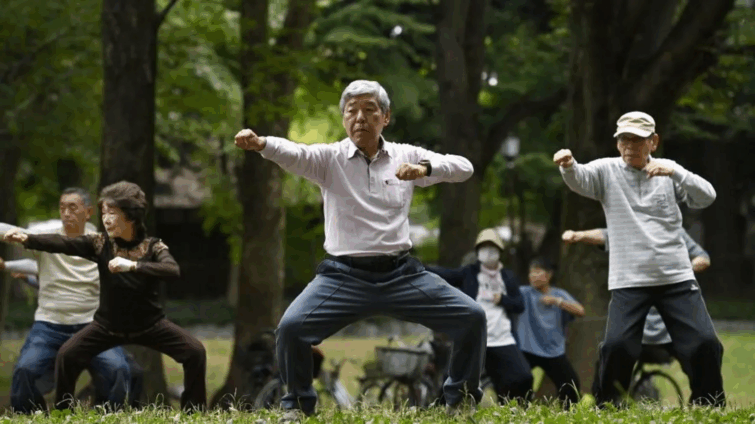
Radio Taiso, a daily group exercise, has been a part of Japanese culture since 1928, established to encourage a sense of community as well as public health. The three-minute routine is broadcast on television and practised in small community groups across the country.
However, several studies have cast doubt on the validity of global centenarian numbers, suggesting data errors, unreliable public records and missing birth certificates may account for elevated figures.
A government audit of family registries in Japan in 2010 uncovered more than 230,000 people listed as being aged 100 or older who were unaccounted for, some having in fact died decades previously.
The miscounting was attributed to patchy record-keeping and suspicions that some families may have tried to hide the deaths of elderly relatives in order to claim their pensions.
The national inquiry was launched after the remains of Sogen Koto, believed to be the oldest man in Tokyo at 111, were found in his family home 32 years after his death.
Latest Stories
-
Woman, 25, convicted over acid attack that killed boyfriend
1 second -
Bars close and hundreds lose jobs as US firm buys Brewdog in £33m deal
11 minutes -
Barker-Vormawor vows to challenge GH₵5.1m Kan Dapaah defamation judgment
18 minutes -
Court slaps Barker-Vormawor with GH₵5m in favour of Kan Dapaah for defamation
24 minutes -
Kwakye Ofosu to present findings on review of last-minute appointments
31 minutes -
US/Israel attack: Iranian Ambassador to Ghana slams ‘state terrorism’; violation of the UN Charter
38 minutes -
Abuakwa South MP challenges Mahama’s one million jobs claim
54 minutes -
Warrant issued for arrest of Kenyasehene, Odikro of Buobai over alleged sale of public land
57 minutes -
Ghana marks World Wildlife Day 2026 with focus on medicinal and aromatic plants
1 hour -
From backlash to dialogue: EU, DUBAWA convene bloggers to confront monetised disinformation amid controversy
1 hour -
Former President John Agyekum Kufuor hosts NPP organiser hopeful
1 hour -
Vindicated by time: Rev. Lamina’s lonely fight for echoing hills finally proven right
1 hour -
EC assures Ayawaso East voters of readiness ahead of by-election
1 hour -
Africa’s creative economy: 60% of creators earn less than US$100 a month – Deloitte Infrastructure Partner
1 hour -
Government must liaise with Gulf states to safeguard Ghanaians – Prof Antwi-Danso
1 hour