

Audio By Carbonatix
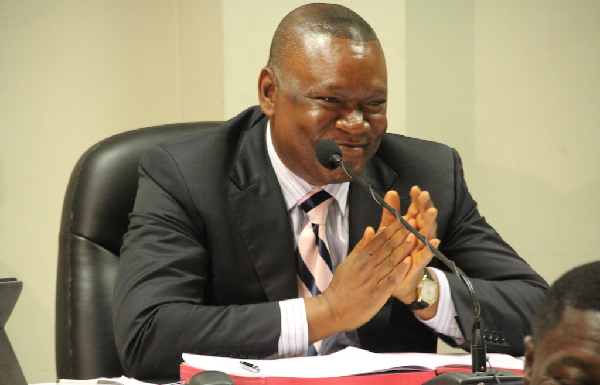
Supreme Court judge nominee Justice Senyo Dzamefe has strongly endorsed the principle of an uncapped number of judges for the apex court, aligning his views with long-standing arguments from the Chief Justice regarding judicial efficiency and the unique demands on Ghana's judiciary.
His stance was articulated during his vetting by Parliament's Appointments Committee on Monday, June 16, 2025.
Justice Dzamefe firmly stated that the country's constitutional framers deliberately left the number of Supreme Court judges uncapped, a design he believes remains relevant.
"The framers of our law, the constitution, know why they haven't put a limit on the number of Supreme Court judges; it's not capped," he told the committee. "So far as the constitution doesn't cap the number of judges, I am for it."
He lent his support to two key arguments frequently made by the Chief Justice for an increased bench size.
Firstly, Justice Dzamefe agreed that a larger number of judges is crucial to mitigate significant delays in the administration of justice.
He acknowledged that the current complement of judges, estimated at 13 prior to the current seven nominees, are "overburdened" by heavy caseloads, which impact their ability to efficiently "write opinions" and "hold conferences."
This burden, a Chief Justice's 2024 letter to the President reportedly indicated, affects the overall administration of justice.
Secondly, Justice Dzamefe dismissed the often-cited comparison between Ghana's Supreme Court and the United States Supreme Court.
He backed the Chief Justice's argument that such comparisons are flawed because, while the US Federal Supreme Court indeed has only nine judges, it operates within a system that includes "50 Supreme Courts in the states plus the one federal Supreme Court."
"You can't compare the Ghana situation, where we have one Supreme Court, versus the US that has 50 Supreme Courts at the state joining the federal supreme court," he explained.
He further clarified that the US federal court's jurisdiction is limited primarily to "constitutional and federal issues" and, crucially, it retains "the discretion to choose" which cases it hears, a luxury not afforded to Ghana's single, broader-jurisdiction Supreme Court.
The Chief Justice's 2024 letter detailed this analysis to justify the need for more appointments, recommending that the "average size of the court should be 20" judges.
Beyond the numbers, Justice Dzamefe also weighed in on the issue of access to justice, particularly for citizens in remote parts of the country.
When asked by the Majority Leader, Mahama Ayariga, about the feasibility of establishing a "northern bench" or branches of the Supreme Court to spare litigants from areas like Bawku the arduous journey to Accra, Justice Dzamefe expressed openness.
"We have only one Supreme Court in Ghana, and that court can have several branches, but it's the same Supreme Court, just as the Court of Appeal and the High Courts," he responded. "So I don't see anything wrong if there's a branch there."
Justice Dzamefe's vetting by the Appointments Committee centred on his qualifications and judicial philosophy for the highest judicial office in the land.
Latest Stories
-
President Mahama is not sincere with Ghanaians on LGBTQ bill matter – Hassan Tampuli
9 minutes -
Gov’t to establish Prison Industrial Hub to equip inmates with income-generating skills – Prison Service boss
28 minutes -
Alhassan Tampuli donates cement, roofing sheets to support storm victims in Gushegu
29 minutes -
Alhassan Tampuli appeals for urgent support for storm victims in Gushegu
31 minutes -
The hypocrisy must stop; pass Anti-LGBTQ+ Bill now – Alhassan Tampuli to Mahama
35 minutes -
Imprisonment should be rehabilitative, not punitive – Ghana Prisons boss at UNGA
57 minutes -
Ga Adangbe traditional priests petition Mahama over McDan aviation licence revocation
1 hour -
Anti-LGBTQ Bill: NDC’s arrogance is worrying – Hassan Tampuli
1 hour -
Let’s give OSP time to mature, not to scrap it – Hassan Tampuli
1 hour -
Nigeria convicts 386 Islamist militants in mass trials
1 hour -
Djibouti president wins election with 97.8% of vote, state media says
2 hours -
We don’t have mandate to deduct tax from rent allowance of security services personnel – Interior Ministry clarifies
2 hours -
Ablakwa receives Presidential Special Envoy on Reparations to advance global agenda
2 hours -
Christina Koch becomes first woman to travel around the moon on Artemis II
2 hours -
Epstein survivors’ calls to meet King Charles and Queen harder to ignore as US visit approaches
2 hours