


Audio By Carbonatix
Eleven selected kayayes are to undergo skills training to create employment opportunities in their communities to improve on their livelihood.
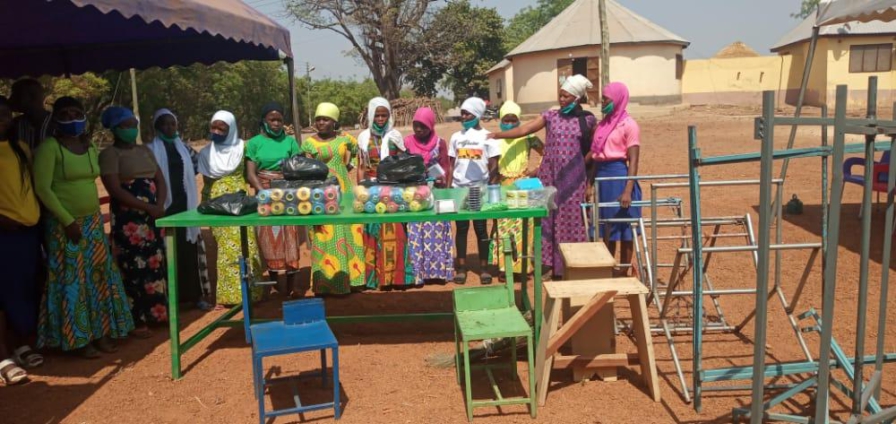
The beneficiaries are young girls who had gone to look for income as kayayes in Accra and Kumasi to support their families but returned to the Northern region because of the Covid-19 outbreak.
At a durbar in Kakpagyili, a community in the Tamale Metropolis of the Northern region, the beneficiaries were presented with equipment and materials needed to start their training.
They would be attached to master skill trainers to acquire the needed skills to venture into their preferred enterprises, including soap making, weaving and beads making.
The gesture formed part of Livelihood Empowerment for Migrant Returnees, a pilot project, under the Healthy Cities for Adolescents (HCA) Project, being implemented by the Regional Institute of Population Studies (RIPS) of the University of Ghana.
With support from the Botnar Foundation, the project is being implemented in partnership with the Tamale Metropolitan Assembly (TaMA) and Planned Parenthood Association of Ghana (PPAG) among other partners.
It is aimed at improving the health and general wellbeing of adolescents towards achieving the Sustainable Development Goals in the Tamale Metropolis.
Mrs Clara Lamisi Weobong, HCA Project Officer in Tamale, said: “the lockdown brought untold hardships to these young girls and many of them had to return home and so we thought it wise to pilot and test the livelihood empowerment programme to see if selected young girls can make living back home.”
That, she noted, would also build the capacities and confidence of the beneficiaries to create employment for other young people in their communities.
Also, it would discourage others from travelling to the Southern part of Ghana to engage in kayaye.
She appealed to parents and guardians as well as traditional authorities to be committed to ensure the wellbeing of their children and to discourage them from engaging in activities that would hamper their growth and development.
Guma Naa Fuseini Nayi, Chief of Kakpagyili, lauded the implementers of the HCA Project for the intervention and said the move would enhance the living standards of beneficiaries in the community. He encouraged beneficiaries to be dedicated and committed to their work to ensure they realized their ambitions.
Beneficiaries also expressed gratitude to the HCA for coming to their aid and pledged their commitment to ensuring they successfully go through the training to achieve the desired outcomes.
Management of the HCA project announced that successful graduates would receive start-up capital and equipment.
Latest Stories
-
“Feels amazing” – Antoine Semenyo reveals after Manchester City dismantle Liverpool
4 minutes -
Mahama calls for emergency cabinet meeting over rising fuel prices
47 minutes -
Asante Gold reports US$345million loss for 2025
2 hours -
Gov’t making progress in clearing $1.7bn power debt – Mahama
3 hours -
Justice is the engine of growth – Chief Justice
3 hours -
Meet us halfway – Trade Minister tasks private sector with AfCFTA success
4 hours -
After more than 14 years at Atletico Madrid, what next for Simeone?
4 hours -
Conquering the World – Building on the foundations laid by Otto Addo
4 hours -
[Playback] Sarkodie, Kwami Eugene, Tinny, Keche and others thrill fans at Gomoa Easter Carnival
4 hours -
Gomoa Easter Carnival: Experts charge indigenes to own festival to ensure sustainability
5 hours -
Gomoa Easter Carnival: Edem Agbana and Joy Prime fans shower festival with huge endorsements
7 hours -
Gathering of Royals 2026: Empowering women, boosting tomato production
7 hours -
Gov’t to overhaul free zones into manufacturing hubs for local production – Trade Minister
8 hours -
Ghana losing $2.5bn yearly from raw exports – Trade Minister reveals
8 hours -
Mahama unveils plans for Kwahu Airport, Convention Centre
8 hours