

Audio By Carbonatix
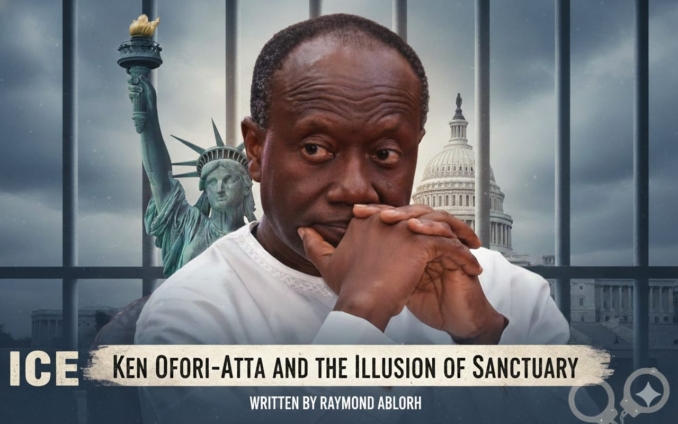
In the high-stakes theatre of international justice, the detention of Ken Ofori-Atta by United States Immigration and Customs Enforcement (ICE) represents a profound intersection of a visa’s expiration and a nation’s exhaustion.
This is not merely a headline regarding an administrative oversight; it is a definitive collision between a carefully constructed private narrative and the cold, unyielding mechanics of a sovereign treaty.
The architecture of Ofori-Atta’s exit from the Ghanaian stage was built upon a foundation of fragile health. In June 2025, as the Office of the Special Prosecutor (OSP) beckoned, the public was fed a consistent diet of medical empathy.
His legal team spoke of complex surgeries and the lingering shadows of post-COVID syndromes, weaving a shroud of physical vulnerability that served as a moral shield against legal summons.
However, beneath this canopy of medical leave, a different blueprint was being drawn. We now know that in the very month his legitimate stay in the United States expired, he was not merely seeking a cure for his body; he was seeking an anchor for his life.
By filing for Permanent Residency while simultaneously assuring Ghanaians of his eventual return, the former Finance Minister’s legal team performed a masterclass in jurisdictional bait and switch.
One does not apply for a permanent future in a foreign land if the genuine intent is to return home upon the healing of a wound. The sickness was the shield, but the residency application was the fortress.
The arrest by ICE in January 2026 stripped away the administrative veneer of his stay. While his lawyers scramble to frame this as a common adjustment of status issue, the shadow of the United States Department of Justice (DOJ) looms larger. In December 2025, the Government of Ghana transmitted a formal extradition packet containing a 78-count indictment. This transforms a simple visa overstay into a high-stakes battle of international law.
These charges are not mere whispers; they are a deafening roar of financial misconduct. They centre on the staggering GH¢1.4 billion SML revenue assurance scandal and the procurement labyrinths of the National Cathedral. This specific money trail is the hook that has captured the attention of federal investigators.
Under the principle of dual criminality, what Ghana terms "using public office for profit," the American justice system recognises as Honest Services Fraud.
The DOJ is currently unspooling the thread of these transactions, and history suggests that the American judiciary is an inhospitable host for such defences. The "political offence exception" that Ofori-Atta’s team seeks to invoke is a porous barricade.
United States courts have established a clear precedent: financial crimes are "pure" offences, not relative political ones.
We need only look at the fate of other high-ranking officials who attempted to use American soil as a legal bunker. From the extradition of Panama’s Ricardo Martinelli to the forced return of Peru’s Alejandro Toledo, the American justice system has consistently ruled that an official title is not a license for embezzlement.
In those cases, as in this one, the defendants claimed a "personal vendetta" by their successors. In each instance, the U.S. courts prioritised documented evidence of financial graft over rhetorical claims of political victimisation. Asylum is a sanctuary for the persecuted, not a bypass for the prosecuted.
The clock is no longer an ally to the former Minister. He is in custody, and the American judiciary is increasingly weary of its soil being used as a sanctuary for those fleeing massive financial accountability in developing democracies. The likely end of this saga is not a quiet deportation but a formal, guarded handover.
As the evidence of the SML scandal is laid bare in a federal courtroom, the medical narrative will likely be remembered as the greatest fiction ever told to the Ghanaian people. Ken Ofori-Atta once managed the wealth of a nation; he is now struggling to manage his own liberty.
In the final analysis, the law may prove to be the only thing more permanent than his residency application.
Latest Stories
-
CUTS International calls for urgent competition law amid sachet water price hikes
2 minutes -
‘I never did this advert’, AI clones hijack Ghanaian identities for profit
20 minutes -
25-year-old woman battles trauma after surviving deadly Nkwanta attack
37 minutes -
Vice President honoured at Tortsogbeza as South Tongu leaders highlight development needs
45 minutes -
Kwahu Business Forum 2026: Corporate citizenship, sustaining African businesses take centre stage with KGL as the case study
2 hours -
Trump seeks $152m to reopen notorious Alcatraz prison
4 hours -
Ex-Chelsea player Oscar retires with heart issue
4 hours -
CA Foundation drives constitutional literacy in Kpone Katamanso municipality
4 hours -
GPRTU to hold talks with Transport Ministry over rising fuel costs
4 hours -
CUTS International urges gov’t to halt sachet water price hike pending cost review
5 hours -
Chief Justice: Efficient Judiciary essential to reducing business costs
5 hours -
Bayern grabs 99th-minute winner to cap superb fightback
5 hours -
Ahmed Ibrahim urges Ghanaians to reflect Easter values in nation-building
5 hours -
ECG inefficiencies undermining power supply -Mahama outlines reforms
5 hours -
Lewandowski scores as Barca fight back to defeat Atletico
5 hours