

Audio By Carbonatix
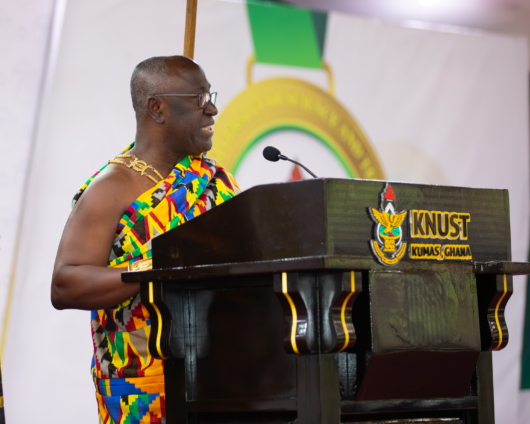
Chairman of the Governing Council of the Kwame Nkrumah University of Science and Technology, Kumasi (KNUST), Akyamfour Asafo Boakye Agyemang-Bonsu, has called on Ghana to renew its key institutions to confront growing climate, financial, and demographic challenges.
Delivering the keynote address at the opening plenary of the Fifth Triennial Conference of the Ghana Studies Association (GSA) at KNUST, Akyamfour Agyemang-Bonsu argued that the country's resilience lies in the combined strength of the constitutional state, universities, traditional authorities,s and faith-based institutions.
Speaking on the theme "Ghana in Uncertain Times: Institutions, Identity, and the Long View," he said Ghana faces an unprecedented convergence of climatic, financial, and demographic challenges, making institutional renewal essential for sustainable national development.
"Uncertainty is not new to Ghana. What is new in our present moment is not uncertainty itself, but its simultaneity: the arrival of several shocks at once, each of a different character, each pressing on a different institution," he said.
He said the country's capacity to respond to uncertainty has historically depended on the complementary roles of its institutions rather than the performance of government alone.
Mr Akyamfour Agyemang-Bonsu identified three major pressures confronting Ghana: climate change and environmental degradation affecting cocoa production; economic vulnerabilities arising from debt and global financial instability; and rising youth unemployment compounded by rapid technological change.
He noted that declining cocoa output, volatile international prices, debt distress, and the growing impact of climate change demonstrate how multiple crises are increasingly occurring simultaneously, placing pressure on national planning and governance.
The KNUST Council chairman argued that universities have a critical responsibility to generate long-term knowledge capable of addressing national challenges beyond electoral cycles.
"The challenges I have described... are, at bottom, knowledge problems. They require research, and research requires institutions with a horizon longer than an electoral cycle," he said.
He cited KNUST's commitment to becoming a net-zero campus as an example of how universities can serve as living laboratories for sustainable development while producing practical solutions for national challenges.
Akyamfour Agyemang-Bonsu also stressed the continuing relevance of traditional authorities in land administration, dispute resolution, and preserving institutional memory, describing chieftaincy as a functioning organ of governance rather than a relic of the past.
He further highlighted the contribution of churches and other faith-based organisations in providing education, healthcare, and social welfare, particularly during periods when the state's fiscal capacity is constrained.
While acknowledging the indispensable role of the constitutional state, he said government alone cannot effectively manage the country's growing uncertainties because of the short-term nature of electoral cycles.
"None of these four institutions is sufficient on its own," he said. "The university supplies the long horizon of knowledge. The stool supplies the deep continuity of land and community. The church supplies the formation of ethics and the reach into the social fabric. The state supplies the democratic mandate and the force of law."
Turning to national identity, Akyamfour Agyemang-Bonsu described Ghana's cultural, religious, and linguistic diversity as a source of resilience rather than division.
He believes that the country's plural identity has enabled it to adapt to changing circumstances over generations.
He cautioned, however, that institutional legitimacy cannot be sustained by history alone.
"Inherited legitimacy expires unless it is renewed by present competence," he said, adding that universities, traditional authorities, faith institutions, and the state must continually demonstrate their relevance in addressing contemporary challenges.
He urged scholars attending the four-day conference to critically examine whether Ghana's institutional diversity should be viewed as a weakness or as a strategic asset capable of strengthening national resilience in an increasingly uncertain world.
The Fifth Triennial Conference of the Ghana Studies Association is being held at KNUST from 21 to 24 July 2026 under the theme "Ghana in Uncertain Times."
It brings together scholars from Ghana and abroad to discuss issues relating to governance, identity, development, and national resilience.
Latest Stories
-
EOCO’s handling of arrests could cost NDC power – Kpebu
7 minutes -
Health sovereignty a priority for 1.4b Africans – President Mahama declares
20 minutes -
NACOC begins pre-screening checks at Accra International Airport
23 minutes -
‘I was stepping up into an alliance’ – Sammy Crabbe clarifies John Boadu backing
26 minutes -
Turn CSIR research into commercially viable products for national dev’t – Dr Agyeman-Rawlings
48 minutes -
Baffour Awuah thanks Bawumia, NPP supporters after GH¢10m bail
50 minutes -
Ghana gaining notoriety for drugs – Bawumia demands bipartisan probe
1 hour -
Government urges SMEs to embrace digitalisation for growth and job creation
1 hour -
Ghana’s university libraries urged to lead change in digital age
1 hour -
NPP National Delegates Conference: Nhyiaeso MP calls for unity and peace
1 hour -
Cargill Ghana renovates, equips ICT laboratory for Ahmadiyya Basic School
1 hour -
GH¢6,500 cocoa promise has turned out to be a scam – Bawumia
1 hour -
Firefighters battle blaze behind Amasaman China Mall
1 hour -
We’ll pursue accountability despite intimidation – Afenyo-Markin
2 hours -
‘Ghana Jollof’: Restoring the flavor
2 hours