

Audio By Carbonatix
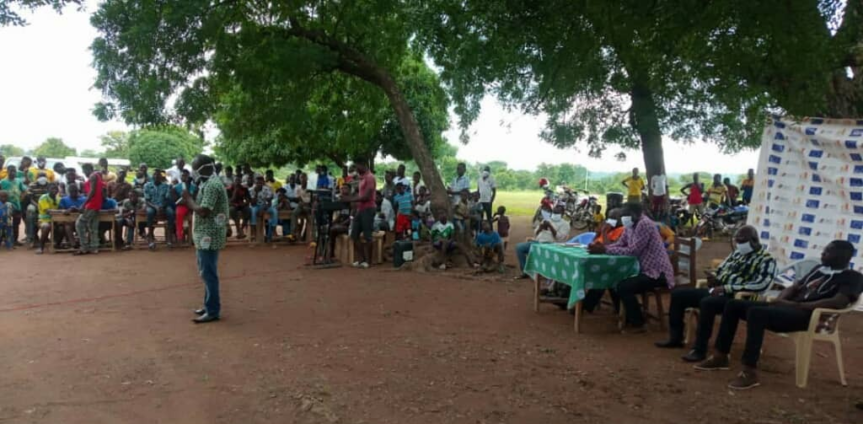
The Krachi Nchumuru District Office of the National Commission for Civic Education (NCCE) has engaged residents of Wornando, a farming community in the Krachi Nchumuru District of the Oti Region to social auditing regime.
The programme funded by European Union (EU) is aimed at promoting discourse among citizens and office bearers on planning, implementation, monitoring and evaluation of development projects and programmes.
Abass Yussif, Krachi Nchumuru District Director of NCCE, speaking at the inauguration called on the people to initiate their own development projects and take steps to get all community members to monitor the execution of development projects in their areas.
He advised them to be innovative in charting the course of their developmental projects and refrain from bottling up their hopes on the District Assembly or central government.
He urged Assembly-members to continue to lobby for projects from the level of the District Assembly and NGOs and discuss policies and programmes of the Assembly and central government with their electorates.
Robert Boame, acting Oti Regional Director of NCCE said the project was to promote anti-corruption, rule of law and accountability among duty bearers.
Mr Boame added that it was meant at helping community members to understand the operations of the Local Governance system and to get them to take part in decision-making affecting their daily livelihood.
He explained that the NCCE was mandated among others to campaign, advocate and lobby for increased accountability and reduction in corruption in the country.
The District Planning Officer, James Awapoay, Krachi Nchurumu District Planning Officer outlined the operations of the local government system including; how the District Assembly works.
He said the District Assembly was owned by the people through the elected and appointed members and not the District Chief Executive or any head of decentralised departments.
Mr Awapoayi said the District Assembly had two main sources of funding; the District Assemblies’ Common Fund (DACF) and Internally Generated Funds (IGF).
According to him, the Assembly did not have enough money to develop all communities at the same time and called on the people to have patience and that all projects in the area would be completed in due course.
At the end of the durbar, the community identified two developmental projects they wished got completed.
That is the completion of the CHPS Compound, which has been abandoned since 2016 and the completion of Rural Electrification Project, which has also been stalled.
A six-member committee was formed and inaugurated to lobby for the completion of the said projects.
Latest Stories
-
Mussa Dankwah is like a ‘lotto doctor’ – Miracles Aboagye
3 minutes -
Investors target Ho Airport for training and maintenance hub — GACL Chair
8 minutes -
NDC’s ‘grand deception’ on anti-LGBTQ+ bill exposed – Ntim Fordjour
9 minutes -
Speak out against Mahama government’s LGBTQI+ u-turn – Ntim Fordjour to clergy
13 minutes -
Ghanaians worse off despite improved macroeconomic indicators — Miracles Aboagye
16 minutes -
Police intercept narcotics, arrests five suspects in Upper West
22 minutes -
Government to establish Kumasi Machinery Innovation Park under 24-Hour Economy programme
25 minutes -
When Hormuz Fails: The day a waterway stops the world
26 minutes -
Ghanaian students in UK to protest over unpaid fees, stipends
26 minutes -
Inflation to go up marginally in April 2026 – Report
28 minutes -
Newborn baby found abandoned at Kronkromase cemetery, residents in shock
29 minutes -
VIP Jeoun Transport increases fares effective April 8
31 minutes -
Minority warns against alleged LGBTQ provisions in constitutional review
37 minutes -
Wave of violence kills at least 26 in Nigeria as army thwarts mass church abduction
54 minutes -
Anti-LGBTQ+: Mahama must be held to account to fulfil his promise – Ntim Fordjour
56 minutes