

Audio By Carbonatix
Two drill rappers from Liverpool who were seen carrying guns and parading with troops in Somalia during a cross-border clan conflict could be questioned by police upon their return to the UK, the BBC has learned.
British citizens Abdifatah Gulaid, 31, and Noah Ihiekwe, 30, travelled to the north-east of the African country earlier this year.
The pair, both from the Toxteth area of Liverpool, produce music under the names Still Brickin' and Rayzer.
In footage obtained by the BBC, Mr Gulaid can be heard telling armed troops: "The time for talk is finished."
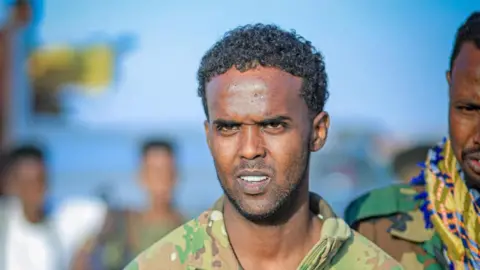
The extent of the men's involvement with the troops is not known, but the government told the BBC that "any person who travels from the UK to conflict zones to engage in unlawful activity should expect to be investigated upon their return".
Mr Gulaid is affiliated to the Warsangeli clan which has been embroiled in tension and fighting with the rival Isaaq clan.
Mr Gulaid and Mr Ihiekwe, who were both seen in a hotel in Badhan in the Sanaag region in the north of Somalia, did not respond when contacted by the BBC.
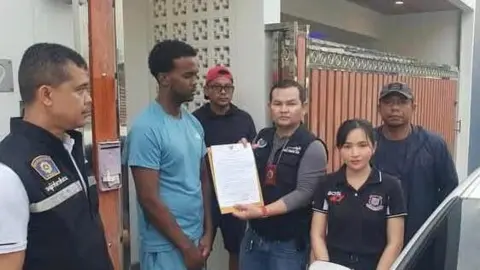
In the week prior to their arrival in Somalia, the BBC understands they, along with four other men, were detained in Phuket, Thailand, during a drugs raid.
Thai police stormed a luxury villa in the Ratsada district at about 06:30 local time on 23 January and recovered 12 bags of cannabis, weighing about 6kg, and 39 tanks of nitrous oxide, also known as laughing gas.
Cannabis was legal in Thailand at the time for personal use, but its sale without a licence was prohibited.
The men were later released without charge.
The BBC has approached the Thai authorities for further information.
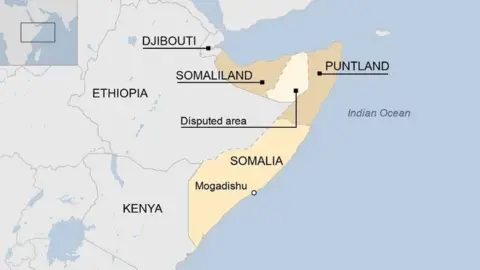
Analysis of the rappers' own social media and eyewitness accounts suggests that in the days following the drugs bust, they travelled to Sanaag, in north-east Somalia.
The region is claimed by both the self-declared republic of Somaliland and by Somalia's autonomous state of Puntland.
Somaliland declared independence after the overthrow of the Somali military dictator Siad Barre in 1991.
Though not internationally recognised, Somaliland has a working political system, government institutions, a police force and its own currency.
Puntland declared itself an autonomous state in August 1998, but unlike Somaliland, it does not seek recognition as an independent entity.
There has long been tension between clans in the region due to competition over resources and vendettas going back generations.
'They had guns'
An international development consultant, who was in the country on business, said she saw the rappers in the Laasqoray Hotel in Badhan at the beginning of February.
"The hotel had people, mostly men from the local area, Bossasso, Northern Puntland and Mogadishu, so these two with British accents stuck out," the consultant said.
She added: "I saw them several times in the hotel lobby, they were just very casual, coming and going and I noticed they were speaking English with a Scouse accent.
"We had a brief conversation as they heard me speaking English too, they told me they were from Liverpool and that they were enjoying their time in Somalia, but they didn't say why they were there."

In late January, the hotel hosted a conference attended by Warsangeli clan leaders, during which a campaign was declared to take the town of Ceerigaabo from Somaliland, marking a significant escalation in the region's ongoing territorial dispute.
The consultant added, "One evening I saw them, but they were no longer wearing casual clothes; they were wearing combat clothing, and they were carrying guns. I don't know much about guns, but they looked like AK-47s to me.
"They left the hotel and joined a much bigger group outside who had assault rifles and guns attached to retrofit cars with enhanced body work.
"Not long after, I could hear gunshots; some of the bullets hit the buildings. The hotel manager told me to go to my room and lock my door as it wasn't safe.
"I stayed there for three days until I could be safely escorted out of Badhan to Bossasso to catch a flight back to Nairobi."
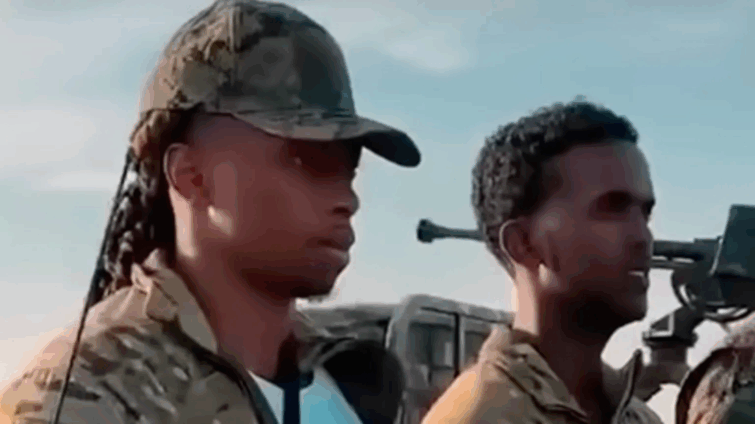
In social media videos obtained by the BBC, Mr Gulaid and Mr Ihiekwe can be seen posing in military uniform with soldiers, believed to be from Puntland state.
In the videos, filmed by local media, soldiers can be seen riding in technical vehicles and holding assault rifles.
In one video Mr Gulaid, addressing troops in Somali, said: "There is no more need for talk, they're going to see us.
"You know what I am here for, I'm not messing around, time for talk is finished."
In another video, he adds: "You know what we're about, you're going to see our mettle in the battle."
Around the time the rappers were in the country there were ongoing skirmishes between Puntland and Somaliland.
"Tensions had been brewing for a while between the Somaliland administration and the local clan communities that live in that region, and it came to a head earlier this year," said Dr Idil Osman from the University of Leicester.
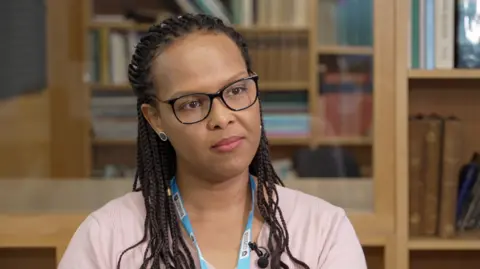
Dr Osman, who has written extensively about Somalia, said: "Some of the clans don't want to be part of Somaliland, and conflict seems to have started when Somaliland sent troops into parts of the region. The Warsangeli clan have armed itself, and there has been a violent conflict.
"I think things have simmered down after clan elders got involved, but things are not settled; there are still ongoing political disagreements, but the fighting seems to have stopped for now."
Asked why British-born Somalis might return to the region and become involved in such conflicts, Dr Osman said: "The Somali community is one of those communities that have a very close connection to their homeland and therefore a close and intimate involvement with the dynamics that are happening on the ground.
"So, clan politics and clan conflicts unfortunately also extend to the diaspora communities."
'Questions to answer'
A UK government spokesman said anyone who returns from taking part in a conflict abroad "must expect to be investigated by the police to determine if they have committed criminal offences".
Clive Walker, a professor emeritus at Leeds University School of Law, explained the difficulties in prosecuting such cases.
"You won't find official action for a variety of reasons in most cases. In this case it really depends on where in Somalia they have been and who they have been involved with.
"It reduces the heat on these people if it isn't Al-Shabaab, as that is a proscribed organisation.
"If it isn't Al-Shabaab then that probably reduces the chances of official action, but there will likely be queries and they're likely to be stopped at whichever UK port they re-enter."
Mr Gulaid and Mr Ihiekwe were last known to be in Dubai.
Latest Stories
-
‘We’ve become quite experienced in negativity’ – Liverpool’s Slot
3 hours -
Legendary manager Lucescu dies days after resigning
3 hours -
One dead as train travelling 99mph collides with lorry in France
3 hours -
Airlines cut flights and hike fares as fuel prices surge
3 hours -
Kane inspires Bayern to first-leg advantage over Real Madrid at Bernabéu
4 hours -
Wireless Festival cancelled after Kanye West blocked from coming to UK
4 hours -
Wa West MP commissions five boreholes for the benefit of his constituents
4 hours -
Havertz’s late strike hands Arsenal narrow first-leg advantage over Sporting
4 hours -
Damang mine award: Minority not against Ghanaian participation; we’re asking for fair process – Konadu
4 hours -
NPA to enforce stricter registration rules for petroleum tankers
5 hours -
Manhyia South MP laments decline in hospitality operations in his constituency
5 hours -
How a simple clean charcoal innovation could benefit Ghana’s climate future
5 hours -
NPA, COMAC launch Safety Week 2026 to promote risk management in petroleum sector
5 hours -
Stakeholder engagement resolves onion trade impasse
5 hours -
Gender Ministry holds staff durbar, welcomes new Chief Director
5 hours