

Audio By Carbonatix
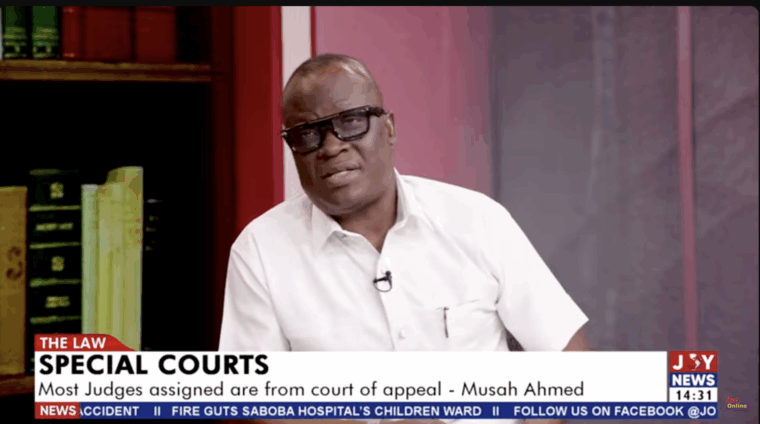
Judicial Secretary, Musah Ahmed, has explained the rationale behind Chief Justice Paul Baffoe-Bonnie's move to establish special courts, describing the initiative as a principled application of "specialisation" in the justice delivery system — one he likens to the economic concept of division of labour.
Ahmed made the remarks on The Law on Joy News, speaking in the wake of Chief Justice Baffoe-Bonnie's formal establishment of a Specialised High Court Division through a circular signed on February 5, 2026.
"Specialisation is instituted when you want to achieve efficient, speedy, and effective production," Ahmed said. "We take it back to the court. The court is to deliver justice to all manner of persons without fear or favour."
The Judicial Secretary clarified that the new division is not a dismantling of the existing court structure, but a deliberate deepening of specialisation within the High Court. His remarks echo the rationale the Chief Justice has used in outlining his broader judicial reform agenda since being sworn in on November 17, 2025.
Exercising powers conferred under Section 14(3) of the Courts Act, 1993 (Act 459), the Chief Justice issued a circular mandating that specific judges of the Superior Court of Judicature be assigned to the new division to handle matters of critical national interest. The division's mandate is broad, covering corruption and public accountability cases from the Auditor-General's reports, galamsey and environmental crimes under the Minerals and Mining Act, state asset recovery, organised crime, narcotics offences, and cybersecurity cases under the Cybersecurity Act, 2020.
The establishment of the specialised court is seen as a direct response to public outcry over the slow pace of justice in cases involving public funds and the devastating impact of illegal mining.
The Chief Justice has also ordered that the offices of the High Court remain open from 8:00 am to 6:30 pm on weekdays — a notable departure from traditional operating times intended to help manage increased caseloads without further delays.
Ahmed also grounded his defence of the courts in law, pointing to CI 47, Order One of the Rules of Court, which he said explicitly mandates that the rules exist to achieve efficient and speedy justice.
"That is what the law actually says justice delivery should be," he stated, reinforcing that the reforms are not mere administrative preference but a fulfilment of an existing legal obligation.
The Chief Justice had earlier briefed Vice President Professor Jane Naana Opoku-Agyemang on the judiciary's key achievements and reform plans, with the Vice President reaffirming her support for efforts to improve efficiency and access to justice.
The Judicial Service is also revising the Rules of Court, expected to come into force by March 2026, alongside technological innovations to further enhance justice delivery.
Latest Stories
-
Let The Constitution direct Chieftaincy to deliver “All Development Is Local”
32 minutes -
Ghana explores centre of excellence for hearing, communication and cochlear implant care
2 hours -
Schizophrenia-related disorders lead mental health cases recorded in Ghana
2 hours -
Dutch authorities enlist Ghana in hunt for fugitive drug lord Bolle Jos
3 hours -
Ghana housing finance conference adopts communiqué to improve affordable housing access
7 hours -
Special Initiatives Minister urges Wa Technical Institute to enrol more girls as EU-backed solar training lab opens
8 hours -
In the matter of my first year at the Bar
8 hours -
ActionAid Ghana calls for an end to child marriage, greater investment in girls’ rights
8 hours -
Newsfile to tackle World Cup visa scandal, beach demolitions, education strikes, BRICS bid
8 hours -
UK-Ghana Trade & Investment Summit: Trade Resource Centre to help businesses maximise UK-Ghana trade opportunities
8 hours -
Embassy of Denmark celebrates World Maritime Day
9 hours -
Linking LEAP to productive inclusion could cut extreme poverty by 2030 – UNICEF
10 hours -
Trade Ministry backs use of creative arts to rehabilitate prison inmates
10 hours -
Negotiations with government to continue despite strike suspension – GNAT
10 hours -
‘Ghana cannot afford to waste public resources; every cedi has a job’ – Ato Forson
10 hours