

Audio By Carbonatix
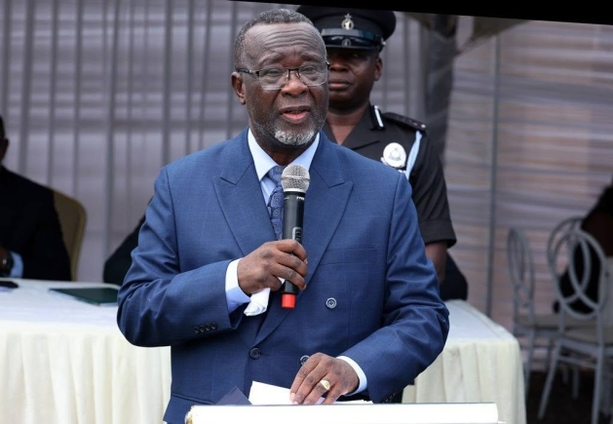
The Chief Justice, Justice Paul Baffoe-Bonnie, has urged the Judiciary to focus on strengthening the foundations of justice rather than merely introducing reforms, saying the true test of every reform is whether it endures beyond the moment.
He said while a foundation could be laid in a day, its strength was tested over time, and that reforms announced in a moment had to be judged by whether they survived the moment.
Justice Baffoe-Bonnie gave the charge in a message at a special church service at the Cathedral Church of the Most Holy Trinity in Accra last Saturday to mark the opening of the 69th Legal Year.
The service was held on the theme: “Strengthening the Foundations of Justice through Leadership, Innovation and Technology.”
The service brought together Justices of the Supreme Court, justices of the Court of Appeal, judges of the High Court, Circuit Court Judges and magistrates, the Judicial Secretary, Musah Ahmed, and other senior members of the Judicial Service.
Also present were the Attorney-General and Minister of Justice, Dr Dominic Akuritinga Ayine, his deputy, Dr Justice Srem-Sai, the President and the Vice-President of the Ghana Bar Association (GBA), Efua Ghartey and Victoria Barnes, respectively, as well as the President of the Ghana Law Society, Rockson Nelson Etse Dafeamakpor.
Trust earned
The Chief Justice said public confidence in the Judiciary could not be secured by the Constitution and the law alone, but had to be earned through the everyday experiences of people who used the courts.
“The citizen who enters a court does not experience the Constitution as an abstract document.
He experiences it through the manner in which he is received, the time within which his case is heard, the fairness with which his matter is determined and the dignity with which he is treated,” he said.
Justice Baffoe-Bonnie said, similarly, ordinary activities such as registry interactions, proper filing of documents and answering telephone calls could determine whether a person left the court believing that he had been treated fairly.
The Chief Justice said the foundations of justice were, therefore, built not only through judgments but also through the daily conduct of everyone who worked within the Judiciary.
Digital inclusion
Justice Baffoe-Bonnie also cautioned that the Judiciary’s digital transformation should not create a new form of exclusion.
He said people without digital literacy, those in underserved communities and vulnerable litigants should not be left outside a door that technology was intended to open.
“Technology must bridge the distance between the citizen and justice, not widen it,” he said.
The Chief Justice called for continuous learning, retraining and institutional support to accompany technological transformation, saying judicial workers should not simply be given new tools and left to learn how to use them through trial and error.
Justice Baffoe-Bonnie further said institutions did not belong to the generation that happened to occupy them, but were inherited, tended and eventually handed over to others.
He said the reforms and systems being developed today could serve citizens who had not yet been born, while the standards tolerated today could become the standards by which the next generation judged the Judiciary.
“As I approach the conclusion of my service as Chief Justice later this year, I am especially conscious of this truth,” Justice Baffoe-Bonnie said.
Righteous leaders
The Anglican Bishop of Ghana, the Rt Rev. Dr Daniel Sylvanus Mensah Torto, who delivered the sermon, called for righteous leadership in the justice system.
“God does not need more clever lawyers.
We need righteous leaders in the justice system,” he said.
Drawing on biblical examples, the Bishop said weak and corrupt leadership could undermine justice, and urged judges and lawyers to exercise their authority with humility and a commitment to serve.
The Anglican Bishop of Ghana said servant leadership in the justice system meant ensuring that a poor woman who could not afford a lawyer, and prisoners who had spent years awaiting trial were not forgotten.
“Legacy in justice is not to be served, but to serve the poor woman at Makola Market who cannot afford a lawyer,” he said.
He also urged judges to be prepared to rule against the powerful and wealthy when justice demanded it.
Innovation demanded
Rt Rev. Dr Mensah Torto said the justice system also required the courage to innovate, particularly in case management, to prevent cases from remaining in court for years.
He said innovations such as court-connected Alternative Dispute Resolution had shown what was possible, but more needed to be done to make justice faster, cheaper and kinder.
“We need courage to innovate in case management.
Why should that case be in court for years? Justice delayed is justice denied,” Rt Rev. Dr Mensah Torto said.
On technology, the bishop welcomed tools such as e-filing, virtual courts, digital transcription and case tracking, saying they could reduce corruption and delays, while improving transparency.
He, however, cautioned that technology must remain a servant of justice rather than become its master.
The Anglican Bishop of Ghana further warned that technological advancement without ethical leadership could worsen rather than solve problems in the justice system.
“If we put technology on a foundation of corrupt leadership, we only have digitised corruption,” he said.
Latest Stories
-
Local Gov’t Minister announces plans to regenerate Agbogbloshie enclave
4 minutes -
LA 2028: Black Queens performance watch ahead of Mauritius clash
5 minutes -
Gov’t transfers GH¢9.1bn DACF to MMDAs under Mahama — Mahama Ayariga
5 minutes -
From tools to strategy: How Ghanaian MSMEs can harness AI for scale
7 minutes -
GCB MD engages customers in live social media ‘Ask Me Anything’ session
10 minutes -
Football clubs ‘are in love’ with Kurt Okraku – Aduana FC boss
10 minutes -
397 CHPS compounds, 502 classroom blocks completed under DACF projects – Mahama Ayariga
10 minutes -
SavannaFest Tournament: Coach appeals to MTN to invite scouts in future tournaments
12 minutes -
John Boadu pledges unity, reconciliation as he takes over as NPP National Chairman
14 minutes -
‘Whatever the personal cost, I will not abandon my duty’ – Baffour Awuah assures Salomey Bafoh
16 minutes -
Government to increase funding for Houses of Chiefs to speed up dispute resolution
17 minutes -
Mahama Ayariga outlines plans to transform sanitation system in Greater Accra
18 minutes -
Govt’ to introduce digital property rate system to boost MMDAs’ revenue – Mahama Ayariga
19 minutes -
Traditional Medicine Practice Council closes three unlicensed spa and massage centres in Ashanti Region
22 minutes -
Let’s accept the reality and move along – Mike Oquaye on NPP’s decision to make flagbearer party leader
24 minutes