

Audio By Carbonatix
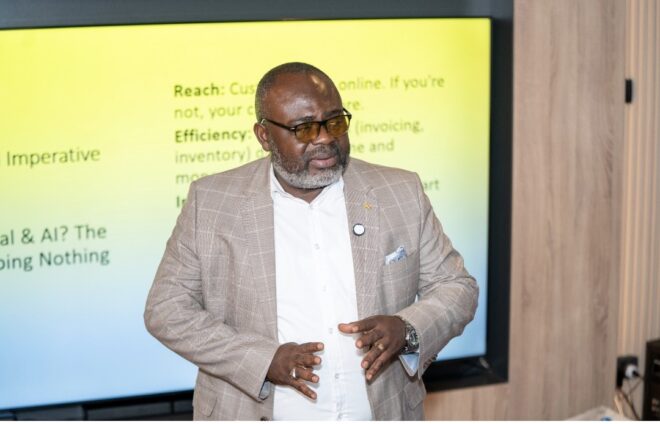
This article draws on a presentation delivered at the Master Class organised by the WERIse Network for its members and selected women entrepreneurs, where the topic was discussed and warmly received by participants.
The global discourse on artificial intelligence often frames it as a technology for the well-resourced large corporations with dedicated data teams, cloud infrastructure, and capital to experiment. From the vantage point of a Ghanaian micro, small, or medium enterprise, this framing is not only misleading but strategically dangerous. It obscures a more important truth: AI, in its current form, is most transformative precisely for firms that have historically been locked out of advanced business capabilities by cost and complexity.
This was the central argument I advanced at the recently concluded Master Class organised by the WERIse Network for its members and a select group of women entrepreneurs. The session was met with considerable enthusiasm. Participants, many of them owner-managers of growing enterprises, recognised in the discussion not abstract technological possibilities but practical answers to the daily constraints they face: limited time, limited staff, limited access to finance, and the constant pressure to compete in markets that reward speed and responsiveness. Their engagement confirmed what the academic literature suggests: when AI is presented in the language of their operational reality rather than in the jargon of Silicon Valley, Ghanaian entrepreneurs are not merely willing to adopt it; they are eager to do so.
Ghana's MSMEs constitute over 90 per cent of businesses and provide more than 70 per cent of employment. They are the economy's operational core. Yet they face a persistent structural constraint that management theory has long recognised: the tension between the owner-manager's limited attention bandwidth and the expanding demands of market opportunity. AI, viewed through the lens of the Resource-Based View, offers a mechanism to acquire capabilities that were once the preserve of larger competitors: customer responsiveness, data-driven insight, and financial discipline at variable rather than fixed cost.
Why AI Matters for the Ghanaian MSME Context
The adoption picture is sobering. A study of National Entrepreneurship and Innovation Programme beneficiaries found that fewer than 5 per cent of surveyed SMEs were using AI. The barriers are not primarily financial, though cost matters. The more binding constraints are low digital skills among employees, attachment to traditional practices, and inadequate infrastructure. These are managerial and organisational challenges, not merely technological ones.
What makes AI strategically relevant now is a convergence of enabling conditions. First, large language models have emerged as "foundational building blocks" that allow smaller firms to adopt AI quickly and at relatively low cost, according to UNCTAD's recent report on AI and entrepreneurship in developing countries. Second, Ghana's National AI Strategy, launched in April 2026, explicitly positions AI as a tool for "the trader in Makola and the tailor in Tamale," with commitments to AI-powered credit scoring, fraud protection, and market access tools. Third, locally developed solutions are emerging that address the specific linguistic and operational realities of Ghanaian businesses.
The academic evidence on outcomes is also encouraging. A study of 249 Ghanaian SME users of AI-based accounting systems found that system quality and service quality significantly drive usage, and that both usage and user satisfaction strongly affect firm performance. The causal chain is clear: better tools, properly adopted, produce measurable performance gains.
Appropriate AI Tools for Ghanaian Businesses
A central insight from UNCTAD's research is that successful AI adoption follows a phased logic: start with off-the-shelf tools, move to partnerships for specialised needs, and only then consider building in-house capabilities. For most Ghanaian MSMEs, the first phase is where the immediate value lies.
Conversational AI for customer engagement. Chatbots integrated with WhatsApp Business represent the lowest-friction entry point. UNCTAD notes that simple tools such as chatbots are "easier to deploy and often deliver quick returns." For businesses that lose sales to delayed responses, this is a direct revenue intervention. At the WERIse Master Class, several participants immediately saw the application to their own customer-facing operations, where missed enquiries during busy periods translate directly into lost income.
Natural-language business intelligence. Papermap.ai, a Ghanaian startup, has developed a no-code analytics platform that accepts queries in Pidgin, Twi, and French. Its "glass box" approach, showing users exactly what data was pulled and what code was generated, addresses the trust deficit that inhibits adoption of opaque AI systems. This is precisely the kind of tool that bridges the gap between spreadsheet-bound businesses and genuine data-driven decision-making.
AI-enhanced record-keeping and financial management. The UNCDF has documented cases of Ghanaian mobile money agents using ChatGPT, Gemini, and Copilot to check data quality, generate Excel formulas, and derive performance metrics from simple descriptions. The scholarly finding that information quality and internal control quality significantly affect user satisfaction reinforces the value of AI in transforming messy records into decision-useful information.
Visual content generation for marketing. Tools such as Meta AI, Leonardo, and Playground, introduced through The Pitch Hub's SmartScale programme, enable entrepreneurs to create high-quality product photos and videos without expensive production processes. For MSMEs competing for attention on digital platforms, this reduces a significant barrier to professional presentation. Among the women entrepreneurs at the Master Class, this category of tools generated particular interest, given the centrality of visual storytelling to building consumer trust in sectors such as fashion, food processing, and personal care.
Seven Strategic Pathways for Scaling
The following pathways are ordered from operational to strategic, reflecting a progression from efficiency gains to competitive positioning.
- Compress transaction cycles through zero-friction response. In Ghana's consumer markets, speed of response is increasingly a determinant of conversion. AI-powered instant response systems do not merely save labour; they compress the interval between customer interest and transaction, which has a structural effect on close rates.
- Reallocate managerial attention to high-value activities. The owner-manager's attention is the scarcest resource in an MSME. Delegating inventory monitoring, sales trend analysis, and receivables follow-up to AI tools releases cognitive capacity for supplier negotiation, product innovation, and channel development. This is the micro-foundation of dynamic capabilities: the ability to sense opportunities depends on the ability to step back from operations. For women entrepreneurs in particular, who often shoulder disproportionate domestic and caregiving responsibilities alongside business leadership, this reallocation of attention is not a luxury but a condition of sustainable growth.
- Build a data trail for creditworthiness. Many Ghanaian MSMEs are excluded from formal credit because they lack verifiable operating records. AI accounting and business management tools generate structured transaction data that can function as an alternative credit asset. The UNCDF's work in Ghana explicitly explores how AI can "de-risk" investment in MSMEs by making their performance legible to financiers. Regular use of AI management tools is, in effect, credit-building behaviour.
- Develop lightweight cross-border capabilities. The AfCFTA opens a market of 1.2 billion people, but accessing it requires communication and content that resonates across linguistic and cultural boundaries. AI tools can generate French-language marketing materials, translate product descriptions, and adapt visual content for different markets capabilities that would otherwise require either expensive agencies or multilingual staff.
- Accumulate proprietary data in agricultural and food-processing value chains. Ghana's agricultural sector is already seeing AI applications: Mutus Tech's Pezego app uses computer vision and retrieval-augmented generation to provide real-time pest management advice to farmers. For MSMEs in agro-processing or distribution, the systematic collection of local data on weather patterns, harvest cycles, and logistics bottlenecks creates a compounding advantage. AI tools are not merely analytical; they are instruments for deliberate data accumulation.
- Convert compliance into competitive differentiation. Ghana's AI Strategy places data sovereignty, privacy, and accountability at its core. For MSMEs, this creates a signalling opportunity. Businesses that can demonstrate responsible data handling and transparent AI use will be better positioned to win institutional clients and cross-border partners who face their own compliance obligations. Choosing tools with transparent operations like Papermap's "glass box" model is both an ethical choice and a commercial one.
- Participate in the ecosystem as a co-creator, not merely a consumer. The government's One Million Coders Programme and initiatives like The Pitch Hub's SmartScale training represent more than skills development. They are entry points into networks where entrepreneurs define use cases, provide feedback to tool developers, and shape the direction of local AI development. As Ghana's strategy explicitly states, "AI systems built in Ghana must learn from Ghanaian data." The WERIse Network's Master Class itself exemplifies this principle: by convening women entrepreneurs to discuss AI strategy, it created a space where the demand side of Ghana's AI ecosystem could articulate its needs and build the confidence to experiment. MSMEs that engage with this process through training programmes, peer networks, or simply articulating their needs position themselves to benefit from solutions designed for their realities rather than adapted from elsewhere.
Conclusion
The strategic question for Ghanaian MSMEs is not whether to adopt AI, but where to apply it first. The evidence suggests that the most reliable starting points are those that address immediate operational pain points- customer response, record-keeping, marketing content while building the data foundations and organisational habits for more sophisticated applications over time.
The response at the WERIse Network Master Class offers a hopeful signal. Women entrepreneurs, often operating at the intersection of resource constraint and high community impact, demonstrated both the appetite and the strategic instinct to engage with AI seriously. What they need is not persuasion but access to training, to affordable tools, to networks that normalise experimentation and share lessons learned.
The window of first-mover advantage is narrowing. With the National AI Strategy committing substantial resources and the Pan-African AI Summit just ended, the ecosystem is mobilising. For faculty and students in Ghana's business schools, this represents both an intellectual opportunity and a practical imperative: to study, teach, and practise AI adoption in ways that are grounded in the operational realities of the enterprises that constitute the economy's backbone. The firms that move now, with deliberate strategy rather than passive adoption, will define the competitive landscape of the next decade.
-
By Kweku Hammond, Snr Sales & Marketing Consultant / Faculty, Nova Business School Africa.
Latest Stories
-
SLTF offers fee advance to first-year students under ‘No Academic Fees’ policy
1 minute -
Ghana Institute of Architects calls for action to make adequate housing a human right
1 minute -
BoG, Police arrest seven over cedi bouquets
2 minutes -
NCPTAs appeal to striking teachers to return to classroom
2 minutes -
Government plans engineered landfills and waste transfer stations nationwide – Ayariga
4 minutes -
Second edition of Prince Amoako Jr giveback project scheduled for December
7 minutes -
Muntaka commissions polyclinic at Ayigya Zongo to address healthcare challenges
14 minutes -
World Habitat Day: Adequate housing for all – a right we must build
16 minutes -
Ghana Institute of Architects urges government to adopt coordinated agenda for affordable housing
16 minutes -
Yutong bus extensively damaged by fire at Gbogdaa
16 minutes -
Spanish PM Sánchez calls early election after housing protests
22 minutes -
GH¢3,000 monthly allowances for Paramount Chiefs and Queen Mothers fully paid – Ayariga
22 minutes -
Government disbursed over GH¢5bn to MMDAs in 2025- Ayariga
23 minutes -
Teachers’ strike: Abosamso queenmother, assemblyman take over classroom
26 minutes -
GPL 2026/27: Tanko, Agyemang shortlisted for September Coach of the Month award
32 minutes