

Audio By Carbonatix
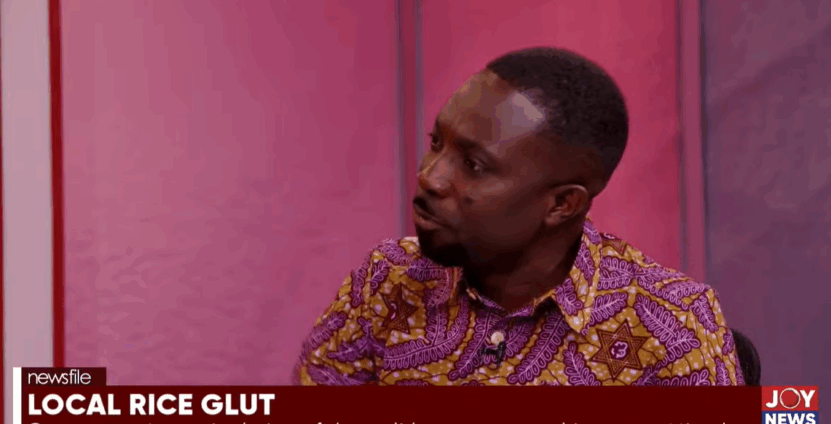
Director of Communications for the Bawumia Campaign, Dennis Miracles Aboagye, has blamed the current challenges faced by Ghana’s agricultural and export sectors on what he described as the artificial manipulation of the Cedi.
Speaking on JoyNews’ Newsfile on Saturday, November 8, during a discussion on the local rice glut, Mr Aboagye argued that the deliberate interference in the exchange rate was hurting real sector players, particularly farmers and exporters.
“This is the cost you pay when you artificially manipulate your currency. Economics doesn’t allow you to fake your way around it. It will always catch up with you, and that’s where we are.”
He explained that many farmers are losing out because of the unstable value of the Cedi. Farmers who bought inputs at high exchange rates, he noted, now face losses when the Cedi suddenly strengthens, while importers take advantage of the situation.
“People buy agricultural inputs at a certain cost, plant and wait for harvest. Then just weeks before harvest, the currency based on which they bought their input drops by over 30%. Meanwhile, others go and buy that currency at a cheaper rate and import more rice. What happens to the farmer?” he asked.
According to him, the manipulation of the currency not only affects local farmers but also discourages foreign buyers of Ghanaian goods.
“Exporters are suffering because of the same currency manipulation. Their buyers are stopping the purchase of Ghanaian export products. They used to spend, say, one dollar to buy from us, but now they need three dollars to buy the same thing,” he explained.
Mr Aboagye warned that this trend was leading to job losses, reduced export earnings, and further strain on the cedi.
“When exports suffer, people lose jobs. The government will then have to find more money to stabilise the currency because no money is coming in. This farming situation is just one of the sectors silently dying as a result of currency manipulation.”
He said that the main beneficiaries of this “fanciful policy” were wealthy business owners, not ordinary consumers.
“Who are the real beneficiaries of this policy of pumping money to artificially keep our currency at a certain point? The business people and the rich.”
Mr Aboagye also criticised the government’s reliance on inaccurate data for economic planning.
“When I look at the figures, the data from government institutions are lies. We don’t have accurate data. We can’t even tell how many houses we have in this country,” he claimed.
He said that Ghana’s economic problems are rooted in weak fundamentals, particularly the lack of reliable, digitised data systems.
“We need to stop pretending and admit that the fundamentals of our economy are not strong. That includes data. Excel is not data; it’s manual. We need to build proper digital databases across sectors, including identifying farmers and tracking their output in real time."
“Whether we like it or not, government has a huge responsibility to ensure that whenever we are advocating for local consumption, we back it with real economic strength,” he added.
Latest Stories
-
Ghana needs a law to sustain constitutional reforms – CDD-Ghana
3 hours -
COVID fumigation audit: Auditor-General has a lot of questions to answer – Akwatia MP
3 hours -
Stranded Ghanaian medical graduates in Cuba appeal to Mahama for immediate return
3 hours -
GNFS contains fire outbreak at Teshie Lekma Road near Lekma Hospital
9 hours -
Samia Nkrumah rejects the narrative that Ghanaians were happy after Nkrumah’s overthrow
10 hours -
A Mother’s pain: Tribute by Ivan Baidoo’s mother
11 hours -
‘Forgive us for staying away’ — Samia Nkrumah leads family back to Nkroful, pledges to preserve Nkrumah’s legacy
11 hours -
Ernest Nuamah scores twice as Lyon beat Rennes
11 hours -
‘My dear Ivan’ – A father’s tribute to a son tragically killed
11 hours -
GNPC Explorco advances Voltaian Basin drilling preparations with 13.5km access road
11 hours -
Cabinet approves facility manager for Borteyman Sports Complex – Kofi Adams
12 hours -
Sanitation is improving; critics may be ‘living in another world’ – Salaga South MP replies Bekwai MP
12 hours -
Government must do more to tackle sanitation crisis – Bekwai MP
12 hours -
World Cleanup Day: GFF begins sanitation education in local communities
12 hours -
EU Ambassador, IGP discuss stronger cooperation on policing and security
12 hours